CUSTOM ARSENIC TREATMENT FOR NEW ENGLAND WELL WATER

Arsenic Removal & Well Water Treatment Systems

Reduce arsenic in private well water with a treatment system designed around laboratory results, water chemistry, household demand, and the other contaminants present in your water.

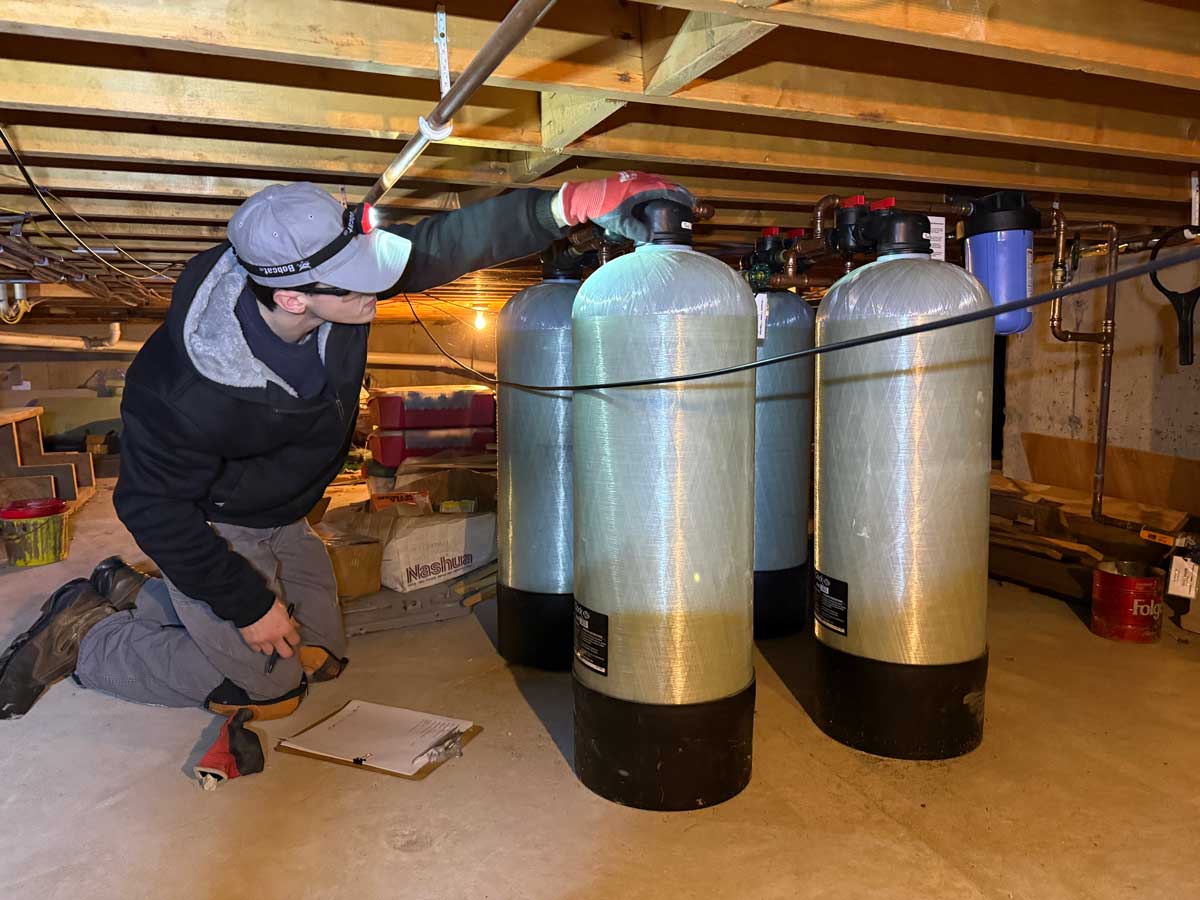
A & B Water Consultants technician beside a whole-house water filtration installation in New Hampshire
TEST-BASED RECOMMENDATIONSCUSTOM-DESIGNED SYSTEMSPROFESSIONAL INSTALLATIONFREE ESTIMATES

Arsenic Treatment Designed Around Your Water-Test Results

Arsenic can occur naturally in groundwater as water moves through soil, rock, and mineral deposits. It has no reliable taste, odor, or color, so a private well can contain arsenic even when the water looks and tastes normal. The only way to know the concentration is through laboratory testing.

Effective arsenic treatment is not based on the arsenic result alone. The form of arsenic, pH, iron, manganese, hardness, competing minerals, and other water-quality conditions can affect which technology is appropriate and how the system should be arranged. Household water use, available space, plumbing, and maintenance requirements also matter.

A & B Water Consultants designs and installs point-of-entry and point-of-use arsenic treatment systems for homes in New Hampshire, southern Maine, and Essex County, Massachusetts. Each recommendation begins with test results and is developed for the actual well, home, and treatment objective—not around a one-size-fits-all filter.

DISCUSS YOUR ARSENIC TEST RESULTSA & B Water Consultants servicing an arsenic and PFAS treatment system in Boxford, Massachusetts

Direct Answer: How Is Arsenic Removed From Well Water?

Arsenic is removed from well water with a treatment process selected for the arsenic concentration, arsenic form, and overall water chemistry. Depending on those conditions, treatment may use adsorptive media, reverse osmosis, specialized ion-exchange media, oxidation, prefiltration, or a coordinated combination of methods.

Some systems treat all water entering the home. These are called point-of-entry or whole-house systems. Others treat water at a specific tap, usually the kitchen sink. These are called point-of-use systems. The right scope depends on test results, household needs, state guidance, and where treated water is needed for drinking and food preparation.

Before a system is selected, the water should be tested and the results reviewed as a complete profile. After installation, treated water should be retested to confirm performance. Ongoing testing and timely media or filter replacement are essential because arsenic treatment capacity is not unlimited.

Why Arsenic in Well Water Requires Testing

Arsenic is different from water problems that announce themselves with stains, scale, taste, or odor. You cannot determine whether arsenic is present by looking at a glass of water, and a clear-water result does not indicate that the water is free of arsenic.

The U.S. Environmental Protection Agency's maximum contaminant level for arsenic in public drinking-water systems is 10 micrograms per liter, which is the same as 10 parts per billion. Private wells are not regulated under the federal Safe Drinking Water Act in the same way as public systems, so private-well owners are responsible for arranging testing, understanding the results, and maintaining any needed treatment.

Regional geology makes testing especially important. Naturally occurring arsenic is a recognized private-well concern in New Hampshire, Maine, and parts of Massachusetts. Wells located near one another can produce very different results, which means a neighbor's test cannot substitute for testing your own water.

If arsenic is detected, do not select equipment from the arsenic number alone. A current laboratory report gives a water-treatment professional the information needed to determine what additional testing or system design work may be required.

Understanding an Arsenic Water-Test Result

Test InformationWhat It Tells YouWhy It Matters for Treatment
Total arsenicThe combined amount of arsenic reported in the sampleEstablishes whether arsenic is detected and provides the starting concentration for system design.
Result in µg/L or ppbThe measured concentration; for water, 1 µg/L is approximately 1 ppbAllows the result to be compared with applicable drinking-water standards or guidance.
Arsenic speciationSeparates arsenic III from arsenic V when this additional analysis is performedArsenic III is generally more difficult for some media to remove and may require oxidation before the main treatment stage.
Raw-water sampleWater collected before treatmentShows what the well is supplying and is used to size and select treatment.
Treated-water sampleWater collected after the treatment systemVerifies whether the installed system is reducing arsenic as intended.

The EPA public-water limit of 10 ppb is an important reference point, but the complete interpretation of a private-well result may also involve state-specific standards, recommendations, and household risk considerations. A & B can review the report from a treatment-design perspective. Questions about health risk, medical conditions, infant feeding, or immediate water-use decisions should be directed to the appropriate state health agency or a qualified healthcare professional.

Arsenic III and Arsenic V: Why the Form Can Affect Treatment

Arsenic in groundwater commonly occurs in two inorganic forms: arsenic III, also called arsenite, and arsenic V, also called arsenate. A standard total-arsenic test measures their combined concentration but does not necessarily show how much of each form is present.

That distinction can matter because many adsorptive treatment media capture arsenic V more readily than arsenic III. When arsenic III is present, an oxidation step may be used to convert it to arsenic V before the water reaches the primary removal media. The oxidant, contact time, filtration, and equipment sequence must be appropriate for the rest of the water chemistry.

Not every home automatically needs an arsenic-speciation test. Whether it is useful depends on the total result, the proposed treatment method, and the information already available about the water. A & B reviews the existing laboratory report and recommends additional analysis when it would materially affect system selection or verification.

Whole-House or Under-Sink Arsenic Treatment?

Treatment ScopeBest Suited ForImportant Considerations
Point-of-entry / whole-house treatmentTreating the home's incoming water before it is distributed to fixturesMust be sized for household flow and water use. It usually requires more equipment, installation space, media capacity, and service planning.
Point-of-use / under-sink treatmentProducing treated water at a selected drinking and cooking tapTreats only that outlet. Other fixtures remain untreated, and the system needs dedicated filter changes and verification testing.
Combined approachHomes that benefit from broad treatment plus a final drinking-water stageEquipment must be coordinated so each stage has a defined purpose and maintenance schedule.

The primary exposure concern for arsenic in water is ingestion. That often makes drinking, cooking, beverage preparation, and ice important treatment priorities. However, the appropriate scope is a household-specific decision. Test results, arsenic concentration, family needs, treatment goals, state recommendations, plumbing, and long-term operating costs should all be considered.

A & B explains what each option treats, which fixtures will receive treated water, and what testing and maintenance will be required before the homeowner chooses a system.

COMPARE WHOLE-HOUSE AND DRINKING-WATER OPTIONS

Arsenic Treatment Options for Private Wells

There is no single arsenic filter that is best for every well. The treatment method must be compatible with the arsenic form, concentration, flow requirements, and other minerals or contaminants in the water.

Adsorptive Media

Adsorptive systems pass water through a specialized media that binds arsenic. Iron-based and other arsenic-selective media may be used in appropriate conditions. Media capacity depends on the incoming arsenic level, pH, competing ions, flow, water use, and other factors. The media must be replaced before it is exhausted.

Reverse Osmosis

Reverse osmosis can reduce arsenic at a dedicated drinking-water tap when the system and pretreatment are selected for the water conditions. It is often used as a point-of-use solution or as a polishing stage. Membrane performance, arsenic form, pressure, pretreatment, storage, filter replacement, and periodic testing all matter.

Specialized Ion Exchange

Certain specialized resins may be used to reduce arsenic under suitable water conditions. This is different from assuming that an ordinary water softener will remove arsenic. Resin selection, competing ions, regeneration or replacement requirements, and waste handling must be evaluated for the application.

Oxidation and Pretreatment

When arsenic III is present or when iron, manganese, sediment, or other conditions interfere with treatment, oxidation and pretreatment may be needed ahead of the arsenic-removal stage. Pretreatment protects the primary media and can improve consistency, but it must be designed as part of the full system rather than added without considering the water chemistry.

Coordinated Multi-Stage Treatment

A well may contain arsenic along with hardness, iron, manganese, low pH, radon, uranium, PFAS, nitrate, or other concerns. In those cases, separate treatment stages may be needed. Their order matters: one stage may protect the next, while an incorrect sequence can reduce capacity, create maintenance problems, or leave a contaminant untreated.

The proposal should identify what each component is expected to reduce, where treated water will be delivered, how performance will be verified, and when service or media replacement is expected.

How A & B Designs an Arsenic Removal System

Arsenic Concentration and Form

The total-arsenic result establishes the treatment load. When appropriate, arsenic speciation helps determine whether an oxidation stage should be considered before adsorption or another removal method.

pH and Complete Water Chemistry

pH can substantially affect the performance of some arsenic media. Iron, manganese, hardness, silica, phosphate, sulfate, sediment, and other water characteristics may also affect treatment selection, capacity, and pretreatment needs.

Household Water Demand

A whole-house system must support the home's required service flow. The number of residents, bathrooms, fixtures, and simultaneous water use can influence equipment size, tank configuration, and media volume.

Well and Plumbing Conditions

Pump performance, pressure, pipe size, available installation space, drainage, electrical access, and existing treatment equipment are reviewed before the system is finalized.

Treatment Scope

The design must clearly distinguish between water treated at one drinking-water tap and water treated throughout the home. A & B helps the homeowner compare the coverage, capital cost, maintenance, testing, and operating requirements of each approach.

Maintenance and Verification

Arsenic media and filters have finite capacity. The system plan includes service requirements and a testing schedule so performance is verified rather than assumed.

What an Arsenic Treatment System Does—and Does Not—Treat

What the System Is Designed to Do

A properly selected and maintained arsenic treatment system is designed to reduce arsenic at the specified point of treatment. Depending on the design, that may mean all water entering the home or water delivered through one dedicated drinking-water faucet.

The intended benefits may include:

  • Reduced arsenic in treated water
  • A treatment scope matched to household needs
  • Equipment selected from laboratory results rather than appearance or guesswork
  • Defined maintenance and media-replacement requirements
  • Post-installation testing to verify performance
  • A system sequence coordinated with other water-treatment needs

What It Does Not Automatically Address

An arsenic treatment system should not be assumed to remove:

  • Hardness minerals that cause white scale and soap scum
  • Iron or manganese that causes orange, brown, or black staining
  • PFAS or PFOA
  • Radon in well water
  • Bacteria or viruses
  • Nitrate
  • Uranium
  • Sediment, sulfur odor, acidity, or every taste concern

Some technologies can reduce more than one constituent, but performance must be established for the specific equipment and water conditions. A visually clear glass of treated water is not proof that arsenic or another invisible contaminant has been removed.

REVIEW YOUR COMPLETE WATER PROFILE

When Arsenic Is Only Part of the Water Problem

Arsenic With Iron or Manganese

Iron and manganese can foul media, create particles, and affect the performance of downstream equipment. If the water also causes orange, brown, gray, or black staining, a separate mineral-removal stage may be needed before arsenic treatment.

Arsenic With Hard Water or Low pH

Hardness causes scale and can shorten the useful life of plumbing and appliances, while low pH may contribute to corrosive water. These conditions do not disappear when arsenic is treated and may affect equipment selection or treatment order.

Arsenic With Other Health-Related Contaminants

Private wells may also contain radon, uranium, PFAS, nitrate, or bacteria. Each has its own testing and treatment requirements. A treatment plan should address every confirmed concern rather than using arsenic equipment as a universal solution.

Arsenic at the Drinking-Water Tap

When the selected solution is point-of-use treatment, a properly designed reverse-osmosis or other dedicated drinking-water system may be installed at the kitchen sink. The homeowner should understand that only the connected faucet receives treated water.

REVERSE OSMOSIS DRINKING-WATER SYSTEMS

For homes with several confirmed problems, begin with the broader Well Water Treatment & Whole-House Filtration Systems page to understand how individual treatment stages can work together.

Our Arsenic Removal Process

1. Share the Laboratory Report

Send your current water-test results, including the arsenic concentration and any other tested parameters. If the report is incomplete or outdated, A & B can explain which additional information is needed before equipment is selected.

2. Review the Water Profile

We evaluate arsenic along with pH, iron, manganese, hardness, sediment, competing minerals, and other confirmed contaminants. Arsenic speciation may be recommended when it would affect treatment design.

3. Evaluate the Home

For whole-house systems, we consider household size, bathrooms, service flow, well and pump conditions, plumbing, installation space, drainage, electrical access, and existing treatment equipment. For point-of-use systems, we review the selected tap, cabinet space, pressure, storage, and connection requirements.

4. Recommend the Treatment Scope and Method

The proposal identifies whether the system is point-of-entry, point-of-use, or a combined design; what each component is intended to accomplish; and how the equipment fits into the complete treatment sequence.

5. Professionally Install and Start Up the System

A & B installs the specified equipment, configures it for the application, and explains normal operation, filter or media requirements, and homeowner responsibilities.

6. Verify and Maintain Performance

Treated water is tested after installation to confirm performance. A continuing test and service schedule helps determine when cartridges, membranes, or media require replacement and confirms that the system continues to work as intended.

START WITH YOUR WATER-TEST RESULTS

Arsenic System Maintenance and Follow-Up Testing

Arsenic treatment should never be treated as “install it and forget it.” Adsorptive media eventually reaches capacity. Reverse-osmosis systems require cartridge and membrane service. Oxidation or pretreatment equipment may require replenishment, cleaning, or adjustment. Changes in well chemistry or household water use can also change system performance.

A practical maintenance plan may include:

  • Post-installation testing at the treated tap
  • A follow-up test interval based on the system and water conditions
  • Cartridge, membrane, or media replacement before breakthrough
  • Inspection of pretreatment and flow conditions
  • Review after changes to the well, pump, plumbing, or household use
  • Periodic raw-water testing to identify changes in the source water
  • Service records showing test dates and maintenance performed

Do not rely on taste, odor, or appearance to determine whether an arsenic system is still working. Arsenic has no dependable sensory warning. Laboratory verification is the evidence that matters.

ASK ABOUT ARSENIC SYSTEM SERVICE

Benefits of a Properly Designed Arsenic Treatment System

  • Treatment selected for measured arsenic and complete water chemistry
  • A clear choice between whole-house and dedicated drinking-water treatment
  • Pretreatment included when iron, manganese, pH, or other conditions require it
  • Equipment sized for the intended flow and household use
  • A defined testing and maintenance plan
  • Professional installation and system startup
  • Coordination with other well-water treatment needs
  • Greater confidence based on verification testing rather than water appearance

Why Homeowners Choose A & B Water Consultants

Experience With Regional Well Water

A & B has worked with private-well water systems in New Hampshire, southern Maine, and northeastern Massachusetts for more than two decades. That regional experience helps the team recognize common combinations of arsenic, iron, manganese, hardness, acidity, radon, and other concerns.

Recommendations Based on Testing

The process begins with laboratory data and the home's actual requirements. A & B does not select arsenic equipment from a generic package or a visual inspection of the water.

Whole-System Design

When several treatment stages are needed, their sequence is planned as one system. The goal is to protect equipment, maintain usable household flow, and give every component a defined job.

Installation, Service, and Accountability

A & B provides professional installation, explains maintenance requirements, and supports the follow-up testing and service needed to keep the system working properly.

Clear Options for the Homeowner

Homeowners receive an explanation of point-of-entry and point-of-use options, treatment limitations, maintenance needs, and expected operating responsibilities before making a decision.

SPEAK WITH A WATER-QUALITY SPECIALIST

Arsenic Treatment Service Areas

A & B Water Consultants provides residential arsenic treatment and related well-water services throughout its regional service area.

New Hampshire

Rockingham County, Strafford County, Hillsborough County, Merrimack County, Belknap County, and Carroll County.

Southern Maine

York County and Cumberland County.

Northeastern Massachusetts

Essex County.

The company serves many communities within these counties. Contact A & B with your address and existing water-test results to confirm availability and discuss the next step.

VIEW ALL SERVICE AREAS

Frequently Asked Questions About Arsenic in Well Water

START WITH THE LAB RESULTS

Get a Treatment Plan for Arsenic in Your Well Water

If a laboratory test found arsenic in your private well, A & B Water Consultants can review the report, identify the water conditions that may affect treatment, and explain point-of-entry and point-of-use options for your home.

Send your existing results or request guidance on the testing needed to move forward. You will receive a recommendation based on the measured water quality, household demand, installation requirements, and long-term maintenance—not a generic equipment package.

Thank you! Your submission has been received!
Oops! Something went wrong while submitting the form.