White or Chalky Scale
Mineral deposits may develop around faucets, showerheads, sink drains, humidifiers, coffee makers, and other places where water evaporates or is heated.
CUSTOM WATER SOFTENER SYSTEMS FOR NEW ENGLAND HOMES
Reduce white scale, soap scum, mineral spotting, and hardness-related buildup with a whole-house water softener selected for your water conditions and household demand.

Hard water is primarily caused by dissolved calcium and magnesium. As water moves through soil and rock, it can pick up these minerals before reaching a private well or public water supply. The minerals are not always visible in the water itself, but they can leave their mark throughout a home.
White scale on fixtures, spotting on glassware, soap scum in showers, and mineral deposits around faucets are common signs of hard water. Scale can also accumulate inside water heaters, pipes, valves, and other water-using equipment.
A whole-house water softener uses ion exchange to reduce hardness minerals before the water travels through the home's plumbing. However, choosing the right equipment involves more than selecting a tank from a catalog. The system must be sized for the measured hardness, household water use, required flow rate, plumbing configuration, and any additional water conditions that could affect performance.
A & B Water Consultants designs and installs custom water softener systems for homes in New Hampshire, southern Maine, and Essex County, Massachusetts. We evaluate the complete water profile so that the softener fits the property and works appropriately with any other treatment equipment.
FIND THE RIGHT WATER SOFTENER FOR YOUR HOMEA traditional water softener reduces calcium and magnesium—the minerals primarily responsible for hard water—through a process called ion exchange. The system passes hard water through a tank containing resin beads. The resin captures hardness minerals and exchanges them for sodium or potassium ions, depending on the system and regenerant used.
Once the resin reaches its working capacity, the softener completes a regeneration cycle. A concentrated brine solution refreshes the resin so it can continue treating incoming water. Modern metered systems can initiate regeneration based on actual water use and programmed capacity rather than relying only on a fixed schedule.
A water softener is designed to address hardness. It should not automatically be treated as a substitute for filtration systems designed for arsenic, PFAS, radon, bacteria, sediment, unpleasant odors, or other water-quality concerns.
The severity of hard-water symptoms varies according to mineral concentration, water temperature, plumbing, cleaning habits, and household water use. Common signs include:
Mineral deposits may develop around faucets, showerheads, sink drains, humidifiers, coffee makers, and other places where water evaporates or is heated.
Dissolved minerals can remain behind after water droplets dry, leaving cloudy-looking spots or a film on glasses, dishes, and flatware.
Hardness minerals react with soap and can make it more difficult to create lather. Homeowners may find themselves using more soap, shampoo, or detergent while still seeing residue on tubs and shower walls.
Hardness deposits tend to form more readily when water is heated. Water heaters, dishwashers, washing machines, and other equipment that uses hot water can develop mineral buildup over time.
Mineral residue can remain on fabrics after washing and may affect how clothing, towels, and linens look or feel.
If scale and water spots return soon after faucets, sinks, shower doors, and tile are cleaned, hardness may be contributing to the problem.
Mineral deposits can accumulate in faucet aerators and showerheads. Low flow can have several causes, so the plumbing and water conditions should be evaluated before assuming hardness is solely responsible.
Water hardness is commonly reported as milligrams per liter—or parts per million—of calcium carbonate. Some water-treatment reports use grains per gallon. Approximately 17.1 milligrams per liter equals one grain per gallon.
| Hardness Classification | Milligrams per Liter as CaCO3 | Approximate Grains per Gallon |
|---|---|---|
| Soft | 0–60 mg/L | 0–3.5 gpg |
| Moderately hard | 61–120 mg/L | 3.6–7.0 gpg |
| Hard | 121–180 mg/L | 7.1–10.5 gpg |
| Very hard | More than 180 mg/L | More than 10.5 gpg |
These classifications help describe the water, but the hardness number alone does not determine the complete treatment plan. Iron, manganese, pH, sediment, water usage, and required flow can affect equipment selection and capacity.
If you already have a laboratory or water-quality report, send it with your inquiry. A & B can review the reported hardness and related conditions when developing a recommendation.
A water softener should have a clearly defined job: reduce hardness minerals at the point where water enters the home. When the system is selected and maintained appropriately, homeowners may see practical improvements throughout the property.
Reducing calcium and magnesium can reduce the white or chalky deposits commonly found on faucets, showerheads, sinks, tubs, and shower glass.
Softened water interacts differently with soap and detergent, which can make it easier to produce lather and reduce mineral-related residue.
Water heaters, dishwashers, washing machines, humidifiers, coffee makers, and other equipment can be exposed to hardness minerals whenever they use untreated water. Softening the water can reduce this source of scale.
When fixtures and surfaces accumulate less mineral residue, homeowners may spend less time repeatedly removing scale and water spots.
A point-of-entry softener treats water before it reaches most fixtures and appliances. That is different from a point-of-use filter or reverse osmosis system that treats water at one specific faucet.
Benefits will depend on the original hardness, other water conditions, system settings, household demand, and ongoing maintenance. A water softener should be evaluated based on measurable water conditions rather than broad promises about every aspect of household water.
Water softeners are effective tools when used for the right purpose. They are not universal water purifiers.
Some ion-exchange softeners can reduce limited amounts of dissolved iron or manganese under suitable water conditions. However, higher concentrations, oxidized particles, iron bacteria, low pH, or complex mineral conditions may require dedicated pre-treatment or filtration.
If testing identifies a health-related contaminant or the home has multiple water problems, A & B may recommend a staged system in which each treatment component has a specific role.
VIEW ALL WELL WATER TREATMENT OPTIONSThe terms “water softener” and “water conditioner” are often used interchangeably, but the systems do not necessarily do the same thing.
A conventional ion-exchange softener removes calcium and magnesium from the water and replaces them with sodium or potassium ions. Because the hardness minerals are reduced, the treated water can be measured as softer.
Ion-exchange systems require regeneration. This typically involves a brine tank, salt or potassium chloride, a drain connection, and periodic maintenance.
Salt-free systems generally do not remove calcium and magnesium through ion exchange. Depending on the technology, they may alter how minerals behave or reduce their tendency to form certain types of scale. The water may still test as hard because the hardness minerals remain present.
A salt-free conditioner may be considered in some situations, but it should not be presented as equivalent to true softening when the homeowner's objective is to reduce measured hardness.
The answer depends on the water analysis, the severity of the symptoms, plumbing configuration, wastewater considerations, maintenance preferences, and what the homeowner expects the system to accomplish. A & B explains the practical differences before recommending equipment.
An undersized softener may regenerate too often, struggle during periods of higher demand, or fail to deliver consistent treatment. An oversized or poorly programmed unit may use more salt and water than necessary. Proper design considers several factors together.
The hardness concentration establishes how much treatment capacity is consumed by each gallon of water.
These minerals can affect softener sizing and resin performance. Depending on their form and concentration, separate filtration may be more appropriate.
The number of occupants, bathrooms, fixtures, and water-using appliances helps estimate daily demand and reserve capacity.
The system must support expected simultaneous use without creating an unnecessary pressure drop. A home with several bathrooms and high-flow fixtures may require different equipment than a smaller property with modest demand.
Water pressure, pipe size, well equipment, available installation space, drainage, electrical access, and the location of the main water line influence system design.
Control-valve settings, usable resin capacity, salt dose, reserve capacity, and regeneration frequency should work together. Metered controls can help match regeneration to household use.
Sediment filters, neutralizers, iron filters, arsenic systems, PFAS treatment, ultraviolet equipment, and reverse osmosis systems must be arranged in a sequence that supports their intended performance.
New England well water frequently presents more than one condition. A homeowner may have hardness along with iron staining, manganese, acidity, sediment, arsenic, PFAS, radon, or unpleasant odors.
Installing a softener without evaluating the rest of the water profile can result in incomplete treatment or unnecessary stress on the softener. For example:
A & B designs multi-stage systems so that each component addresses a defined water condition and supports the equipment that follows it.
DISCUSS A COMPLETE WATER TREATMENT PLAN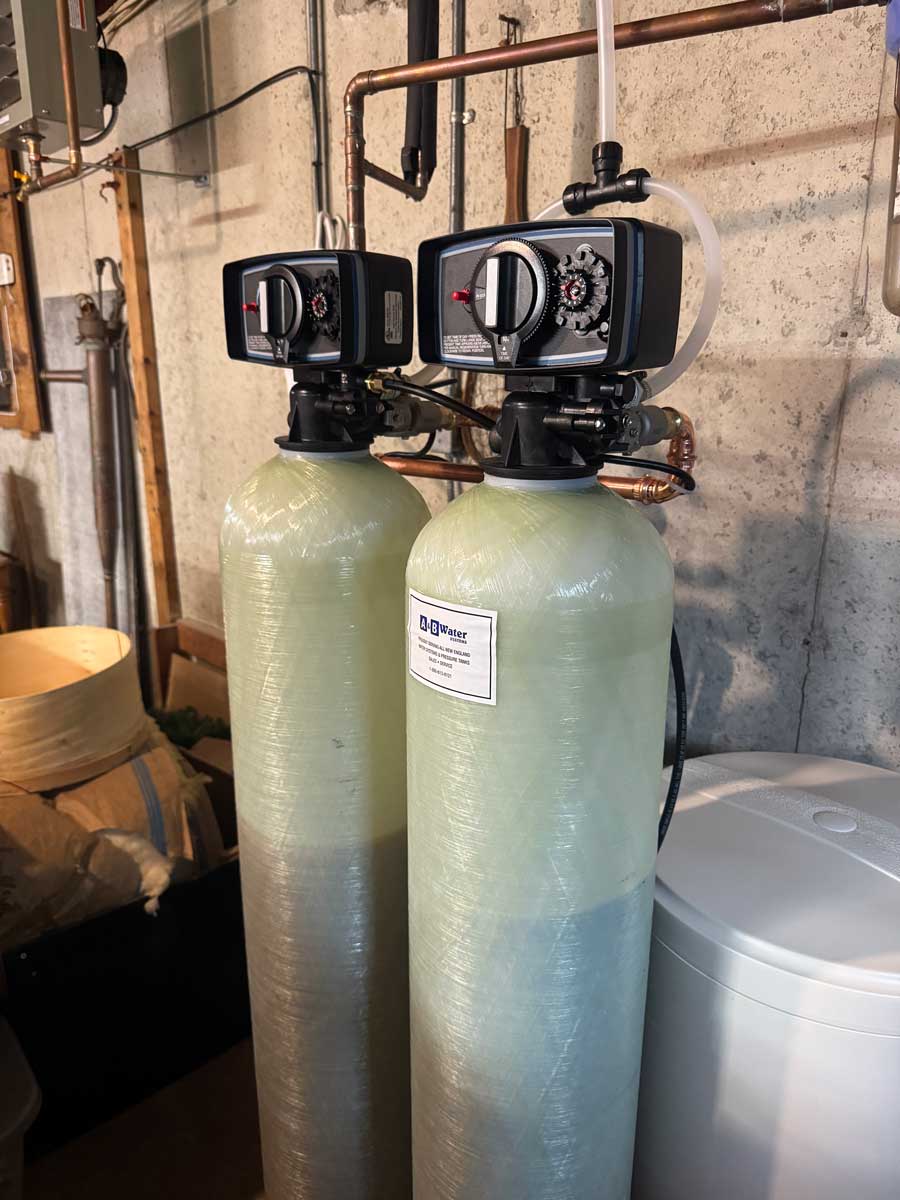
Tell us what you are seeing around the home, whether the property uses private-well or public water, and whether another treatment system is already installed.
Send current results when available. We review the measured hardness and any related conditions that could affect equipment selection.
We consider expected water use, service flow, pipe size, pressure, installation space, drainage, electrical access, and existing treatment equipment.
The proposal explains the equipment, intended capacity, treatment sequence, installation approach, and routine maintenance requirements.
The system is connected to the home's water supply and programmed for the reported water conditions and household demand. Bypass and drain arrangements are incorporated as appropriate for the installation.
We explain how the system operates, where to add salt or other approved regenerant, what settings homeowners should leave unchanged, and when routine service should be scheduled.
Water softeners require routine attention to operate consistently and efficiently. Maintenance needs vary by system, water conditions, and household use, but commonly include:
An abrupt return of scale, spotting, or reduced lather may indicate that the salt supply is low, a bypass valve is open, settings have changed, the system needs service, or the water conditions have shifted.
EPA WaterSense recommends considering both water and salt efficiency when selecting and maintaining a cation-exchange softener. Proper sizing and programming can help avoid unnecessary regeneration.
The system is selected around measured hardness and the home's broader water profile—not simply the number of bedrooms or the size of the plumbing connection.
Capacity, flow requirements, regeneration settings, equipment sequence, and installation conditions are considered together.
A & B evaluates how hardness may interact with iron, manganese, acidity, sediment, arsenic, PFAS, radon, and other conditions commonly found in regional wells.
We explain what the softener is intended to treat, what it will not treat, why a particular system is being recommended, and what maintenance it will require.
When hardness is only one part of the problem, A & B can develop a coordinated treatment plan rather than treating each symptom in isolation.
A & B Water Consultants provides water softener installation and residential water treatment services in the following areas:
Rockingham County, Strafford County, Hillsborough County, Merrimack County, Belknap County, and Carroll County.
York County and Cumberland County.
Essex County.
Contact us with the property location and your primary water concern if you are unsure whether the home is within our current service area.
If hard water is leaving scale, spots, soap scum, or mineral buildup around your home, A & B Water Consultants can help you determine the next step.
Tell us where the property is located, what symptoms you are seeing, and whether you already have water-test results. We will evaluate the available information and recommend a water softener or broader treatment approach appropriate for the home.
Copyright 2022 A & B Water Consultants | All Rights Reserved | Sitemap | Website by Plumb Development a Digital Marketing Agency
X