Water Enters the Treatment System
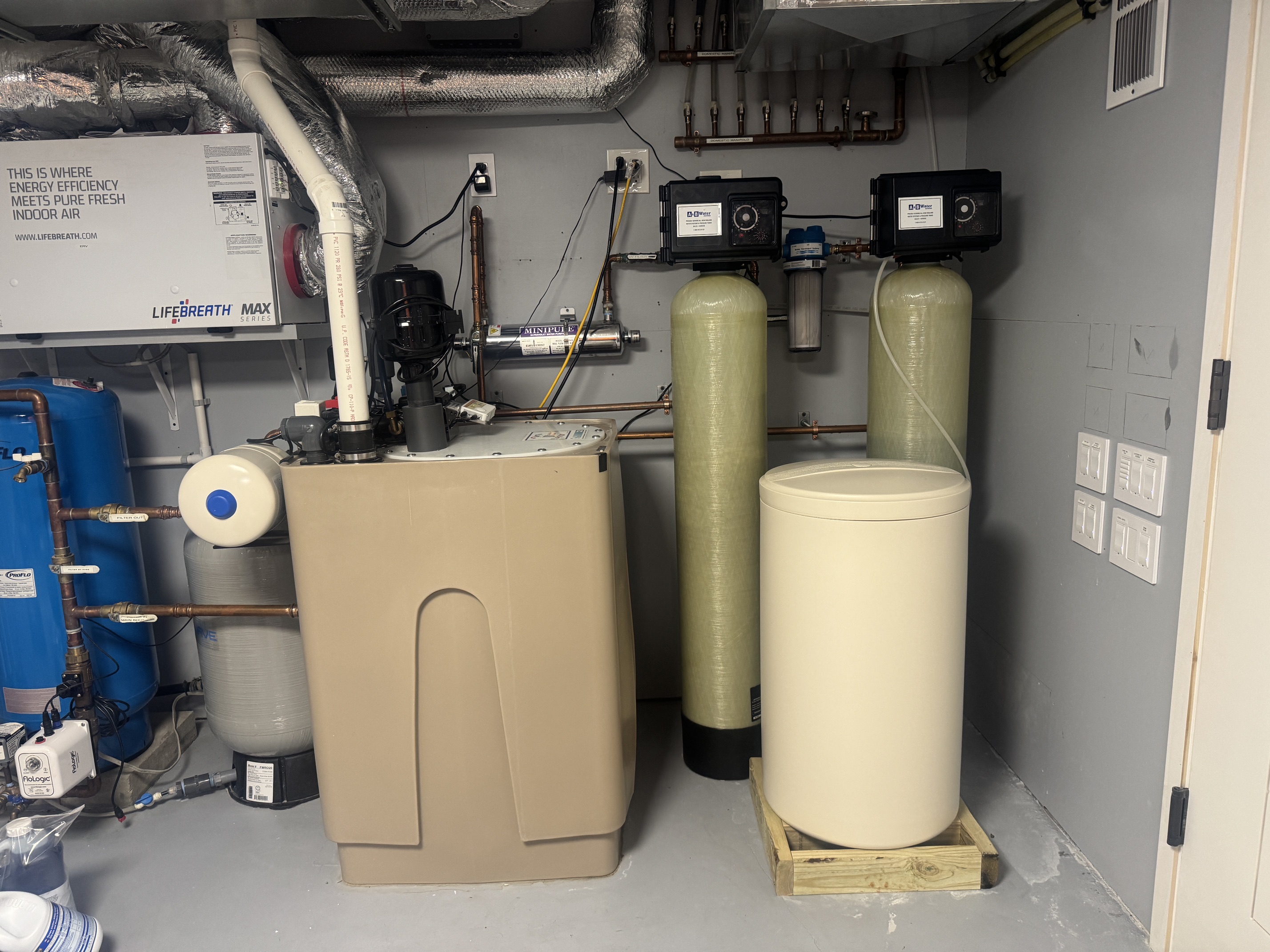
Untreated water from the private well is directed into the radon aeration equipment before it reaches household fixtures.
WHOLE-HOUSE RADON TREATMENT FOR NEW ENGLAND WELL WATER
Reduce radon in private well water with a whole-house treatment system designed around laboratory results, household demand, water chemistry, and the home's complete radon profile.
Radon is a naturally occurring radioactive gas produced as uranium breaks down in soil and rock. It can dissolve into groundwater and enter a home through water supplied by a private bedrock well. When that water is used for showering, laundry, dishwashing, cooking, and other household activities, some of the dissolved radon can be released into the indoor air.
Radon has no color, odor, or taste. Clear, good-tasting well water can still contain an elevated concentration, which means laboratory testing is the only way to identify the problem. The indoor air should also be tested because radon moving through the soil and foundation is generally the larger source of household exposure.
A & B Water Consultants designs and installs point-of-entry radon water treatment systems for private-well homes in New Hampshire, southern Maine, and Essex County, Massachusetts. Recommendations consider the measured water-radon concentration, indoor-air results, household flow, well-water chemistry, installation conditions, and applicable state guidance.
Radon in indoor air from soil gas is a separate condition. If your air test is elevated, visit the Radon Mitigation System Installation & Services page or send both reports so each exposure pathway can be evaluated correctly.
DISCUSS YOUR RADON WATER RESULTS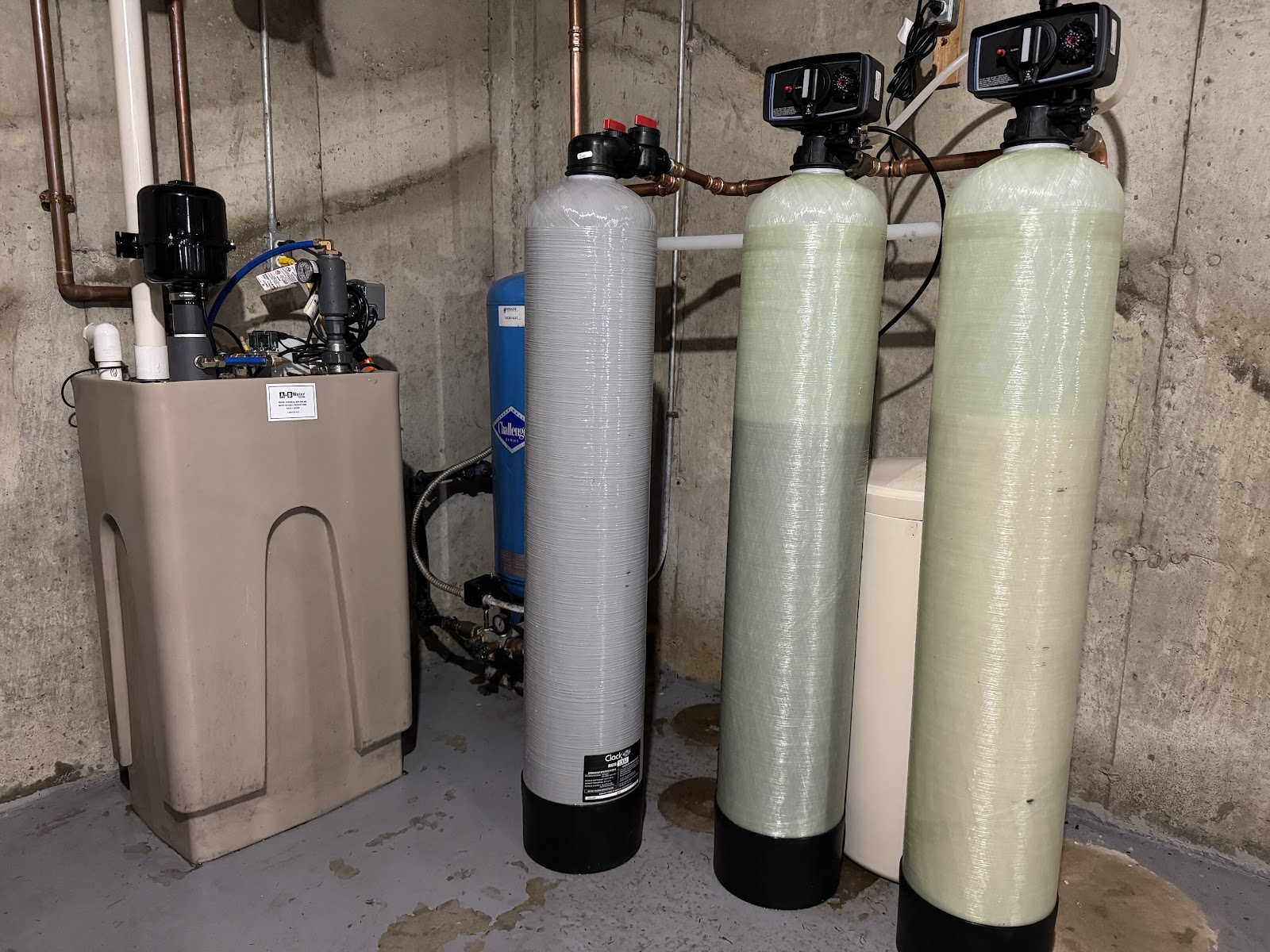
Radon is removed from private well water with a whole-house point-of-entry treatment system installed where the well supply enters the home. The two principal treatment approaches are aeration and granular activated carbon.
An aeration system mixes the water with air so dissolved radon transfers out of the water. The radon-bearing air is then vented safely outdoors, and the treated water is delivered back to the household plumbing. Aeration is generally the preferred approach because it removes and exhausts the radon rather than collecting radioactive decay products in treatment media.
A granular activated carbon system passes water through carbon media that adsorbs radon. Carbon may be considered for selected lower concentrations and suitable water conditions, but the media can accumulate radioactivity over time. System location, tank size, water chemistry, testing, replacement schedule, professional handling, and disposal requirements must all be considered.
The correct treatment cannot be selected from the radon result alone. Iron, manganese, hardness, sediment, pH, flow rate, other contaminants, available space, ventilation, electrical access, and existing equipment can all affect system design and treatment sequence.
Radon cannot be identified by looking at, smelling, or tasting the water. A dedicated laboratory test must be performed on a properly collected raw-water sample. Sample collection matters because agitation and exposure to air can allow radon to escape before the sample is analyzed.
Radon levels in a well can also vary. New Hampshire guidance recommends at least two water-radon tests, at least one month apart when possible, before making a treatment decision. Homeowners should follow the collection kit instructions and the current requirements of the laboratory, state agency, local board of health, lender, or real-estate transaction.
A useful radon evaluation may include:
Test the air even when the concern began with a water report. Soil gas entering through the foundation is usually the larger source of indoor radon. Treating the water does not correct that pathway, and installing an air-mitigation system does not remove radon from the well.
SEND YOUR AIR & WATER TEST RESULTSThere is no current federal maximum contaminant level for radon in private well water. New Hampshire, Maine, and Massachusetts provide guidance that differs in how water results are evaluated. Homeowners should use the current guidance for the property's location and should consider the water result together with the indoor-air result.
| Service Area | Current Guidance to Review | Treatment Implication |
|---|---|---|
| New Hampshire | NHDES recommends treatment at or above 10,000 pCi/L in conjunction with indoor-air mitigation. Between 2,000 and 10,000 pCi/L, water treatment may be advisable when indoor air exceeds 4 pCi/L. | Test both air and water. Treatment selection should consider total radon exposure, not only the water number. |
| Maine | Maine's advisory level for radon in water is 4,000 pCi/L. At or above that level, homeowners should consider action and review total risk; treatment becomes a stronger consideration as the result approaches 10,000 pCi/L. | Use a registered provider when state law requires it, particularly for properties involved in a sale. |
| Massachusetts | Massachusetts guidance identifies 10,000 pCi/L as a water-radon action level. Private wells are generally regulated by local boards of health, which may impose additional requirements. | Confirm current local-board requirements and evaluate both indoor air and the private-well result. |
These values are not interchangeable with the EPA indoor-air action level of 4 pCi/L. Air and water reports use the same unit abbreviation but operate on very different numerical scales.
Guidance can change, and a local health authority, lender, or transaction may apply additional requirements. A & B can review results from a treatment-design perspective; health-risk questions and immediate water-use decisions should be directed to the appropriate state or local public-health agency.
| Treatment Method | How It Works | Potential Advantages | Important Considerations |
|---|---|---|---|
| Whole-house aeration | Mixes air with the incoming water so radon transfers out of solution, then vents the radon-bearing air outdoors | Removes and exhausts radon rather than storing it in media; preferred by regional guidance for many applications | Requires equipment space, ventilation, electrical service, appropriate flow and repressurization, cleaning, and ongoing mechanical maintenance |
| Granular activated carbon | Passes water through carbon media that adsorbs radon | May offer a simpler equipment arrangement for selected lower-level applications | Radioactive decay products can accumulate in the media; placement, shielding distance, monitoring, replacement, handling, and disposal require careful planning |
Aeration is commonly preferred for higher concentrations and when the goal is to avoid accumulating radioactivity inside a media tank. Carbon treatment should not be chosen only because it appears simpler or costs less initially. New Hampshire and Massachusetts guidance apply different concentration-related cautions to carbon, which reinforces the need to design the system for the state and property.
The recommendation should explain why the selected technology is appropriate, which test results were used, where the system will be installed, how performance will be verified, and what long-term service will be required.
COMPARE RADON WATER TREATMENT OPTIONSUntreated water from the private well is directed into the radon aeration equipment before it reaches household fixtures.
The equipment creates substantial air-to-water contact using spray, diffused bubbles, packed media, or another engineered method. This encourages dissolved radon to leave the water and move into the air inside the treatment chamber.
A blower or fan moves the released gas through dedicated vent piping to an appropriate exterior discharge location. The exhaust arrangement must be planned to reduce the chance of radon reentering the home through doors, windows, vents, or other openings.
Depending on the system configuration, pumps, storage, controls, or pressure components deliver the treated water at the pressure and flow needed for household use.
Controls coordinate treatment as the home uses water. The equipment must be sized for the well supply, storage arrangement, number of fixtures, peak flow, and expected household demand.
A treated-water sample is analyzed after installation. The system is then maintained and periodically retested according to the design, test results, and current guidance.
Granular activated carbon, commonly called GAC, is a porous adsorption media. As water passes through the treatment tank, radon is retained on the carbon. The radon then decays into other radioactive materials that can remain in the media.
This accumulation is the central design and maintenance concern. A radon carbon tank should not be treated like an ordinary taste-and-odor filter. Concentration, media volume, tank location, distance from occupied areas, replacement timing, radiation exposure, service methods, transportation, and disposal may all require consideration.
GAC may be evaluated when:
State guidance is not uniform. For example, current Massachusetts private-well guidance cautions against using GAC above 5,000 pCi/L, while New Hampshire guidance discusses GAC at or below 10,000 pCi/L with scheduled media replacement. The system must follow the guidance that applies to the property and the final professional design.
The incoming concentration establishes the radon load. More than one raw-water result may be appropriate because well-water radon can vary and sampling technique can affect the number.
The air test helps separate the contribution from the well from radon entering through the foundation. Elevated air may require a separate active soil-depressurization system.
The system must support the home's service flow and peak demand. Household size, bathrooms, fixtures, simultaneous use, well yield, pump performance, pressure tank, and storage can affect system capacity.
Iron, manganese, hardness, sediment, pH, bacteria, and other contaminants may affect aeration equipment, carbon media, pumps, spray components, diffusers, and downstream treatment. Pretreatment may be required.
Water softeners, neutralizers, mineral filters, arsenic systems, PFAS filters, ultraviolet disinfection, and other equipment must be arranged in a logical order. One treatment stage may protect the next.
Aeration can require a treatment tank, pumps, controls, venting, electrical service, drainage, and adequate service clearance. Carbon systems also require appropriate tank placement and safe future media access.
An aeration system needs a dedicated outdoor exhaust route. Pipe length, termination location, windows, doors, mechanical intakes, snow, ice, and service access can affect the plan.
The design should identify cleaning, mechanical service, filter or media requirements, alarm or control checks, post-installation testing, and future retesting.
A properly designed point-of-entry system can:
A radon water system should not be assumed to:
Some equipment may affect additional dissolved gases or water conditions, but those effects must be evaluated for the specific system and water profile. A follow-up laboratory result—not taste, odor, appearance, or equipment noise—is the evidence that water-radon treatment is performing as intended.
Iron, manganese, and sediment can foul aeration components, pumps, spray nozzles, diffusers, or carbon media. Mineral filtration or pretreatment may be needed before the radon stage.
Hardness can create scale on treatment components and throughout the plumbing. A water softener may be part of the system, but it is not a substitute for radon-specific treatment.
Radon, uranium, radium, and gross alpha are related to regional geology but require different testing and treatment methods. A system selected for radon should not be assumed to remove other radionuclides.
Arsenic and PFAS are invisible contaminants that require contaminant-specific treatment. When several systems are needed, equipment order, flow, pressure, maintenance access, and sampling points should be planned together.
An elevated indoor-air result may come primarily from soil gas beneath the foundation. That condition requires a separate building-mitigation system—commonly active soil depressurization—not water treatment.
For homes with multiple confirmed conditions, begin with the broader Well Water Treatment & Whole-House Filtration Systems page to understand how separate treatment stages can work together.
Send the complete radon-in-water laboratory report, indoor-air result, property location, and testing dates. Include other available well-water results and information about existing treatment.
We review the reported concentration, state guidance, sample history, indoor-air result, and whether additional raw-water or supporting tests are needed before equipment is selected.
We consider household demand, well and pump conditions, pressure, plumbing, existing equipment, water chemistry, installation space, drainage, electrical access, ventilation, and potential exhaust routing.
The proposal identifies aeration or an appropriate alternative, intended performance, system capacity, pretreatment, installation arrangement, exhaust or media requirements, and ongoing service needs.
A & B installs and configures the equipment, integrates it with the home's plumbing, verifies operating controls, and explains normal operation and homeowner responsibilities.
A post-installation laboratory sample confirms performance. Continuing service and periodic testing help identify changes in the well or treatment system.
Radon water treatment is not an install-and-ignore system. Aeration equipment uses mechanical, electrical, air-handling, storage, pressure, and control components. Carbon systems have finite media capacity and specialized handling considerations.
Depending on the system, maintenance may include:
The exact schedule depends on the equipment, source-water concentration, water chemistry, household use, and test history. A visual inspection cannot confirm radon reduction. Laboratory testing provides the performance evidence.
REQUEST RADON WATER SYSTEM SERVICERadon is reduced before well water is distributed to showers, sinks, laundry, dishwashing, and other fixtures.
Treating the incoming supply reduces the amount of waterborne radon available to transfer into indoor air.
Aeration or carbon is selected based on the measured concentration, state guidance, water chemistry, household demand, and maintenance requirements.
Treatment, storage, pumping, and pressure components are planned around expected flow and peak household use.
Pretreatment and other contaminant systems can be arranged to protect equipment and keep every component performing its intended job.
Post-installation testing confirms the treated-water result, while ongoing testing and service help support long-term operation.
A & B works with private bedrock wells throughout New Hampshire, southern Maine, and Essex County, Massachusetts, where radon and other naturally occurring contaminants are recurring concerns.
Indoor-air and well-water radon are separate but related pathways. A & B can review both results and explain whether the home may need water treatment, air mitigation, or two separate systems.
Equipment is selected after reviewing the laboratory result, state guidance, water chemistry, household demand, and installation conditions.
Treatment capacity, pumps, storage, venting, pressure, pretreatment, plumbing sequence, and service access are planned for the individual property.
The equipment is integrated with the home's well and plumbing system, configured for the application, and followed by an operating walkthrough.
Homeowners receive an explanation of normal operation, service needs, system limitations, and the follow-up testing required to verify performance.
A & B Water Consultants provides radon water treatment and related residential well-water services throughout its established regional service area.
Rockingham County, Strafford County, Hillsborough County, Merrimack County, Belknap County, and Carroll County.
York County and Cumberland County.
Essex County.
Testing, provider-registration, private-well, real-estate, and local-board requirements can vary by location. Contact A & B with the property address and existing results to confirm availability and the appropriate next step.
START WITH THE LABORATORY RESULTS
If a laboratory found radon in your private well, A & B Water Consultants can review the water result, indoor-air test, complete water profile, and household requirements to recommend an appropriate point-of-entry treatment system.
Send the full reports rather than only the final numbers. We will explain whether additional testing is needed, compare aeration and appropriate alternatives, and identify how radon treatment should fit with existing or planned water-treatment equipment.
A water-quality specialist will review your information and contact you to discuss the appropriate next step.
Copyright 2022 A & B Water Consultants | All Rights Reserved | Sitemap | Website by Plumb Development a Digital Marketing Agency
X