Homeowners in New Hampshire and the surrounding parts of Southern Maine and Massachusetts who try to choose pfas filtration system face a mix of technical choices, local regulations, and practical tradeoffs. PFAS contamination is a nuanced problem that calls for testing, technology selection, and ongoing maintenance. With more than 25 years designing custom water treatment systems, A & B Water Consultants helps families evaluate options and install solutions that meet both health goals and household needs.
Why PFAS Matter and Where They Come From in New England
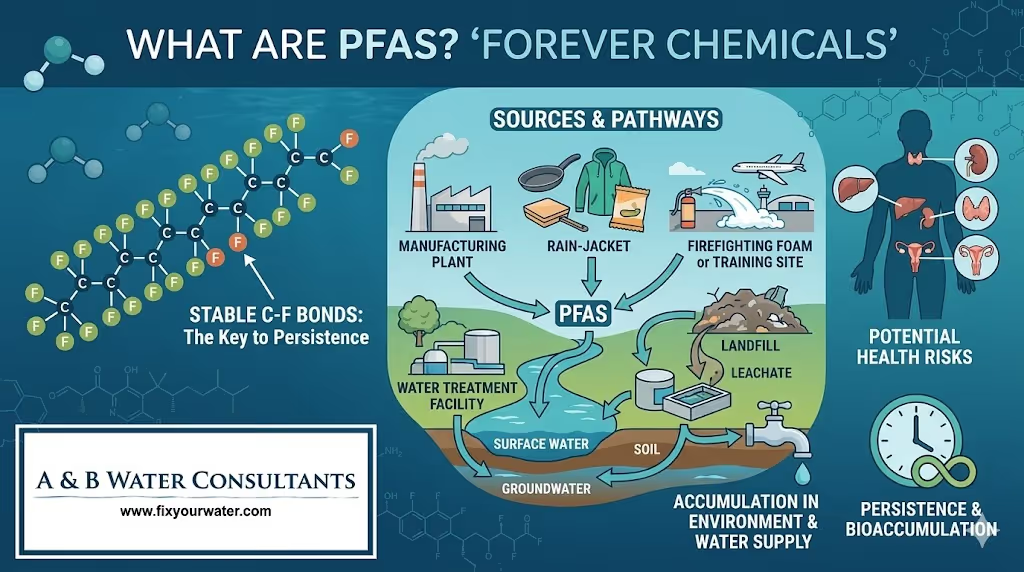
PFAS stands for per- and polyfluoroalkyl substances, a large class of human-made chemicals used for decades in firefighting foam, stain-resistant fabrics, nonstick cookware, and many industrial processes. They resist breakdown in the environment and can accumulate in water. In New Hampshire, Southern Maine, and parts of Massachusetts, common PFAS sources include firefighting training sites, certain industrial facilities, landfills, and wastewater treatment plant discharges.
Because PFAS can be linked to health effects even at low concentrations, homeowners with private wells or those reviewing municipal reports often want to treat their drinking water proactively. That starts with testing and a clear plan for PFAS water treatment selection.
First Step: Test and Interpret Your Water Results
Choosing any treatment starts with reliable data. A homeowner should get a certified laboratory test for PFAS in their water, ideally including both long-chain and short-chain PFAS compounds.
- Use a state-certified lab in New Hampshire, Maine, or Massachusetts.
- Ask for a speciation report when possible, listing concentrations for common PFAS like PFOA, PFOS, PFHxS, PFNA, and shorter-chain analogs.
- Compare results to current state advisories and EPA guidance, and discuss what the numbers mean with a water treatment professional.
Local context matters. A municipal water system may publish Consumer Confidence Reports and PFAS monitoring results. Private well owners should test their well water and consider testing frequency: annual is common when PFAS are present, more often if contamination is near a known source.
Contact A&B Water Consultants for a free PFAS removal services quote. Their team can review lab results, discuss treatment goals, and outline options tailored to New Hampshire-area homes.
Overview of PFAS Treatment Technologies
Not all water treatment technologies remove PFAS the same way. Here’s a practical breakdown of the most common and effective options for homes.
Granular Activated Carbon (GAC)
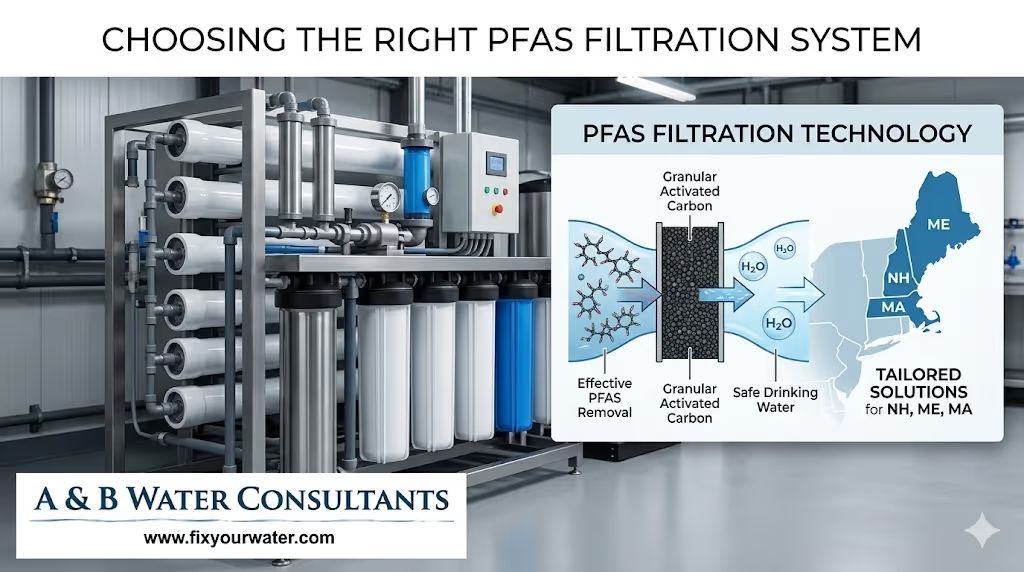
GAC is one of the most widely used options for PFAS removal at scale. Carbon adsorbs many long-chain PFAS compounds, making it effective for a variety of household applications.
- Pros
- Well-proven for long-chain PFAS such as PFOA and PFOS
- Scalable to whole-house (point-of-entry) systems
- Relatively low pressure drop and easy to retrofit
- Cons
- Less effective for some short-chain PFAS
- Media gets exhausted and requires replacement or off-site regeneration
- Performance depends on contact time and water chemistry
Ion Exchange (IX)
Specialized ion exchange resins have been developed to target PFAS. These can be particularly effective for certain short-chain compounds that carbon struggles with.
- Pros
- High removal rates for many PFAS, including some short-chain types
- Smaller physical footprint than GAC for equivalent capacity
- Regenerable on site or via vendor regeneration
- Cons
- Regeneration produces a concentrated brine that needs proper disposal
- Costs can be higher than GAC upfront
- Resin selection must match specific PFAS chemistry
Reverse Osmosis (RO)
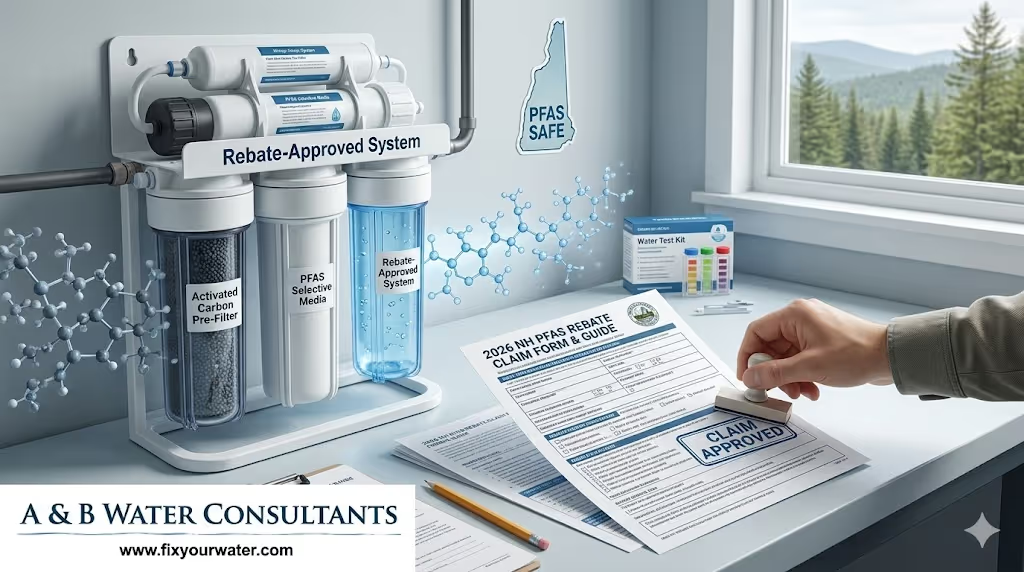
Reverse osmosis is a point-of-use technology that forces water through a semipermeable membrane, rejecting many PFAS along with other dissolved contaminants. RO systems are commonly used under the kitchen sink for drinking and cooking water.
See our guide to filtration systems for contaminants for more detail on how RO compares to other options.
- Pros
- Very high removal for a broad range of PFAS, including many short-chain varieties
- Provides excellent overall water quality improvement
- Cons
- Only treats water at the tap where it’s installed
- Wastewater (brine) is produced and needs a drain
- Filters and membranes require periodic replacement
Membrane Technologies and Nanofiltration
Membrane treatments such as nanofiltration and ultrafiltration can remove PFAS to varying degrees, often used in industrial or municipal settings. For most residential applications, RO and GAC/IX are more practical.
Technologies That Are Not Typically Effective
Some common water treatment names, like basic oxidation or simple softening, do not reliably remove PFAS. Understanding limitations prevents wasted expense and false assurance.
Point-of-Entry vs Point-of-Use: Which to Pick
Choosing between treating all the water entering a home (point-of-entry, POE) or treating at the tap (point-of-use, POU) is a central decision. Each approach has pros and cons.
Point-of-Entry (Whole-House)
- Treats water for bathing, laundry, and all taps
- Good for families concerned about inhalation or skin exposure from showering
- PFAS-contaminated water used for laundry or cooking can be addressed
- Typically uses GAC or IX systems sized for household flow
Point-of-Use (Under-Sink or Refrigerator)
- Treats only drinking and cooking water
- RO systems are common here
- Lower cost than whole-house systems but doesn’t address shower exposure
For many New England homeowners with private wells, a combined approach makes sense: a POE system for major loads and a POU RO for drinking and cooking where ultra-low PFAS levels are desired.
Contact A&B Water Consultants for a free PFAS removal services quote. Their team can recommend whether a POE, POU, or combined strategy suits a particular home and test results.
How to Choose: Key Factors to Consider
To successfully choose pfas filtration system, the homeowner or decision-maker should weigh several technical and practical factors.
- PFAS Concentration and Speciation High concentrations may require more robust systems or staged treatment. Short-chain PFAS can be harder to capture with GAC, making IX or RO more attractive. A speciation report helps guide media selection.
- Household Flow Rate and Peak Demand Whole-house systems must be sized to handle peak flow, not just average use. Undersized systems reduce contact time and performance.
- Water Chemistry High levels of iron, manganese, or organics can foul adsorption media faster. Pre-treatment for iron or particulates may be required before PFAS media.
- Footprint and Location GAC tanks need space, while many IX systems are more compact. RO under-sink systems require cabinet space and a drain line.
- Maintenance and Regeneration Options Consider whether media replacement will be done onsite or by a vendor, how often, and how the waste will be handled.
- Certifications and Testing Look for systems with third-party lab data or certifications for PFAS reduction. If a system lacks an established certification, request lab test results for similar installations.
- Budget and Lifecycle Cost Upfront cost is one factor. Calculate annual replacement, regeneration fees, and testing costs to understand lifecycle expense.
- Local Regulations and Disposal State rules may affect how spent media or regeneration brine must be handled. Work with a vendor who understands New Hampshire and Massachusetts requirements.
Comparing Options: Which Is Best for a Home?
There’s no single best option for every homeowner. Here are practical recommendations based on common scenarios in New England.
Scenario 1: Private Well with Moderate PFAS (Few ng/L to Low ppb Range)
Recommended: Whole-house GAC POE to protect showers and whole-home use, plus under-sink RO for drinking water if they want very low PFAS. GAC handles many long-chain PFAS and is a cost-effective first-line solution.
Scenario 2: Short-Chain PFAS Dominant or Higher Concentrations
Recommended: Specialized ion exchange or a combination of IX for the POE with RO at the tap for drinking water. IX helps target short-chain PFAS where GAC is less effective.
Scenario 3: Very High Contamination (Near Industrial Source or Firefighting Foam Site)
Recommended: Work with a qualified consultant to design a robust system, often using staged treatment, pre-filtration, and careful disposal plans. Off-the-shelf consumer units may not be sufficient.
For many homeowners trying to find the PFAS removal options, a combined approach that balances POE and POU solutions will deliver the best mix of health protection and value.
Sizing, Life Expectancy, and Maintenance
System sizing depends on household flow, contaminant load, and desired run time between service calls. A few practical points:
- GAC performance is often described in bed volumes treated before breakthrough. The higher the PFAS mass, the faster media exhausts.
- Typical GAC service life in residential settings can range from months to a few years depending on influent levels and water quality. Regular testing is the only reliable way to know when replacement is needed.
- IX resins may need regeneration on a schedule or when breakthrough is detected. Regeneration frequency depends on PFAS load and resin capacity.
- RO membranes usually last several years but filters (sediment, carbon) require more frequent change.
Routine monitoring and scheduled maintenance protect the investment and ensure continued PFAS reduction. A & B Water Consultants offers service plans and will interpret breakthrough monitoring so the homeowner doesn’t have to guess when to replace media.
Contact A&B Water Consultants for a free PFAS removal services quote. Their team can size systems for New Hampshire homes and arrange regular testing and maintenance plans.
Cost Expectations and Budgeting
Costs vary widely depending on technology, system capacity, and whether the installation is POE or POU. Typical cost ranges for residential installations are:
- Activated carbon whole-house systems: roughly $3,000 to $10,000+ installed depending on tank size and plumbing work
- Ion exchange whole-house systems: roughly $5,000 to $12,000+ depending on resin type and regeneration system
- Under-sink RO systems: roughly $500 to $3,000 including installation
- Annual maintenance and testing: $200 to $1,500+ depending on media replacement and lab testing frequency
These are ballpark numbers. Specific quotes depend on household needs, water chemistry, and site conditions. A & B Water Consultants conducts free initial consultations to provide precise estimates and a clear picture of lifecycle costs.
Contact A&B Water Consultants for a free PFAS removal services quote. They can provide a detailed, site-specific estimate for homes in New Hampshire, Southern Maine, and Massachusetts.
Installation, Permitting, and Local Considerations
Installation should be performed or overseen by a qualified technician. In New Hampshire, Massachusetts, and Maine, local plumbing codes, well setbacks, and disposal rules for spent media or regeneration brines can affect the final design. Homeowners should:
- Confirm the installer’s experience with PFAS systems and local permitting
- Ask about how spent media will be handled or if on-site regeneration is planned
- Check for warranties and service agreements
A & B Water Consultants understands regional requirements and builds systems that satisfy both performance and compliance concerns. That local knowledge helps homes avoid surprises during installation and while disposing of PFAS-laden wastes.
Choosing a Vendor: Questions to Ask
When comparing contractors, homeowners should ask:
- Do they test and interpret PFAS lab results or only sell equipment?
- Can they show third-party performance data for similar installations?
- How do they handle disposal or regeneration of spent media?
- Do they offer service contracts and routine testing plans?
- Can they provide references from nearby homes in New Hampshire or Massachusetts?
Working with a firm that offers a full suite of services from testing to installation to maintenance simplifies PFAS water treatment selection. A & B Water Consultants combines laboratory coordination, custom system design, and long-term service, which is particularly helpful for homeowners who prefer one trusted partner.
Contact A&B Water Consultants for a free PFAS removal services quote. Their staff will walk homeowners through lab coordination, system choices, and long-term service plans.
Practical Tips Homeowners Appreciate
- Keep a simple log of water tests and service dates. This helps spot trends.
- If a system uses vendor regeneration, confirm the tracking and disposal protocols for PFAS-laden waste.
- If a well has high iron or turbidity, address that first to protect PFAS media from premature fouling.
- Consider an under-sink RO for drinking water even if the POE system is in place for showers and laundry.
- Budget for routine lab testing at least annually after installation to verify continued removal.
Case Examples From New England
Example 1: A family in a rural New Hampshire town found low but measurable PFAS in their well. They installed a whole-house GAC system sized for their four-bedroom home to reduce exposure from showers and laundry and an under-sink RO for drinking water. Regular testing showed the combined approach kept tap water well below advisory levels.
Example 2: A property near a former training site in Southern Maine had elevated short-chain PFAS. The chosen solution combined ion exchange at entry with vendor-managed resin regeneration to handle the specific PFAS profile. A & B Water Consultants coordinated lab testing and arranged a regeneration schedule that met state disposal rules.
Example 3: A homeowner in Massachusetts on a municipal supply received a notice of trace PFAS. They opted for an under-sink RO and periodic testing rather than a whole-house installation, balancing cost and risk.
Ongoing Monitoring and When to Retest
After installation, monitoring is the only reliable way to ensure the system still removes PFAS. Typical guidance:
- Test water immediately after installation to validate performance
- Retest annually, or more often if the property is near an evolving contamination source
- Test after any major changes to the system or plumbing
Breakthrough detection is the moment PFAS begins to pass through the media at levels that exceed health goals. A service provider should set up a testing plan and notify the homeowner when replacement or regeneration is needed.
Summary and Recommendations
Selecting the right system to remove PFAS from household water requires good testing, thoughtful PFAS water treatment selection, and a plan for maintenance and disposal. For many New Hampshire homeowners, effective strategies include:
- Start with certified lab testing and get a speciation report
- Match technology to the PFAS profile: GAC for many scenarios, IX for targeted short-chain removal, and RO for drinking water
- Decide between POE and POU based on exposure concerns and budget
- Work with a vendor who understands local rules and can support long-term monitoring
When a homeowner is ready to move forward, a practical next step is to get a site-specific evaluation and quote. Contact A&B Water Consultants for a free water treatment quote. Their team brings regional experience in New Hampshire, Southern Maine, and Massachusetts and can coordinate testing, design, and service to match the household’s needs.
Choosing a PFAS filtration system is a layered decision. With the right testing, realistic expectations, and a reputable installer, a reliable treatment strategy is within reach for most families. Contact A&B Water Consultants for a free PFAS removal services quote. They’ll help homeowners compare options and choose the best pfas filters for home use based on real data and local experience.
Frequently Asked Questions
How often should a homeowner test for PFAS after installing a treatment system?
After validating system performance with an initial post-installation test, most homeowners test annually. If the home is near a known contamination source, testing every six months is reasonable. A service plan can be tailored to the household and local risk.
Will a simple carbon pitcher or faucet filter remove PFAS?
Small, consumer-grade filters may reduce some PFAS but aren’t a reliable long-term solution for household protection. They are not suitable for high concentrations or for whole-house treatment. For meaningful and verifiable PFAS reduction, homeowners should choose certified or professionally designed systems such as cartridge RO, GAC, or IX configured for their specific needs.
Are PFAS media regenerations handled on-site or off-site?
Both approaches exist. Some vendors regenerate resins off-site at licensed facilities; others perform on-site regeneration that creates a brine waste needing proper disposal. Homeowners should verify how spent media or brine will be handled and ensure it aligns with state regulations.
Can municipal water customers skip treatment if local levels are low?
Municipal customers should review their water utility’s PFAS monitoring reports. If levels are consistently below state or EPA guidance, additional treatment may not be necessary for everyone. However, households that want the lowest practical exposure often choose a point-of-use RO for drinking and cooking water as an extra precaution.
Who should a homeowner call first when they suspect PFAS contamination?
Start with a certified lab for testing and then consult a water treatment professional who can interpret the results and recommend a targeted solution. For homeowners in New Hampshire, Southern Maine, or Massachusetts, local expertise helps navigate state rules and practical installation concerns. Contact A&B Water Consultants for a free PFAS removal services quote.