Most online guides to water treatment systems read like product review roundups. They compare pitcher filters by pour speed, rank under-sink units by price point, and crown a "best overall" based on lab tests conducted with municipal tap water. For homeowners in New Hampshire, southern Maine, and Massachusetts drawing water from a private well, that kind of advice is not just unhelpful. It can be genuinely dangerous.
Well water in New England presents a unique and serious set of challenges. Arsenic occurs naturally in the bedrock geology across much of the region. Radon in water dissolves readily into groundwater as it passes through granite formations. PFAS compounds have migrated from military installations, industrial sites, and landfills into aquifers throughout all three states. No pitcher filter addresses these contaminants adequately. No cartridge swap from a big-box store solves them either.
This guide is written for homeowners who are serious about understanding their water quality and selecting the right professional treatment solution. It covers the contaminants most prevalent in New England well water, explains how the best water treatment systems address each one, and walks through what a professional consultation process actually looks like from start to finish.
Why New England Homeowners Need Professional Water Treatment Systems
The Prevalence of Arsenic, Radon, and PFAS in NH, ME, and MA Well Water
New Hampshire consistently ranks among the states with the highest rates of arsenic in private well water. Studies conducted by the U.S. Geological Survey and the New Hampshire Department of Environmental Services (NH DES) have found that a significant percentage of private wells in the state exceed the EPA maximum contaminant level (MCL) of 10 micrograms per liter (10 ppb). Certain counties, including Hillsborough, Merrimack, and Rockingham, show particularly elevated rates due to the granite and gneiss bedrock formations that naturally contain arsenic-bearing minerals.
Radon in water is another defining concern for New England homeowners. New Hampshire has among the highest concentrations of waterborne radon in the nation, a direct result of the same granitic geology. Unlike radon in air, which enters homes through foundation cracks, radon in water is released when water is used for showering, washing dishes, or running the tap. The EPA has proposed a maximum contaminant level of 300 picocuries per liter (pCi/L) for radon in water, but many New Hampshire wells exceed this level significantly.
PFAS contamination, often called "forever chemicals" because they do not break down in the environment or the human body, has emerged as a growing concern across all three states. In New Hampshire, contamination plumes from military bases and industrial facilities have affected both public water supplies and private wells. Maine has documented PFAS contamination from the land application of sewage sludge used as agricultural fertilizer, a practice that spread these compounds across farmland and into groundwater. Massachusetts has addressed PFAS contamination near Otis Air National Guard Base and several manufacturing sites, with state regulators setting some of the strictest PFAS standards in the country.
Why Off-the-Shelf Filters Fall Short
Retail water filters, including pitcher filters and basic faucet attachments, are designed to address taste, odor, and chlorine in municipal water. They are not engineered to handle the regulated contaminants found in New England well water at the concentrations commonly detected in this region.
Arsenic removal requires either a properly sized adsorptive media system or a reverse osmosis unit with verified performance data. Radon in water demands either an aeration system or a granular activated carbon (GAC) system sized specifically for the home's flow rate and radon concentration. PFAS removal requires activated carbon or reverse osmosis systems carrying NSF/ANSI certifications for PFAS reduction. None of these outcomes can be reliably achieved with a consumer-grade pitcher or a cartridge filter purchased online.
Beyond the technical limitations, off-the-shelf products carry another risk: they create a false sense of security. A homeowner who installs a basic whole-house sediment filter may believe their water is protected when in fact arsenic levels remain unchanged. For contaminants with documented links to cancer and other serious health conditions, that false confidence carries real consequences.
Health Risks of Untreated Private Well Water
The EPA classifies arsenic as a known human carcinogen. Long-term exposure through drinking water has been linked to cancers of the bladder, lung, skin, kidney, liver, and prostate. It is also associated with cardiovascular disease and developmental effects in children. Because arsenic has no taste or odor, many homeowners are unaware their water is contaminated until testing reveals the problem.
Radon in water contributes to indoor radon levels and, when ingested over time, is associated with an increased risk of stomach cancer. The primary exposure pathway for waterborne radon is inhalation after it volatilizes during household water use, making it a concern for respiratory health as well.
PFAS compounds have been linked to thyroid disease, immune system suppression, elevated cholesterol, kidney cancer, testicular cancer, and adverse reproductive outcomes. The EPA has established maximum contaminant levels for several PFAS compounds in public water systems, and the science supporting the health risks continues to strengthen. For private well owners, there is no regulatory body testing their water. The responsibility falls entirely to the homeowner.
Water Quality in New Hampshire, Maine, and Massachusetts: What the Data Shows
Understanding the regional context is essential for making informed water treatment decisions. New England's water quality challenges are shaped by both geology and land use history, and the risk profile varies meaningfully from state to state and even county to county.
In New Hampshire, NH DES maintains data showing that approximately 40 percent of tested private wells in the state exceed the arsenic MCL of 10 ppb. The highest concentrations are found in the southern and central parts of the state, where granitic bedrock is most prevalent. NH DES recommends that all private well owners test for arsenic, radon, and a standard suite of contaminants at least once and ideally every three to five years. The state also maintains a voluntary testing program for PFAS near known contamination sites.
In Maine, the Maine Center for Disease Control and Prevention has conducted extensive well water testing programs that document arsenic contamination across much of the state, particularly in areas underlain by the Sebago Lake Pluton and other granitic formations. Maine's PFAS contamination from sludge application has affected farms and private wells in rural areas, with the state providing free PFAS testing to affected property owners through ongoing remediation programs.
Massachusetts has established a state PFAS6 standard of 20 parts per trillion (ppt) for the sum of six PFAS compounds, one of the most protective standards in the country. The Massachusetts Department of Environmental Protection has documented PFAS contamination in both public water systems and private wells near industrial and military sites. Arsenic in private wells is also a documented concern in areas of eastern and central Massachusetts underlain by granitic bedrock.
For homeowners in all three states, the takeaway is consistent: private well water cannot be assumed to be safe without testing. The contaminants most prevalent in this region are colorless, odorless, and tasteless, making laboratory analysis the only reliable way to understand what is actually in the water.
The Best Water Treatment Systems for New England Well Water
Whole-House vs. Point-of-Use Systems
When evaluating water treatment options, the first structural decision is whether to treat water at the point of entry into the home (whole-house or point-of-entry systems) or at the point where it is consumed (point-of-use systems). Both approaches have legitimate applications, and the right choice depends on the contaminants present and the treatment goals.
Whole-house systems treat all water entering the home before it reaches any fixture. They are particularly well-suited for contaminants that present exposure risks beyond drinking, such as radon, which volatilizes during showering and dishwashing. A whole-house approach ensures that every tap, shower, and appliance in the home receives treated water.
Point-of-use systems, most commonly under-sink reverse osmosis units, treat water at a single tap. They are highly effective for contaminants like arsenic and PFAS, where the primary exposure pathway is ingestion through drinking and cooking. Point-of-use systems are also generally more economical for contaminants that only require treatment at the drinking tap.
Why Custom-Designed Systems Outperform One-Size-Fits-All Products
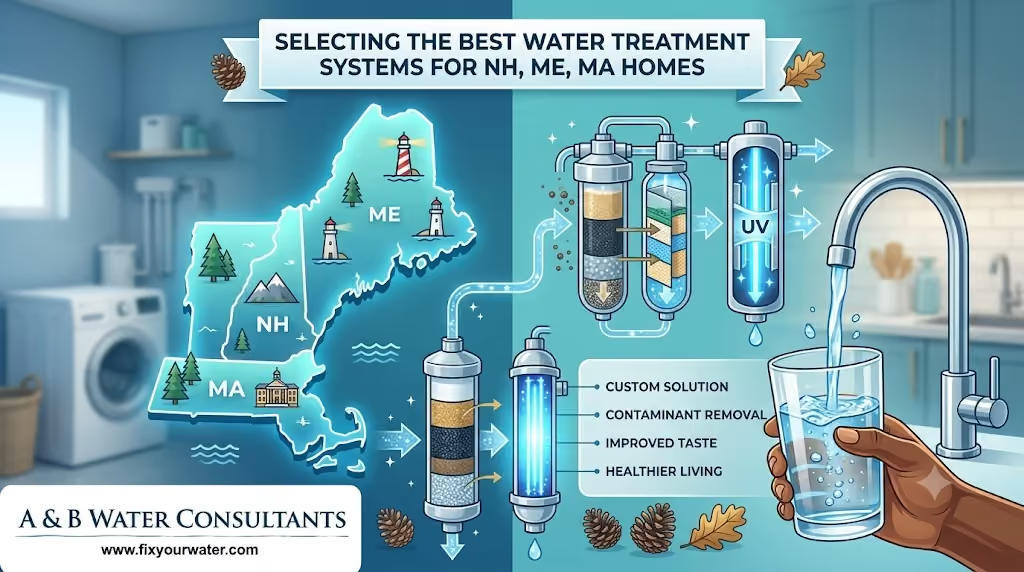
The best water treatment systems for New England well water are not products that can be pulled off a shelf. They are engineered solutions designed around a specific well's water chemistry, the home's flow rate requirements, the household's water usage patterns, and the combination of contaminants present.
A well in Concord, NH with arsenic at 18 ppb and radon at 5,000 pCi/L requires a fundamentally different treatment approach than a well in southern Maine with PFAS contamination but no arsenic. Sizing matters enormously. An undersized GAC system for radon removal will exhaust the carbon media before the next service interval, leaving the homeowner unprotected. An improperly sized reverse osmosis system may not achieve the flow rate a family needs for daily cooking and drinking.
Professional water treatment design accounts for all of these variables. It begins with a comprehensive water test, incorporates the specific contaminant concentrations found, accounts for household size and peak flow demand, and selects certified media and equipment appropriate for the application. This is the difference between a treatment system that works and one that provides only the appearance of protection.
Arsenic Removal Systems: What Works and What Doesn't
Adsorptive Media vs. Reverse Osmosis for Arsenic
Two primary technologies are proven effective for arsenic removal in residential well water systems: adsorptive media filtration and reverse osmosis.
Adsorptive media systems use a bed of specialized media, typically iron-based or titanium-based materials, that binds arsenic as water passes through. These systems are commonly installed as whole-house or point-of-entry systems and can treat the entire home's water supply. They are well-suited for homes where arsenic is the primary contaminant and where whole-house treatment is desired. The media requires periodic replacement based on water volume treated and arsenic concentration, and the system must be properly sized to ensure adequate contact time between the water and the media.
Reverse osmosis systems use a semipermeable membrane to remove arsenic along with a broad range of other dissolved contaminants. Under-sink RO systems are a common and effective choice for arsenic removal at the drinking tap, typically achieving removal rates above 95 percent. They are particularly appropriate when arsenic reduction at the point of consumption is the primary goal, or when the household budget favors a point-of-use approach over a whole-house system.
The EPA MCL for arsenic in public water systems is 10 ppb. NH DES recommends that private well owners take action when arsenic exceeds this level, though some health authorities recommend treatment at lower concentrations given arsenic's carcinogenic classification. A professional water treatment consultant can help homeowners understand what their specific arsenic level means and which removal approach is most appropriate for their situation.
Contact A&B Water Consultants for a free water treatment quote and find out which arsenic removal system is right for your well.
NH and ME Arsenic Hotspots
In New Hampshire, the towns and cities with the highest documented rates of arsenic in private wells are concentrated in Hillsborough, Merrimack, Rockingham, and Cheshire counties. Communities including Manchester, Concord, Nashua, and the surrounding towns have significant percentages of private wells exceeding the arsenic MCL. In Maine, arsenic hotspots are distributed across much of the southern and central portions of the state, with elevated rates in York, Cumberland, and Kennebec counties.
Homeowners in these areas should treat arsenic testing as a priority, particularly if they have never tested their well or have not tested within the past several years. Well water chemistry can change over time as aquifer conditions shift, and a test result from ten years ago does not guarantee current water quality.
Radon in Your Drinking Water: A Hidden Risk Most Water Filter Companies Ignore
Radon in water is one of the most underappreciated water quality issues in New England, and it is almost entirely ignored by the national water filter industry. This is a significant gap, because New Hampshire and Maine have some of the highest waterborne radon concentrations in the United States.
Radon is a naturally occurring radioactive gas produced by the decay of uranium in bedrock. In areas underlain by granite, as much of New England is, radon dissolves into groundwater as it flows through fractured rock. When that water is pumped into a home, radon is released into the indoor air during any water use activity: showering, running the faucet, operating the dishwasher, or doing laundry.
The distinction between radon in water and radon in air is important for treatment planning. Radon entering a home through foundation cracks is addressed by sub-slab depressurization systems, which are the standard radon mitigation approach for airborne radon. Radon entering through water requires a separate water treatment system. A home can have both problems simultaneously, and addressing one does not address the other.
Aeration vs. Granular Activated Carbon for Radon Removal
The EPA recognizes two treatment technologies for radon in water: aeration systems and granular activated carbon (GAC) systems.
Aeration systems work by introducing air into the water and allowing radon gas to escape before the water is distributed through the home. Packed tower aerators and spray aeration systems can achieve radon removal rates of 99 percent or higher and are the preferred approach for wells with very high radon concentrations. These are whole-house systems installed at the point of entry and require professional sizing based on the home's flow rate and the measured radon concentration in the water.
GAC systems adsorb radon onto activated carbon media as water passes through the tank. They are effective for moderate radon concentrations and are simpler to install than aeration systems, though they require careful attention to media replacement schedules. An important consideration with GAC systems used for radon is that the carbon media becomes radioactive as it accumulates radon decay products, which affects disposal procedures and requires professional handling during media replacement.
Choosing between aeration and GAC depends on the measured radon concentration, the home's water usage, and site-specific installation factors. This is a determination that should be made by a qualified water treatment professional after reviewing laboratory test results, not a decision to make based on a product listing online.
PFAS Filtration: Choosing the Right System for Your Home
PFAS compounds, including PFOA, PFOS, and a growing list of related chemicals, have become one of the most pressing water quality concerns in New England. These compounds are extraordinarily persistent in the environment and in the human body, which is why they have earned the name "forever chemicals."
Activated Carbon and Reverse Osmosis for PFAS Removal
Two treatment technologies have demonstrated effectiveness for PFAS removal: activated carbon filtration and reverse osmosis.
Activated carbon systems, particularly those using granular activated carbon or solid block carbon, adsorb PFAS compounds as water passes through the media. The effectiveness of activated carbon for PFAS removal depends on the type of carbon used, the contact time between the water and the media, and the specific PFAS compounds present. Longer-chain PFAS compounds are generally more readily adsorbed than shorter-chain compounds. Carbon media must be replaced on a regular schedule to maintain effectiveness, and a system that has exhausted its adsorption capacity provides no protection.
Reverse osmosis systems are highly effective for PFAS removal, typically achieving reduction rates above 90 percent for most PFAS compounds. Under-sink RO systems are a practical and well-proven choice for PFAS reduction at the drinking tap. For homeowners concerned about PFAS exposure through skin contact during bathing, a whole-house approach using activated carbon at the point of entry may be appropriate, though the primary health concern with PFAS is ingestion.
NSF/ANSI Certification Standards for PFAS
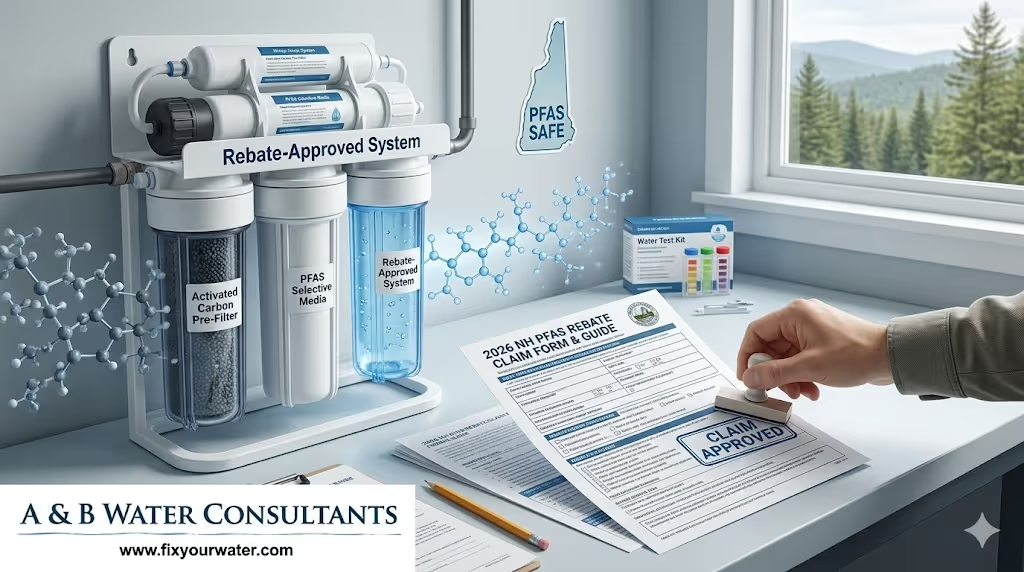
When selecting a water treatment system for PFAS removal, homeowners should verify that the system or media carries NSF/ANSI certification for PFAS reduction. NSF/ANSI Standard 58 covers reverse osmosis systems and includes testing for PFOA and PFOS reduction. NSF/ANSI Standard 53 covers activated carbon systems for health-effects contaminant reduction and has been updated to include testing for certain PFAS compounds.
Third-party certification through NSF International or the Water Quality Association (WQA) is the most reliable way to verify that a treatment system will perform as claimed. A professional water treatment consultant can identify certified systems and media appropriate for the specific PFAS compounds detected in a homeowner's well.
Contact A&B Water Consultants for a free water treatment quote and get expert guidance on PFAS filtration options for your New England well.
Whole-House vs. Point-of-Use Water Treatment: Which Is Right for You?
The choice between whole-house and point-of-use treatment is not always an either-or decision. For New England well water with multiple contaminants, a combined approach is often the most effective and practical solution.
When Whole-House Treatment Is the Right Choice
Whole-house or point-of-entry systems are appropriate when the contaminant presents risks beyond drinking water consumption. Radon is the clearest example: because radon volatilizes during showering and other water use activities, treating only the drinking tap does not address the inhalation exposure pathway. A whole-house aeration or GAC system eliminates radon before it reaches any fixture in the home.
Sediment and iron are also well-suited to whole-house treatment, since they affect not just drinking water quality but also plumbing fixtures, water heaters, and appliances. A whole-house sediment filter or iron removal system protects the entire plumbing system, not just the drinking tap.
When Point-of-Use Treatment Is the Right Choice
Point-of-use systems are the most practical and cost-effective approach when the primary concern is the water consumed for drinking and cooking. Arsenic and PFAS are both well-addressed by under-sink reverse osmosis systems, which can achieve high removal rates at a fraction of the cost of a whole-house system. For a family of four that drinks and cooks with water from a single kitchen tap, a properly sized under-sink RO system provides robust protection against ingestion-pathway contaminants.
Point-of-use systems are also commonly used as a secondary treatment layer in homes that already have a whole-house system for radon or sediment but need additional reduction of arsenic or PFAS at the tap.
When Your Well Has Multiple Contaminants: Designing a Combined Treatment System
One of the most important realities of New England well water that most online resources fail to address is that contamination rarely occurs in isolation. A well in southern New Hampshire may have elevated arsenic, high radon in water, and detectable PFAS simultaneously. Each contaminant requires a different treatment technology, and those technologies must be integrated into a system that functions reliably as a whole.
A professionally designed combined treatment system for a complex well water profile might include a whole-house aeration system for radon removal at the point of entry, followed by a sediment filter to remove any particulates introduced by the aeration process, followed by an under-sink reverse osmosis system at the kitchen tap to address arsenic and PFAS at the point of consumption. Each component is sized to match the others, and the overall system is designed to meet the household's flow rate requirements without creating pressure or capacity problems.
This kind of integrated system design is not something that can be assembled from a collection of individually purchased products. It requires an understanding of how each treatment stage interacts with the others, how the sequence of treatment affects performance, and how the system should be monitored and maintained to ensure ongoing effectiveness. It is the work of an experienced water treatment professional, not a retail purchase decision.
New England homeowners with complex well water profiles should also be aware that adding treatment components without professional guidance can create problems. For example, certain iron levels in well water can foul reverse osmosis membranes if iron is not removed upstream. Chlorination for bacterial treatment can affect activated carbon media performance. A professional consultant designs the system as a whole, accounting for all of these interactions.
How to Choose the Best Water Treatment System for Your Home
Start with a Certified Water Test, Not a Product
The single most important step in selecting a water treatment system is obtaining a comprehensive laboratory water test before making any treatment decisions. This is not optional, and it cannot be replaced by a home test kit from a hardware store. A certified laboratory analysis of well water provides the quantitative data needed to select the right treatment technology, size the system appropriately, and verify that treatment is achieving the desired results.
For New England homeowners, a comprehensive well water test should include arsenic, radon, a full PFAS panel, coliform bacteria, nitrates, pH, hardness, iron, manganese, and any other contaminants relevant to the local area. NH DES and the Maine CDC both publish guidance on recommended testing parameters for private well owners, and a professional water treatment consultant can recommend a testing protocol appropriate for the specific location and well characteristics.
Key Questions to Ask a Water Treatment Consultant
When evaluating water treatment options, homeowners should ask prospective consultants the following questions:
- What laboratory do you use for water testing, and is it certified by the state?
- What specific treatment technologies do you recommend for my contaminant profile, and why?
- Are the systems and media you install NSF/ANSI certified for the contaminants I need to address?
- How is the system sized for my household's flow rate and water usage?
- What does ongoing maintenance involve, and what is the expected cost and schedule?
- Will you conduct post-installation water testing to verify that the system is achieving the required reduction levels?
- What warranty and service support do you provide?
A reputable water treatment professional will answer these questions clearly and completely. Vague answers about system performance or reluctance to discuss post-installation testing are warning signs worth taking seriously.
Understanding Flow Rate, Household Size, and System Capacity
Water treatment system sizing is a technical process that accounts for the home's peak water demand, the well's flow rate, and the treatment capacity of each system component. A system that is undersized for the household's water usage will either fail to treat all of the water passing through it or will create unacceptable pressure drops that affect daily water use.
For radon treatment systems in particular, sizing is critical. An aeration or GAC system must be capable of treating the full volume of water the household uses, at the peak flow rate the household demands, to ensure that radon is removed from all water entering the home. This calculation requires knowing the well's flow rate, the household's peak demand, and the measured radon concentration in the raw water.
Professional Water Treatment Consultation vs. Buying a Filter Online: What's the Difference?
The difference between a professional water treatment consultation and purchasing a filter online is not simply a matter of cost or convenience. It is a fundamental difference in the quality of the outcome and the protection the homeowner actually receives.
When a homeowner purchases a water filter online, they are selecting a product based on marketing claims, product reviews, and their own assessment of what their water needs. They have no certified laboratory data to confirm what contaminants are present. They have no professional guidance on whether the product is appropriate for their specific contaminants or whether it is sized correctly for their household. They have no post-installation testing to verify that the system is working. If the product fails to address their actual contaminants, they may never know.
A professional water treatment consultation with A&B Water Consultants follows a structured process designed to ensure that the treatment system actually solves the homeowner's water quality problem. It begins with a comprehensive water test conducted by a state-certified laboratory. The results are reviewed by an experienced consultant who interprets the data in the context of the local geology, the home's plumbing, and the household's water usage. A treatment system is designed and sized specifically for that home. Professional installation ensures that the system is correctly integrated with the home's plumbing and that all components function as designed. Post-installation testing confirms that the system is achieving the required contaminant reduction levels.
This process protects homeowners from the two most common failure modes of DIY water treatment: selecting the wrong technology for the contaminants present, and installing a correctly chosen technology incorrectly or at the wrong size. Both failures can leave a family drinking water that they believe is treated but is not.
Contact A&B Water Consultants for a free water treatment quote and learn what a professional consultation can do for your family's water quality.
Installation, Maintenance, and Long-Term Performance
Professional Installation vs. DIY Risks
Water treatment systems for arsenic, radon, and PFAS are not consumer-grade products that can be installed without technical knowledge. They involve connections to the home's main water supply, electrical components in some cases, and treatment media that must be properly contained and managed. Incorrect installation can result in bypassed treatment, water leaks, pressure problems, or in the case of radon GAC systems, improper handling of radioactive media.
Professional installation by a qualified water treatment technician ensures that the system is correctly integrated with the home's plumbing, that all connections are secure and leak-free, and that the system is commissioned and tested before the homeowner relies on it for treated water. It also establishes a service relationship with a professional who knows the system and can respond quickly if a problem arises.
Ongoing Maintenance Schedules and Media Replacement
All water treatment systems require ongoing maintenance to sustain their performance. The specific maintenance requirements vary by system type, but the general principles are consistent: filter media must be replaced on schedule, system components must be inspected periodically, and water quality must be tested regularly to confirm that the system is performing as designed.
Adsorptive media for arsenic removal has a finite capacity and must be replaced when it is exhausted. The replacement interval depends on the arsenic concentration in the raw water and the volume of water treated. A professional service provider can calculate the expected media life based on these parameters and schedule replacement accordingly.
GAC media used for radon or PFAS removal also has a finite adsorption capacity and must be replaced before breakthrough occurs. Because GAC used for radon accumulates radioactive decay products, replacement must be handled by a qualified professional following appropriate disposal procedures.
Reverse osmosis membranes and pre-filters require periodic replacement to maintain system performance. Most RO systems require pre-filter changes annually and membrane replacement every two to three years, though actual intervals depend on water quality and usage volume.
Annual Water Testing to Verify System Performance
Routine maintenance is necessary but not sufficient to confirm that a water treatment system is working. Annual water testing of the treated water is the only reliable way to verify that the system is achieving the required contaminant reduction levels and that no changes in raw water quality have compromised system performance.
Water quality in private wells can change over time due to seasonal variations, changes in the aquifer, nearby land use changes, or changes in the well itself. A system that was correctly sized and performing well two years ago may not be performing adequately today if raw water contaminant levels have increased. Annual testing catches these changes before they result in prolonged exposure to untreated water.
How to Verify Your Water Treatment System Is Actually Working
Post-installation verification testing is a step that most online filter guides and retail product sellers skip entirely, yet it is one of the most important elements of a responsible water treatment program. For regulated contaminants like arsenic and PFAS, verification testing is not optional. It is the only way to confirm that the system is doing what it is supposed to do.
Verification testing involves collecting water samples from the treated water tap after the system has been installed and has been operating for a sufficient period to reach steady-state performance. These samples are sent to a state-certified laboratory for analysis of the target contaminants. The results are compared to the raw water test results and to the applicable MCLs or health advisory levels to confirm that the system is achieving the required reduction.
If verification testing reveals that the system is not achieving adequate reduction, the problem can be diagnosed and corrected before the family continues to rely on the treated water. This might involve adjusting system settings, replacing media, or modifying the treatment approach. Without verification testing, a homeowner has no objective confirmation that their investment in water treatment is actually protecting their family.
A&B Water Consultants includes post-installation water testing as part of the professional service process. Contact A&B Water Consultants for a free water treatment quote to learn how this comprehensive approach protects your family from start to finish.
Frequently Asked Questions About Water Treatment Systems in New England
What is the most effective water treatment system for arsenic removal?
Both adsorptive media systems and reverse osmosis systems are highly effective for arsenic removal when properly sized and installed. Adsorptive media systems are typically used as whole-house treatment, while reverse osmosis is commonly applied at the point of use for drinking and cooking water. The right choice depends on the arsenic concentration in the well, the household's treatment goals, and whether other contaminants are also present. A certified water test followed by a professional consultation is the best way to determine which approach is most appropriate for a specific situation.
What is the best whole house water filtration system for well water?
The best whole-house water filtration system for a New England well is one that is designed specifically for the contaminants present in that well, sized appropriately for the household's flow rate, and installed by a qualified professional. There is no single product that is universally best for all New England wells. A well with high radon requires a different whole-house system than a well with high iron or high sediment. The answer begins with a comprehensive water test.
What water filters remove PFAS from drinking water?
Reverse osmosis systems and activated carbon systems with NSF/ANSI certification for PFAS reduction are the most reliable options for PFAS removal. Under-sink reverse osmosis systems are a practical choice for most homeowners concerned about PFAS in their drinking water. The system should carry NSF/ANSI 58 certification for reverse osmosis or NSF/ANSI 53 certification for activated carbon PFAS reduction. Media must be replaced on schedule to maintain effectiveness.
Does reverse osmosis remove radon from water?
Reverse osmosis systems do remove some radon from water, but they are not the recommended treatment technology for radon. The EPA recognizes aeration and granular activated carbon as the appropriate treatment methods for radon in water. Aeration is preferred for high radon concentrations and achieves removal rates of 99 percent or higher. GAC is effective for moderate concentrations. Because radon in water also creates an inhalation risk when water is used for showering and other household purposes, whole-house treatment at the point of entry is strongly preferred over point-of-use treatment for radon.
How do I know what contaminants are in my well water?
The only reliable way to know what contaminants are in a private well is to have the water tested by a state-certified laboratory. Home test kits are not adequate for regulated contaminants like arsenic, PFAS, or radon. NH DES, the Maine CDC, and the Massachusetts Department of Environmental Protection all provide guidance on recommended testing parameters for private well owners in their respective states. A professional water treatment consultant can recommend a comprehensive testing protocol appropriate for the local area and arrange for certified laboratory analysis.
Who makes the best home water filtration system for New England well water?
The best water treatment systems for New England well water are not defined by a single manufacturer or brand. They are defined by the quality of the design, the appropriateness of the technology for the contaminants present, the quality of the installation, and the ongoing service and verification testing that ensures continued performance. A&B Water Consultants, with over 25 years of experience designing and installing custom water treatment systems for New England homeowners, brings the expertise and regional knowledge needed to address the specific challenges of arsenic, radon, and PFAS in NH, ME, and MA well water.
Choosing the Right Water Treatment Partner for Your New England Home
The water treatment options available to homeowners have never been more numerous, and the marketing claims surrounding them have never been louder. For homeowners in New Hampshire, southern Maine, and Massachusetts dealing with the real and documented risks of arsenic, radon, and PFAS in their well water, cutting through that noise requires a clear-eyed focus on what actually matters: a comprehensive water test, a professionally designed treatment system appropriate for the contaminants found, expert installation, and verified performance.
A&B Water Consultants has been providing custom-designed water treatment solutions to New England homeowners for over 25 years. The company's focus on arsenic and radon filtration, combined with deep expertise in PFAS removal and the specific water quality challenges of the New England region, positions it as the professional resource that homeowners in NH, ME, and MA can rely on for accurate information and effective treatment solutions.
The process begins with a conversation and a water test. From there, the path to clean, safe water is clear. Contact A&B Water Consultants for a free water treatment quote and take the first step toward knowing exactly what is in your water and how to address it.