Private well owners across New Hampshire, southern Maine, and Massachusetts face a water quality challenge that most municipal customers never encounter: the full responsibility of ensuring their drinking water is safe falls entirely on them. No federal agency monitors what comes out of a private well. No utility sends annual reports. No regulatory body mandates treatment. What flows from the tap is the homeowner's concern alone.
For families living above New England's ancient granite bedrock, that responsibility carries real weight. The geology that makes this region beautiful also makes it one of the most arsenic- and radon-affected areas in the country. Add the legacy of industrial and military activity that has seeded PFAS contamination into groundwater across multiple states, and the picture becomes clear: effective water contamination solutions are not optional for many New England households. They are a necessity.
This guide draws on more than 25 years of professional water treatment experience in New Hampshire and the surrounding region. It covers the contaminants most likely to affect private wells here, the treatment technologies proven to address them, and the practical steps homeowners should take to move from concern to clean water.
Why New Hampshire and New England Homes Face Unique Water Contamination Risks
New England's water quality challenges are not generic. They are shaped by geology, land use history, and the prevalence of private wells in ways that make this region distinctly different from much of the United States.
New Hampshire has one of the highest rates of private well use in the nation, with roughly 40 percent of the population relying on groundwater from drilled wells. Maine's rural communities show similar patterns. When a household depends on a private well, that well is drawing water directly from the surrounding bedrock and soil, which in New England means exposure to naturally occurring arsenic and radon at rates that consistently exceed national averages.
The U.S. Geological Survey has documented elevated arsenic concentrations in bedrock aquifers throughout New Hampshire, particularly in the southeastern and central portions of the state. Studies of New Hampshire well water have found arsenic levels exceeding the federal maximum contaminant level (MCL) of 10 micrograms per liter in a significant percentage of tested wells. In some localized areas, concentrations run several times higher than that threshold.
Radon, a radioactive gas that dissolves into groundwater from uranium-bearing granite, is similarly prevalent. New Hampshire and Maine consistently rank among the states with the highest radon concentrations in both air and water. Massachusetts, particularly in areas with older granite formations, also shows elevated groundwater radon levels.
PFAS contamination adds a third layer of risk. Per- and polyfluoroalkyl substances have been detected in groundwater near military installations, fire training facilities, and industrial sites across all three states. In New Hampshire, communities near Pease Air National Guard Base in Portsmouth were among the earliest in the nation to document PFAS contamination in drinking water supplies. That contamination has continued to migrate in groundwater, affecting private wells in surrounding areas.
Understanding these regional patterns is the starting point for any meaningful water quality improvement strategy. The contaminants affecting a home in Concord, New Hampshire may differ in concentration from those affecting a home in southern Maine, but the fundamental risks and the professional solutions available are consistent across the region.
Common Water Contaminants Affecting New England Private Wells
Arsenic
Arsenic occurs naturally in New England bedrock. As groundwater moves through fractured granite and other rock formations, it dissolves arsenic minerals and carries them into well water. This is not a pollution event caused by a single source. It is an ongoing geological process that affects thousands of private wells throughout New Hampshire, Maine, and Massachusetts.
Long-term exposure to arsenic in drinking water is associated with serious health consequences, including increased risk of bladder, lung, and skin cancers. Arsenic also affects cardiovascular function and has been linked to developmental effects in children. Because arsenic is odorless, colorless, and tasteless, there is no sensory warning that it is present. Only a certified water test can reveal whether a well is affected.
Radon in Water
Radon is a naturally occurring radioactive gas produced by the decay of uranium in granite and other igneous rocks. It dissolves readily into groundwater and enters homes through the water supply. When contaminated water is used for showering, washing dishes, or running the dishwasher, radon is released into indoor air. Ingested radon also carries a risk of stomach cancer.
The EPA has estimated that waterborne radon contributes meaningfully to indoor radon levels, particularly in homes with high-radon well water. New Hampshire's geology makes radon in water a legitimate concern for a large share of the state's private well users.
PFAS
PFAS, often called "forever chemicals" because they do not break down in the environment or the human body, represent a newer but significant threat to New England groundwater. These synthetic compounds were used for decades in firefighting foam, non-stick coatings, stain-resistant fabrics, and numerous industrial applications. They have migrated from contamination sites into groundwater and, from there, into private wells.
PFAS bioaccumulate in the body over time. Research has linked PFAS exposure to immune system disruption, thyroid disease, certain cancers, and developmental effects in children. New Hampshire has established some of the most protective PFAS drinking water standards in the country, with MCLs for several PFAS compounds set at 12 parts per trillion, well below the federal threshold.
Comparing Water Treatment Technologies: Which System Removes Which Contaminant?
One of the most useful things a homeowner can have before investing in a treatment system is a clear side-by-side comparison of which technologies address which contaminants. The table below summarizes the primary treatment approaches used in residential settings across New England.
Aeration systems are particularly effective for radon because they physically strip the gas from water before it enters the home's plumbing. Adsorptive media systems use iron-based filtration materials that bind arsenic as water passes through, reducing concentrations to levels well below the MCL. For PFAS, granular activated carbon captures the compounds through adsorption, while reverse osmosis provides an additional barrier at the point of use.
Many New England homes require a combination of technologies because multiple contaminants are present simultaneously. A custom-designed system that addresses all identified contaminants in a single installation is typically more cost-effective and reliable than layering separate systems over time. Contact A&B Water Consultants for a free water treatment quote to find out which combination is appropriate for your specific well water conditions.
Private Well Owners Are on Their Own: What New Hampshire Regulations Actually Require
This is a point that deserves direct attention because it surprises many homeowners: private well owners in New Hampshire and across New England have no federal regulatory protection for their drinking water. The Safe Drinking Water Act, which sets MCLs for contaminants like arsenic and PFAS, applies only to public water systems serving 25 or more people. A household on a private well is entirely outside that regulatory framework.
New Hampshire's Department of Environmental Services (NH DES) provides guidance, testing resources, and educational materials for private well owners, but the state does not mandate that private wells be tested or treated. The responsibility for water quality monitoring falls entirely on the homeowner.
New Hampshire has established recommended action levels for several contaminants in private wells, including arsenic at 10 micrograms per liter and PFAS compounds at 12 parts per trillion for several specific PFAS chemicals. Maine DEP and Massachusetts environmental agencies have similar standards, but again, these are guidelines for private well owners, not enforceable requirements backed by routine monitoring.
What this means practically is that a private well could have arsenic levels ten times the recommended limit, and no agency will notify the homeowner. No inspector will arrive. No violation notice will be issued. The only way to know is to test, and the only way to protect the family is to treat the water based on those results.
This regulatory gap is one of the strongest arguments for working with a professional water treatment consultant rather than relying on government oversight that simply does not exist for private well owners.
From Water Test to Clean Water: What the Treatment Process Looks Like
Homeowners who are new to private well ownership or who have never had their water professionally tested often ask what the process actually involves. Here is a straightforward breakdown of what to expect when working with a professional water treatment consultant.
Step 1: Certified Water Testing
The process begins with a comprehensive water quality test conducted by a certified laboratory. A professional consultant will collect water samples from the well and send them to an accredited lab for analysis. This is categorically different from a basic home test kit, which typically screens for only a handful of parameters and cannot reliably detect arsenic, radon, or PFAS at the concentrations that matter for health decisions.
A certified water test will identify the specific contaminants present, their concentrations, and how those concentrations compare to MCLs and recommended action levels. It may also reveal secondary water quality issues such as hardness, pH, iron, or manganese that could affect treatment system performance.
Step 2: Results Review and System Design
Once test results are available, a water treatment consultant reviews them in the context of the home's plumbing, water usage patterns, and household size. This is where a custom system design begins. A well with arsenic at 25 micrograms per liter and moderate radon requires a different configuration than one with PFAS as the sole concern.
The consultant will recommend specific treatment technologies, explain how each component addresses the identified contaminants, and provide a clear picture of the installation process and ongoing maintenance requirements.
Step 3: Professional Installation
Installation of a whole-house treatment system involves integration with the home's existing plumbing at the point of entry, typically near the pressure tank. The work requires proper sizing of treatment components to match the home's flow rate and daily water demand. Undersized systems fail to treat water adequately; oversized systems waste media and create unnecessary expense.
A professional installation includes all necessary plumbing connections, bypass valves for maintenance access, and initial system startup and testing to confirm that treated water meets target quality levels.
Step 4: Ongoing Monitoring and Maintenance
Treatment systems require scheduled maintenance to sustain performance. Adsorptive media has a finite capacity and must be replaced or regenerated. Activated carbon filters lose effectiveness over time as adsorption sites become saturated. Aeration systems require periodic inspection of mechanical components. A professional maintenance schedule ensures that the system continues to protect the household rather than providing a false sense of security with a depleted filter.
Follow-up water testing at regular intervals confirms that treated water continues to meet quality standards. Contact A&B Water Consultants for a free water treatment quote and to discuss a maintenance schedule appropriate for your system type and contaminant profile.
Is Professional Water Treatment Worth the Investment? A Cost Breakdown for Homeowners
Cost is a legitimate concern, and it deserves an honest answer. Professional water treatment systems represent a meaningful investment, but the financial comparison becomes straightforward when framed against the alternatives.
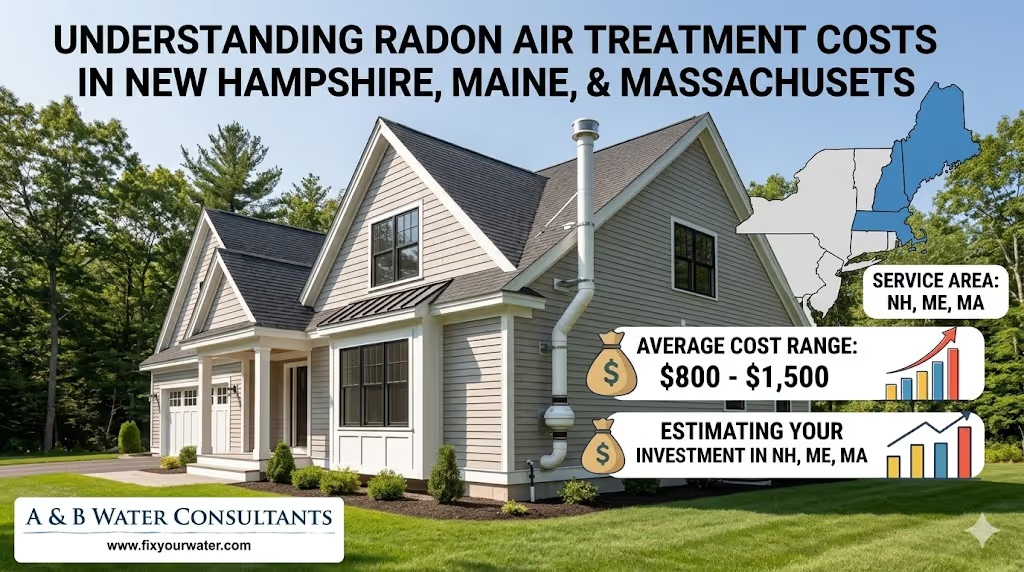
A whole-house arsenic filtration system using adsorptive media typically ranges from approximately $2,000 to $4,500 installed, depending on the severity of contamination, the size of the household, and the specific media configuration required. An aeration system for radon treatment falls in a similar range. Combined systems addressing multiple contaminants will carry higher upfront costs but provide comprehensive protection in a single installation.
Compare that to bottled water. A family of four consuming the recommended daily water intake from bottled sources spends roughly $1,200 to $2,000 per year on bottled water alone. That figure does not account for water used in cooking, for making ice, or for the environmental cost of single-use plastic. Within two to three years, the cost of bottled water exceeds the cost of a professionally installed treatment system, and the treatment system continues protecting the household for a decade or more with proper maintenance.
More importantly, bottled water does not address the risk of bathing or showering in contaminated water. Radon in water, for example, is released into indoor air during showers and is inhaled regardless of whether the family drinks bottled water. A whole-house treatment system addresses all exposure pathways. Bottled water addresses only one.
There is also the question of property value. Homes with documented water quality problems and no treatment system face complications during real estate transactions. A professionally installed and maintained water treatment system, supported by current water test results, is a demonstrable asset that supports property value and simplifies the sale process.
Contact A&B Water Consultants for a free water treatment quote to get a precise cost estimate based on your specific water test results and household requirements.
How to Choose the Right Water Treatment System for Your Home
Selecting a treatment system without a certified water test is one of the most common and costly mistakes private well owners make. Treatment technology must be matched to the specific contaminants and concentrations present in a given well. There is no universal solution that works for every situation.
For arsenic removal, adsorptive media systems using iron-based materials are the most widely used and effective technology for residential applications. These systems treat water at the point of entry, protecting all water uses throughout the home. Reverse osmosis can serve as a point-of-use supplement for drinking and cooking water but does not address bathing or other whole-house exposures.
For radon, aeration is the preferred treatment for high concentrations because it physically removes the gas from water rather than simply adsorbing it. Activated carbon can be effective at lower radon levels but requires careful monitoring because the carbon itself can become radioactive over time as radon decays within the media. Proper disposal of spent carbon is an important consideration.
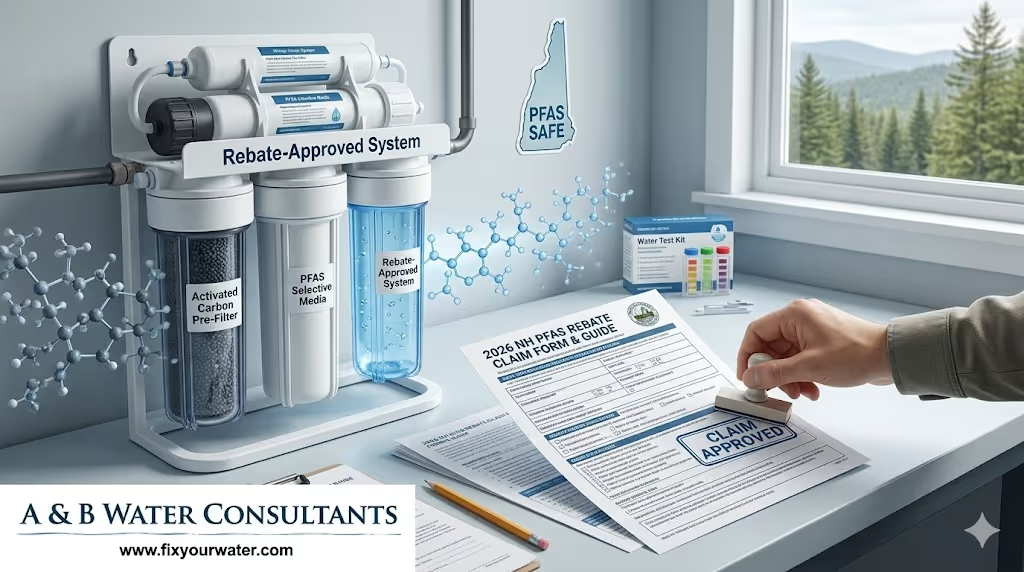
For PFAS, granular activated carbon systems sized appropriately for the home's flow rate and PFAS concentrations provide effective reduction. Reverse osmosis at the point of use offers a high-efficiency option for drinking water specifically. The choice between whole-house GAC and point-of-use reverse osmosis often depends on the PFAS concentrations present, the specific PFAS compounds identified, and the household's budget.
When multiple contaminants are present, a sequenced treatment train, where water passes through components in a specific order designed to address each contaminant without interfering with other treatment stages, is the standard professional approach.
New Hampshire and New England Water Quality Regulations You Should Know
New Hampshire has set MCLs for arsenic in public water systems at 10 micrograms per liter, consistent with the federal standard. For PFAS, New Hampshire has established some of the nation's most protective standards, with MCLs of 12 parts per trillion for PFOA, PFOS, PFNA, PFHxS, and PFHpA, and 15 parts per trillion for HFPO-DA (GenX). These apply to public water systems, but they serve as meaningful benchmarks for private well owners evaluating their own water test results.
Maine has established a maximum exposure level for PFAS in drinking water at 20 parts per trillion for the sum of six PFAS compounds. Massachusetts has adopted MCLs for six PFAS compounds at a combined level of 20 parts per trillion for public water systems.
For radon in water, the EPA has proposed a guidance level of 300 picocuries per liter (pCi/L) as an action level for public water systems, though a final federal rule has not been enacted. NH DES recommends treatment when radon in water exceeds 2,000 pCi/L, though many consultants advise action at lower levels given the cumulative indoor air exposure contribution.
Private well owners should use these regulatory benchmarks as a guide when reviewing their water test results, understanding that the standards exist to protect public health and that the same logic applies to household water regardless of whether a regulatory mandate exists.
Frequently Asked Questions About Water Contamination Solutions
Can contaminated well water be fully remediated?
In most residential cases, yes. Arsenic, radon, and PFAS can all be reduced to levels well below health-based thresholds using properly designed and maintained treatment systems. The key word is "maintained." A system that is installed and then ignored will eventually lose effectiveness. With appropriate maintenance and periodic water testing to confirm performance, treated water can consistently meet or exceed regulatory standards for the life of the system.
How long does a water treatment system last?
The physical infrastructure of a well-installed treatment system, including tanks, valves, and plumbing components, typically lasts 10 to 20 years with proper care. The treatment media within the system (adsorptive media, activated carbon, or reverse osmosis membranes) has a shorter service life and must be replaced on a schedule determined by water usage, contaminant concentrations, and media capacity. A professional maintenance agreement ensures replacements happen on time.
How do I know if my well water is contaminated with radon or arsenic?
There is no way to know without testing. Arsenic, radon, and PFAS are all undetectable by taste, smell, or appearance. A certified laboratory water test is the only reliable method for identifying these contaminants and measuring their concentrations. Homeowners in New Hampshire, southern Maine, and Massachusetts should test their well water at least every three to five years, and more frequently if they are in a known high-risk area or if their water test results have previously shown elevated levels of any contaminant.
Is treated water safe for cooking, bathing, and drinking?
When a whole-house treatment system is properly designed, installed, and maintained, yes. Treated water that meets or falls below MCLs for the contaminants of concern is safe for all household uses, including drinking, cooking, bathing, and laundry. Post-treatment water testing confirms that the system is performing as intended.
What are the best water treatment methods for arsenic and PFAS removal?
For arsenic, adsorptive media filtration using iron-based media is the standard of care for whole-house treatment. For PFAS, granular activated carbon and reverse osmosis are the two most effective technologies. The best choice depends on the specific contaminants identified, their concentrations, and the household's water usage patterns. A professional water quality consultation is the most reliable way to determine the right approach for a specific home.
What are the 7 methods of water treatment and which apply to home wells?
The seven commonly referenced water treatment methods are coagulation and flocculation, sedimentation, filtration, disinfection, ion exchange, adsorption, and aeration. For private residential wells in New England, the most relevant are adsorption (for arsenic and PFAS via activated carbon and adsorptive media), aeration (for radon), and filtration (for sediment and physical contaminants). Disinfection via UV or chlorination is also used when biological contamination is a concern. Ion exchange is used in water softening applications. Professional water treatment consultants select and combine these methods based on water test results.
Working with a Professional Water Treatment Consultant
The value of professional water treatment consultation extends beyond the technology itself. An experienced consultant brings knowledge of local geology, familiarity with the specific contaminants prevalent in a given area, and the ability to design a system that addresses a home's unique water chemistry rather than applying a generic solution.
For homeowners in New Hampshire, southern Maine, and Massachusetts, working with a consultant who has direct experience with the region's arsenic, radon, and PFAS challenges is particularly important. Treatment approaches that work well in other parts of the country may not be optimally configured for New England's specific groundwater conditions.
A professional consultation begins with a conversation about the home's water source, any existing water quality concerns, and the household's health priorities. It proceeds through certified testing, results analysis, system design, installation, and a clear maintenance plan. The goal is not to sell a system. The goal is to deliver water that the family can trust for the long term.
Contact A&B Water Consultants for a free water treatment quote and take the first step toward knowing exactly what is in your water and what it will take to make it safe.
With more than 25 years of experience serving New Hampshire homeowners and families across southern Maine and Massachusetts, A&B Water Consultants has the regional expertise and technical knowledge to design effective, durable water contamination solutions for private well owners throughout New England. From initial water testing through custom system design, professional installation, and ongoing maintenance, the team provides the complete support that private well owners need to protect their families and their homes.