Most homeowners in New Hampshire, Maine, and Massachusetts have heard the word "radon" at some point, but far fewer understand what it actually means for their family's health. Radon is invisible, odorless, and completely undetectable without proper testing. It can accumulate in your home's air, dissolve into your private well water, and silently elevate your household's cancer risk over years or decades. Understanding safe radon levels, and knowing when those levels demand professional action, is one of the most important steps a New England homeowner can take. Contact A&B Water Consultants for a free radon gas removal and treatment quote.
This guide covers everything you need to know: EPA and WHO radon exposure guidelines, how radon enters homes through both soil and well water, what local data shows for New Hampshire, Maine, and Massachusetts, and what professional treatment options are available when levels exceed acceptable thresholds.
What Is Radon and Why Does It Matter for New England Homeowners?
Radon is a naturally occurring radioactive gas produced by the decay of uranium in soil, rock, and water. It has no color, no odor, and no taste. Without a test, there is no way to know it is present. As radon decays, it releases radioactive particles that, when inhaled, can damage lung tissue over time.
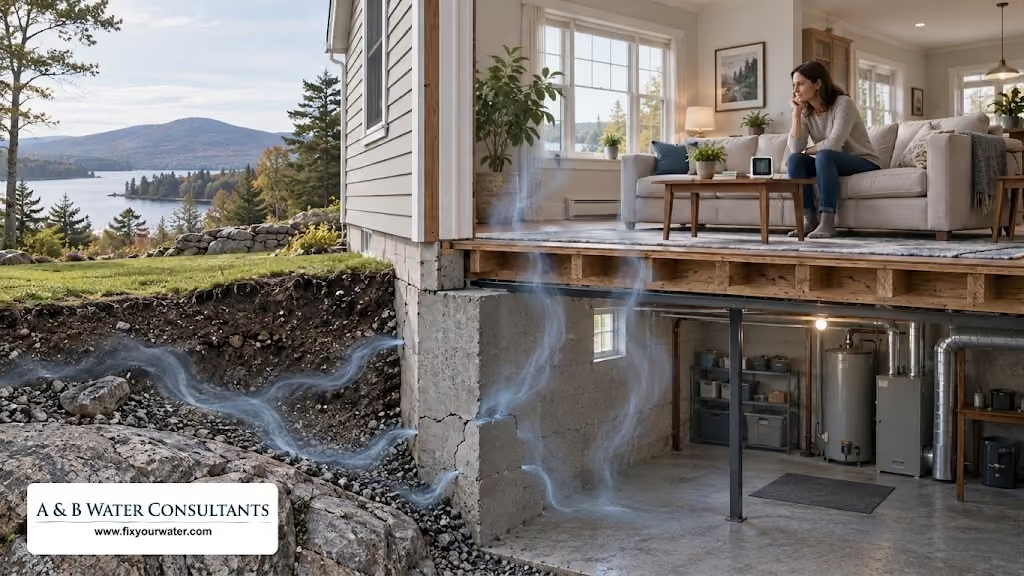
New England's geology makes this region particularly susceptible. Granite bedrock underlies much of New Hampshire, Maine, and parts of Massachusetts. Granite is naturally high in uranium content, which means it produces more radon than many other rock types. That radon migrates upward through soil, enters homes through foundation cracks and pressure differentials, and in areas with private wells, it dissolves directly into groundwater drawn from bedrock aquifers. For families relying on well water in southern New Hampshire or coastal Maine, radon exposure is not just an air quality concern. It is a water quality concern as well.
What Are Safe Radon Levels? EPA and WHO Guidelines Explained
The term "safe radon level" requires some nuance. Scientifically speaking, no level of radon exposure carries zero risk. Radon is a Class A carcinogen, and even low concentrations contribute to long-term lung cancer risk when exposure is sustained over years.
That said, regulatory agencies have established action thresholds to guide homeowners on when to prioritize mitigation:
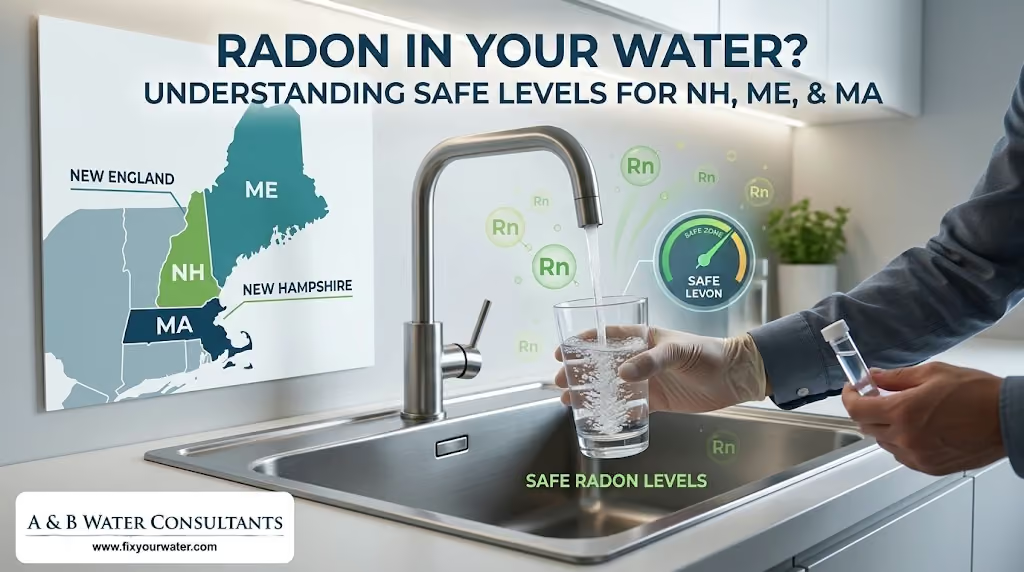
- EPA Action Level: 4.0 picocuries per liter (pCi/L). The U.S. Environmental Protection Agency recommends that homeowners take corrective action when indoor air radon reaches or exceeds this level.
- EPA Consideration Zone: Between 2.0 and 4.0 pCi/L, the EPA strongly encourages homeowners to consider mitigation, even though it falls below the formal action threshold.
- WHO Reference Level: 2.7 pCi/L. The World Health Organization uses a more conservative benchmark, reflecting a lower acceptable risk tolerance at the international level.
- Average U.S. Indoor Radon Level: Approximately 1.3 pCi/L. This is the national average for indoor air, but many New England homes test significantly higher due to regional geology.
Radon Level Comparison Table
The gap between the EPA's 4.0 pCi/L threshold and the WHO's 2.7 pCi/L reference level reflects differing policy frameworks rather than a disagreement about the science. Both agencies agree that radon causes lung cancer and that lower is always better. New England homeowners should treat the WHO benchmark as a meaningful signal, not just the EPA action level.
Radon in Well Water: The Hidden Risk New England Homeowners Often Miss
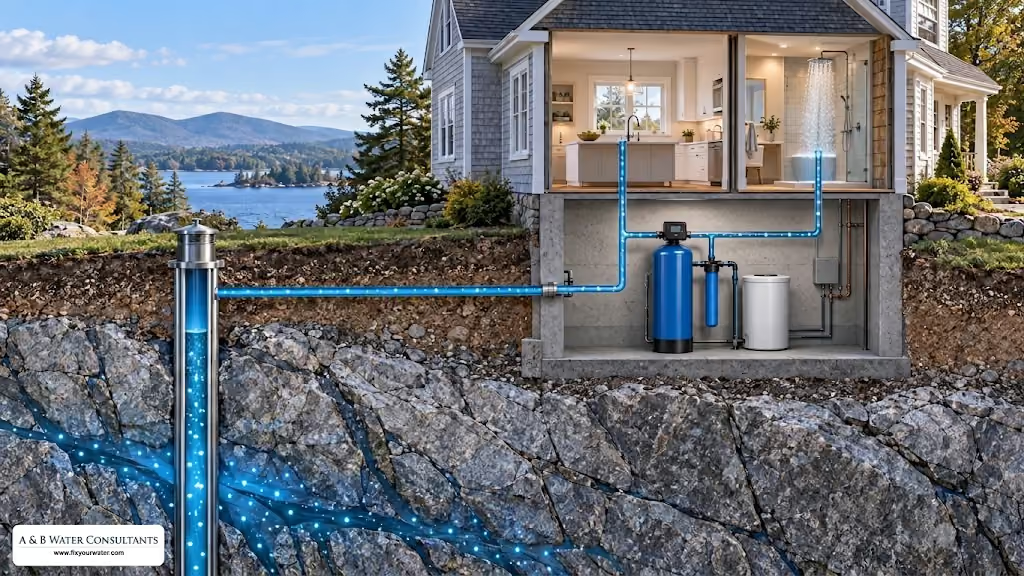
Most national radon resources focus almost exclusively on airborne radon. For New England homeowners on private wells, that framing misses a critical piece of the picture. Radon dissolves readily into groundwater as it passes through uranium-bearing granite. When that well water is drawn into a home and used for showering, cooking, dishwashing, or laundry, the radon off-gasses into the indoor air, adding to whatever airborne concentration already exists from soil infiltration.
The EPA has proposed a maximum contaminant level (MCL) for radon in public water supplies, but private wells are not subject to the same federal oversight. That means well owners in New Hampshire, Maine, and Massachusetts must take responsibility for testing their own water. Studies have found that radon concentrations in private well water in New England can reach tens of thousands of pCi/L, far exceeding the levels found in surface water sources. Even at concentrations of 10,000 pCi/L in water, the contribution to indoor air radon can be significant.
If your home has never been tested for radon in water specifically, that is a gap worth closing. Contact A&B Water Consultants for a free radon gas removal and treatment quote and find out whether your private well water is contributing to your household's overall radon exposure.
Radon Levels in New Hampshire, Maine, and Massachusetts: What Local Data Shows
National radon statistics often reference states like Iowa or Minnesota as high-risk examples. New England rarely gets the same attention in mainstream coverage, yet the data tells a different story for homeowners in this region.
New Hampshire consistently ranks among the states with the highest average indoor radon levels in the northeastern United States. The New Hampshire Department of Environmental Services has documented that a significant percentage of homes tested in the state exceed the EPA's 4.0 pCi/L action level, with granite-rich counties showing particularly elevated readings. Southern New Hampshire, including communities in Hillsborough and Rockingham counties, sees some of the highest concentrations.
Maine presents a similar profile. The state's bedrock geology, particularly in the York and Cumberland county areas of southern Maine, generates substantial radon in both soil and groundwater. Homes on private wells in rural Maine face a compounded risk from both air and water pathways.
Massachusetts shows more variation by region, with communities in central and western Massachusetts and areas near the New Hampshire border demonstrating elevated radon risk. Eastern Massachusetts, served largely by municipal water, sees less waterborne radon concern, but airborne radon from soil and bedrock remains a meaningful issue in older construction.
The EPA's radon zone map designates much of New Hampshire and Maine as Zone 1, the highest-risk classification, meaning predicted average indoor radon levels exceed 4.0 pCi/L. This is not a reason for alarm, but it is a reason for every homeowner in these states to test.
How Radon Enters Your Home and Why New England Homes Are Especially Vulnerable
Radon enters homes through several pathways, and older New England construction styles create multiple points of vulnerability:
- Foundation cracks and joints: Radon seeps through hairline cracks in concrete slabs, block walls, and poured foundations. Older homes with unfinished basements are especially susceptible.
- Sump pits: Open sump pits provide a direct channel for soil gas to enter living spaces.
- Crawl spaces: Many older New England homes have dirt-floor crawl spaces that allow radon to migrate freely upward.
- Well water: As described above, radon dissolved in groundwater off-gasses during household water use.
- Pressure differentials: Homes naturally draw air inward from the ground during colder months. In New England winters, this stack effect intensifies, pulling more radon-laden soil gas into living areas.
Radon levels also fluctuate with the seasons. Levels tend to be highest during winter months when homes are sealed tightly against the cold and the stack effect is strongest. A test conducted in January may show higher readings than one conducted in July, which is why long-term testing provides a more accurate picture of average annual exposure.
Health Risks of Radon Exposure
Radon is the second leading cause of lung cancer in the United States, responsible for an estimated 21,000 deaths annually according to the EPA. Only cigarette smoking causes more lung cancer deaths. For non-smokers, radon is the single largest cause of lung cancer.
The risk is directly related to both concentration and duration of exposure. A person living for 30 years in a home with radon levels at 4.0 pCi/L faces a meaningfully elevated lifetime cancer risk compared to someone living in a home at 1.3 pCi/L. For smokers, the combined risk is dramatically higher because radon and tobacco smoke act synergistically on lung tissue.
Radon-related lung cancer typically develops over years or decades, which is why many homeowners underestimate the urgency. There are no immediate symptoms of radon exposure. By the time a health consequence becomes apparent, the exposure has already occurred over a long period. This makes proactive testing and mitigation the only effective protective strategy.
How to Test Radon Levels in Your Home
Testing is the only way to know whether your home has a radon problem. There are several approaches:
- Short-term charcoal canister tests: These kits are placed in the lowest livable area of the home for two to seven days. They provide a snapshot of radon levels during that period and are useful as an initial screening tool.
- Long-term alpha track detectors: These devices remain in place for 90 days to one year, providing an average radon level that better reflects true annual exposure. They are considered more reliable for determining whether mitigation is needed.
- Continuous electronic monitors: These devices provide real-time radon readings and can track fluctuations over time. Professional-grade monitors are more accurate than consumer devices.
- Water radon testing: A separate water sample must be collected and analyzed by a certified laboratory to determine radon concentration in well water. This is distinct from air testing and requires a different methodology entirely.
Professional testing is recommended when a home is being purchased, when test results fall in the 2.0 to 4.0 pCi/L range and a second opinion is needed, or when a homeowner wants certainty before investing in mitigation. After any mitigation system is installed, retesting is essential to confirm that the system is performing as expected. Post-mitigation testing should be conducted 24 hours after system installation and again 30 days later to verify sustained results.
When Your Home Has Both Air and Water Radon: Understanding Combined Exposure
One of the most underappreciated radon scenarios in New England is the home that faces elevated radon from both soil and well water simultaneously. These are not mutually exclusive problems. In fact, homes built on granite bedrock with private wells are at risk from both pathways at once.
Consider a typical southern New Hampshire home: granite bedrock beneath the foundation contributes soil gas that infiltrates through the slab, while the same bedrock aquifer feeds the private well with water carrying dissolved radon. Every time someone showers or runs the dishwasher, additional radon enters the indoor air. The result is a compounded exposure that neither an air test alone nor a water test alone fully captures.
Addressing only one pathway while ignoring the other leaves the household partially protected at best. A comprehensive assessment should evaluate both sources and design a treatment plan that accounts for the total radon load entering the home. Contact A&B Water Consultants for a free radon gas removal and treatment quote to get a complete picture of your home's radon exposure from both air and water.
Professional Radon Water Treatment Systems: Aeration vs. Activated Carbon Filtration
When radon is detected in well water at elevated concentrations, two primary point-of-entry treatment technologies are used by water treatment professionals:
Aeration Systems
Aeration systems work by exposing well water to air in a controlled environment, allowing dissolved radon gas to off-gas out of the water before it enters the home's plumbing. These systems are highly effective, capable of removing 95 to 99 percent of radon from water. They require venting to the outdoors to safely discharge the off-gassed radon, and they need periodic maintenance to ensure optimal performance. Aeration is generally preferred for homes with very high water radon concentrations.
Granular Activated Carbon (GAC) Filtration
GAC filters use activated carbon media to adsorb radon from water as it passes through. They are compact, relatively simple to install, and effective at moderate radon concentrations. One consideration with GAC systems is that the carbon media accumulates radioactive decay products over time, which means the spent media must be handled and disposed of appropriately by a professional. GAC systems are not typically recommended for extremely high radon levels in water without supplemental treatment.
The choice between aeration and GAC depends on the radon concentration in the water, the home's plumbing configuration, available installation space, and budget. A qualified water treatment specialist will evaluate all of these factors before recommending a system. There is no meaningful DIY path for waterborne radon treatment. These are engineered, point-of-entry systems that require professional sizing, installation, and ongoing service to perform reliably.
What to Do When Airborne Radon Levels Are High
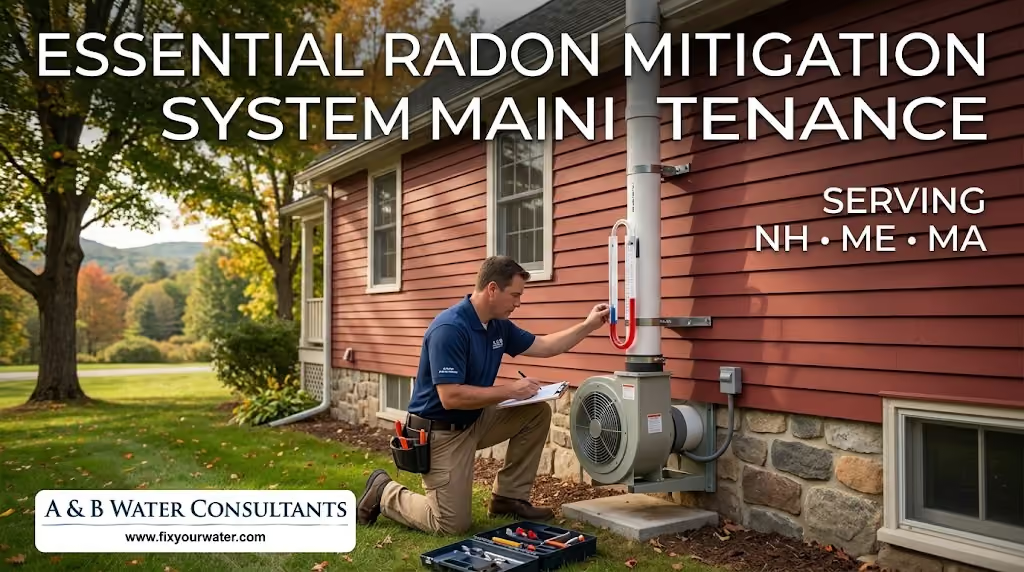
For elevated radon in indoor air, sub-slab depressurization is the most widely used and effective mitigation method. This system involves installing a pipe through the foundation slab and connecting it to a fan that draws radon-laden soil gas from beneath the home and vents it safely outside before it can enter living spaces. When professionally installed and properly sized, sub-slab depressurization can reduce indoor air radon levels by up to 99 percent.
Radon exposure guidelines make clear that action above 4.0 pCi/L is not optional. At that level, the health risk is well-documented and mitigation is the appropriate response. Between 2.0 and 4.0 pCi/L, the decision involves weighing risk tolerance, household composition (families with children or smokers face higher risk), and the relatively modest cost of mitigation compared to the long-term health stakes.
What to Expect When You Schedule a Professional Radon Water Assessment
For New England homeowners concerned about radon in their well water, the process of engaging a professional water treatment company is straightforward. Here is what a typical assessment involves:
- Initial consultation: A water treatment specialist reviews the home's water source, construction type, and any existing test results. If no water radon test has been conducted, a sample is collected and sent to a certified laboratory.
- Results review: Once laboratory results are returned, the specialist interprets the radon concentration in context, accounting for the home's air radon levels if known, household water usage patterns, and applicable guidelines.
- System recommendation: Based on the data, the specialist recommends the appropriate treatment technology, whether aeration, GAC filtration, or a combination approach, and provides a detailed proposal with equipment specifications and installation scope.
- Installation: Professional installation ensures the system is correctly sized, properly vented (for aeration systems), and integrated with the home's existing plumbing.
- Post-installation verification: A follow-up water test confirms that radon levels have been reduced to acceptable concentrations. Ongoing maintenance schedules are established to keep the system performing effectively.
Contact A&B Water Consultants for a free radon gas removal and treatment quote. With over 25 years of experience serving homeowners in New Hampshire, southern Maine, and Massachusetts, the team provides custom-designed water treatment solutions built around each home's specific radon profile.
Frequently Asked Questions About Safe Radon Levels
What is an alarming radon level?
Any level at or above the EPA's 4.0 pCi/L action threshold warrants prompt professional mitigation. Levels above 8.0 pCi/L represent a significantly elevated risk and should be addressed as urgently as possible. However, even levels between 2.0 and 4.0 pCi/L are considered by the EPA to be in a zone where mitigation is worth serious consideration.
Is 4.3 pCi/L a high radon level?
Yes. A reading of 4.3 pCi/L exceeds the EPA's action level of 4.0 pCi/L, which means professional mitigation is recommended. While 4.3 pCi/L is not an extreme reading, it falls into the range where the health risk from long-term exposure is considered unacceptable without corrective action.
Can radon levels in my home change without intervention?
Yes. Radon levels fluctuate based on season, weather, barometric pressure, and changes in home ventilation. Levels are generally highest in winter when homes are sealed and the stack effect pulls more soil gas indoors. A single short-term test may not reflect the true annual average. Long-term testing and periodic retesting are the most reliable ways to track radon exposure over time.
Do air purifiers remove radon from indoor air?
Standard air purifiers do not remove radon gas. Some HEPA filters can capture radon decay products (the radioactive particles released as radon breaks down), which reduces the amount of particles inhaled, but they do not address the radon gas itself. Effective radon reduction in air requires sub-slab depressurization or other professional mitigation systems, not air filtration devices.
What time of year are radon levels highest?
Radon levels in New England homes typically peak during winter months. Cold temperatures cause homes to seal tightly, reducing natural ventilation, while the stack effect created by warm indoor air rising draws more radon-laden soil gas through foundation entry points. Testing in winter often produces the highest readings, which is why the EPA recommends testing during the heating season for the most conservative assessment.
What is the fastest way to reduce radon in a home?
For airborne radon, sub-slab depressurization installed by a certified professional is the fastest and most effective solution, often producing dramatic reductions within days of installation. For waterborne radon, a professionally installed aeration system or GAC filtration unit at the point of entry will treat all water entering the home. Contact A&B Water Consultants for a free radon gas removal and treatment quote to discuss which solution is appropriate for your home's specific situation.
Taking the Next Step to Protect Your Family
Understanding safe radon levels is the first step. Acting on that knowledge is what actually protects your family. For homeowners in New Hampshire, southern Maine, and Massachusetts, the combination of high-risk geology, older home construction, and widespread reliance on private wells creates a radon exposure environment that deserves serious attention.
Whether your concern is airborne radon, radon in your well water, or both, professional assessment and treatment are the most reliable path to a genuinely safer home. A&B Water Consultants has spent over 25 years designing and installing custom radon water treatment systems for New England families. Contact A&B Water Consultants for a free radon gas removal and treatment quote and take the first step toward knowing exactly what is in your water and what can be done about it.