For homeowners across New Hampshire, southern Maine, and Massachusetts, radon is not an abstract concern. It is a measurable, manageable risk hiding in plain sight, specifically in the private well water that families use every day for drinking, cooking, and bathing. Yet despite the well-documented health risks associated with radon exposure, many New England homeowners have never tested their water for this invisible, odorless radioactive gas.
This guide covers everything homeowners need to know about radon in water: where it comes from, how it affects health, how to test for it, and how professional treatment systems can eliminate the risk. With over 25 years of experience serving New England families, A&B Water Consultants has designed and installed custom radon water treatment systems across the region. Contact A&B Water Consultants for a free radon water treatment quote and take the first step toward protecting your family.
What Is Radon in Water and Why It Matters in New England
Radon is a naturally occurring radioactive gas produced by the decay of uranium and radium found in rock and soil. While most people associate radon with indoor air, it also dissolves readily into groundwater as it passes through uranium-bearing bedrock. When that groundwater feeds a private well, radon enters the home through every faucet, showerhead, and appliance connected to the water supply.
New England's geology makes this a particularly serious regional concern. The granite bedrock underlying New Hampshire, Maine, and Massachusetts is naturally rich in uranium and radium, which means the groundwater drawn from drilled wells in these states carries a significantly elevated risk of radon contamination. In fact, New Hampshire consistently ranks among the highest-risk states in the nation for radon in well water, with some wells testing at levels many times above federal guidance thresholds.
It is important to distinguish between radon in air and radon in water. Radon in indoor air typically originates from soil gases entering through foundation cracks, while radon in water becomes a source of both ingestion exposure and secondary airborne exposure when water is used inside the home. Both pathways carry health risks, and both need to be assessed independently.
How Radon Gets Into Your Well Water
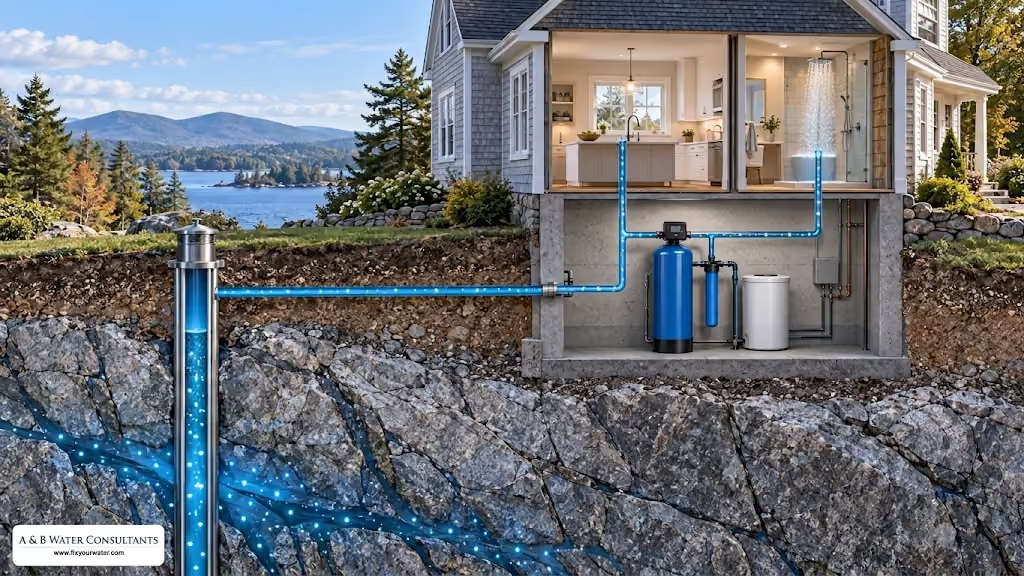
The process begins deep underground. Uranium naturally present in granite bedrock decays over time, producing radium, which in turn decays to produce radon gas. Because radon is a gas, it migrates through fractures and pores in the rock. When groundwater flows through these fractured zones, it picks up dissolved radon and carries it toward the surface.
Private drilled wells, which are the most common water source in rural and suburban New Hampshire and much of southern Maine, draw directly from this bedrock groundwater. Unlike dug wells, which are shallower and draw from surface water that has had more opportunity to off-gas, drilled wells tap deep into the aquifer where radon concentrations are highest and have had no opportunity to dissipate.
Municipal water supplies are treated and regulated, which means public water customers face far lower radon exposure from their tap. However, private well owners carry full responsibility for testing and treatment. In New Hampshire, where a large percentage of the population relies on private wells, this responsibility falls squarely on individual homeowners with no regulatory safety net in place.
Health Risks of Radon in Drinking Water
Radon in water poses two distinct health risks: inhalation and ingestion. Understanding both is essential for appreciating why this contaminant deserves serious attention.
Inhalation Risk
When water containing dissolved radon is used for showering, washing dishes, or running the washing machine, radon gas volatilizes and becomes airborne. This is the more significant of the two exposure pathways. Hot showers are particularly effective at releasing radon from water into bathroom air, and in a poorly ventilated space, concentrations can spike meaningfully during and after a shower. Inhaled radon decays into radioactive particles that lodge in lung tissue, where their continued decay damages cells and increases the long-term risk of lung cancer.
Ingestion Risk
Drinking water that contains radon also exposes the stomach lining to radiation. While the inhalation pathway is considered more dangerous, the EPA has estimated that radon in drinking water contributes to approximately 168 cancer deaths per year nationally, with the majority attributed to lung cancer from inhalation and a smaller portion to stomach cancer from ingestion. For families in high-risk areas like New Hampshire, this is not a negligible statistic.
How Much Radon in Water Is Considered Safe?
The EPA has proposed a Maximum Contaminant Level (MCL) of 300 pCi/L (picocuries per liter) for radon in public drinking water, along with an alternative standard of 4,000 pCi/L for states that implement an enhanced multimedia mitigation program to address radon in air. Private wells are not regulated at the federal level, but these thresholds serve as practical benchmarks for homeowners making treatment decisions.
In New Hampshire, state guidance recommends taking action when well water radon levels exceed 2,000 pCi/L, though many water quality professionals recommend treatment at levels above 300 to 500 pCi/L given the inhalation exposure pathway. Wells in the Granite State frequently test well above these levels, with some results exceeding 10,000 to 20,000 pCi/L or higher.
As a general rule: levels below 300 pCi/L require monitoring but may not demand immediate treatment. Levels between 300 and 4,000 pCi/L warrant serious consideration of treatment, particularly if air radon levels are also elevated. Levels above 4,000 pCi/L call for prompt professional intervention.
Testing Your Well Water for Radon in New Hampshire and New England
Testing is the only way to know whether radon in water is a problem in a specific home. Radon cannot be detected by sight, smell, or taste. Certified laboratory testing is the standard approach, and it involves collecting a water sample from the well using a proper protocol that minimizes off-gassing before the sample reaches the lab.
Homeowners should work with a certified water testing professional or send samples to a state-certified laboratory. In New Hampshire, the Department of Environmental Services maintains a list of approved labs. Testing should be done on first-draw water from the well, not after the water has sat in a pressure tank or treatment system, to get an accurate baseline measurement.
It is equally important to test both water and air for radon simultaneously. Because water is a secondary contributor to indoor air radon, understanding both numbers allows homeowners and radon treatment professionals to design a coordinated mitigation strategy. Retesting after any treatment system is installed is essential to confirm that the system is performing as designed, and periodic retesting every three to five years is advisable given that groundwater conditions can change over time.
Radon in Water in New Hampshire and New England: What Local Homeowners Need to Know
New Hampshire, Maine, and Massachusetts are consistently identified as high-risk states for radon in well water, and the reasons are geological rather than coincidental. The same granite formations that give New England its iconic rocky landscape are the source of elevated uranium and radium concentrations in bedrock aquifers.
New Hampshire has some of the highest documented radon-in-water concentrations in the United States. Studies have found median radon levels in New Hampshire private wells significantly above the EPA's proposed 300 pCi/L MCL, and a substantial percentage of tested wells exceed 4,000 pCi/L. In southern Maine, similar geology produces comparable results, particularly in towns served by bedrock wells in York and Cumberland counties. In Massachusetts, communities in Middlesex, Worcester, and Essex counties with high granite content face elevated risk.
Unlike states with sedimentary geology, New England homeowners cannot assume their well water is radon-free simply because the water looks clear and tastes fine. Professional testing combined with professional treatment is the only reliable approach for this region. Contact A&B Water Consultants for a free radon water treatment quote and get accurate, localized guidance from a team that has been working in New Hampshire and New England for over 25 years.
Radon Water Treatment Options: Aeration vs. Activated Carbon Filtration
Two primary treatment technologies are used to remove radon from well water: point-of-entry aeration systems and granular activated carbon (GAC) filtration. Both are effective, but they work differently and are suited to different situations. Learn more about radon mitigation methods for protecting home water.
Point-of-Entry Aeration Systems
Aeration is the most effective method for removing radon from water and is the preferred choice for homes with high radon concentrations. An aeration system works by spraying or agitating the incoming well water in a tank, exposing it to air and allowing dissolved radon gas to escape before the water enters the home's plumbing. The released radon is then vented safely to the outdoors. Well-designed aeration systems can achieve radon removal rates exceeding 99%, making them highly effective even at very high initial concentrations.
These systems are installed at the point of entry, meaning they treat all water entering the home rather than just water at a single tap. They require professional design and installation to ensure proper venting and sizing for the household's water demand.
Granular Activated Carbon Filtration
GAC filters use carbon media to adsorb radon from water as it passes through the filter. They are generally less expensive to install than aeration systems and can be effective for homes with lower radon concentrations, typically below 4,000 pCi/L. However, GAC filters have important limitations. Over time, the carbon media accumulates radioactive decay products, which means the spent media must be handled and disposed of carefully as low-level radioactive waste. Filter media replacement must be managed by a qualified professional.
Aeration vs. Activated Carbon: Choosing the Right Radon Water Treatment for Your Home
Choosing between these two systems depends on the specific radon concentration in the water, household water usage, available installation space, and budget. A professional assessment is the most reliable way to determine which system will perform best for a given home. A&B Water Consultants designs custom solutions based on actual test results rather than one-size-fits-all recommendations.
Radon in Water vs. Radon in Air: Understanding the Relationship
A common misconception is that treating radon in water will solve an indoor air radon problem. The relationship between the two is real but proportional. As a general guideline, every 10,000 pCi/L of radon in water contributes approximately 1 pCi/L to indoor air radon levels. This means that for a home with water testing at 20,000 pCi/L, the water source is adding roughly 2 pCi/L to indoor air, which is meaningful but may not account for the full air radon picture.
Homes with elevated air radon often have soil gas entry as the primary contributor, which requires a separate sub-slab depressurization system rather than water treatment. Testing both water and air allows homeowners and professionals to understand each source's contribution and design an appropriate combined strategy. Treating water alone is not a substitute for air mitigation, and vice versa.
What to Expect When You Hire a Professional for Radon Water Treatment
Many homeowners are unsure what the professional treatment process looks like, which can create hesitation about moving forward. Here is a clear overview of what to expect when working with A&B Water Consultants.
The process begins with a consultation and water testing. A certified technician will collect water samples from the well and, if not already done, coordinate air testing as well. Results from a certified laboratory typically return within one to two weeks. Once results are in hand, the team reviews the data and recommends a treatment approach tailored to the home's specific radon levels, water usage, and physical layout.
System design follows, including proper sizing of the aeration or GAC unit, identification of the installation location, and planning for venting if an aeration system is selected. Installation is typically completed in a single day by experienced technicians. After installation, post-treatment testing confirms that the system is achieving the expected removal rate. A&B Water Consultants also provides guidance on ongoing maintenance schedules and is available for follow-up service.
Contact A&B Water Consultants for a free radon water treatment quote to get this process started with a team that understands the specific challenges facing New Hampshire and New England homeowners.
How Much Does Radon Water Treatment Cost? What New England Homeowners Should Budget
Cost is a practical consideration for any home improvement project, and radon water treatment is no exception. While prices vary based on system type, home size, water usage, and site-specific installation requirements, the following ranges provide a useful planning framework.
GAC filtration systems for radon removal typically range from approximately $1,500 to $3,500 installed, depending on system size and complexity. Point-of-entry aeration systems, which are more effective and better suited to high-concentration wells, generally range from $3,000 to $6,000 or more installed, again depending on system specifications and installation requirements.
These costs should be weighed against the long-term value they provide: reduced cancer risk, peace of mind, and in many cases improved water quality across multiple parameters. Homes with radon-treated water also represent a more transparent and appealing asset in the real estate market, where water quality disclosures are increasingly standard in New Hampshire and Maine transactions. Professional treatment is a one-time investment with lasting returns. Contact A&B Water Consultants for a free radon water treatment quote to get an accurate estimate specific to your home and water test results.
Radon, Arsenic, and PFAS: Addressing Multiple Contaminants in New England Well Water
Radon rarely exists in isolation as a water quality concern for New England well owners. The same granite geology that produces elevated radon levels also contributes to naturally occurring arsenic contamination, which is a serious and well-documented issue in New Hampshire and southern Maine. Additionally, PFAS (per- and polyfluoroalkyl substances) contamination has been identified in groundwater across multiple New England communities, adding another layer of complexity for private well owners.
Homeowners who test for radon and find elevated levels should consider comprehensive water quality testing that includes arsenic and PFAS screening as well. In many cases, a custom-designed treatment system can address multiple contaminants simultaneously, improving overall water quality rather than solving one problem at a time. A&B Water Consultants specializes in exactly this kind of multi-contaminant approach, drawing on over 25 years of experience with the specific water quality challenges facing New Hampshire, Maine, and Massachusetts families.
Addressing all significant contaminants in a single system design is both more cost-effective and more protective than sequential, piecemeal treatment. A thorough initial assessment is the foundation of this approach.
Frequently Asked Questions About Radon in Water
Is it safe to drink water that has radon in it?
Drinking water with elevated radon levels is not considered safe over the long term. While a single glass of water is unlikely to cause immediate harm, regular ingestion of radon-contaminated water increases the risk of stomach cancer, and the inhalation exposure that occurs during daily water use adds to lung cancer risk. Water testing and treatment are the appropriate responses.
Can you shower in water with radon?
Showering in radon-contaminated water is a meaningful exposure pathway. Hot water releases dissolved radon gas into the air, and enclosed bathrooms can accumulate elevated radon concentrations during and after showers. This is one of the primary reasons that radon water treatment is recommended for homes with elevated well water radon levels, not just those with elevated air radon.
How do you remove radon from your water?
The two proven methods are point-of-entry aeration, which strips radon from water before it enters the home's plumbing, and granular activated carbon filtration, which adsorbs radon as water passes through the filter media. Aeration is generally preferred for higher radon concentrations due to its superior removal efficiency and lower long-term maintenance burden.
Can standard water filters remove radon?
Standard pitcher filters, under-sink filters, and reverse osmosis systems are not effective at removing radon from water. Radon requires either aeration or specifically designed GAC filtration at the point of entry to the home. Standard filters are designed for different contaminants and should not be relied upon for radon removal.
How much radon in water is okay?
The EPA has proposed an MCL of 300 pCi/L for public water systems, and this serves as a practical benchmark for private well owners as well. New Hampshire state guidance recommends action above 2,000 pCi/L, though many professionals recommend treatment at lower levels given the inhalation exposure pathway. Any level above 300 pCi/L warrants a professional evaluation.
What states are worst for radon in water?
States with granite-rich geology consistently rank highest for radon in well water. New Hampshire, Maine, Vermont, and parts of Massachusetts are among the most affected states in the country. New Hampshire in particular has some of the highest documented radon-in-water concentrations in the United States, making professional testing and treatment especially important for homeowners in this region.
Taking Action: Protecting Your Family from Radon in Water
Radon in water is a genuine health concern for New Hampshire and New England homeowners, but it is also one that can be addressed effectively with professional testing and a properly designed treatment system. The key steps are straightforward: test the well water through a certified laboratory, evaluate the results in the context of both water and air radon levels, and work with an experienced local professional to design and install the right treatment system for the home.
A&B Water Consultants has been helping New Hampshire, southern Maine, and Massachusetts families navigate exactly this process for over 25 years. The team brings deep regional expertise, certified testing resources, and custom system design to every project. Contact A&B Water Consultants for a free radon water treatment quote today and take a confident step toward cleaner, safer water for your family.