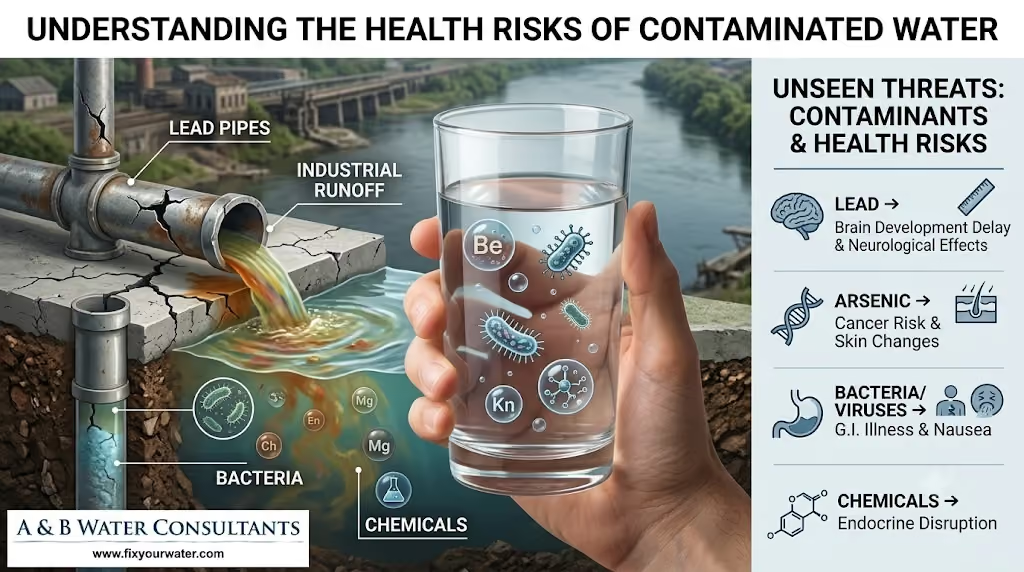
Not all water is created equal, and nowhere is that more apparent than in New Hampshire, southern Maine, and Massachusetts. Homeowners across this region draw water from private bedrock wells that pass through some of the most geologically complex terrain in the country. What comes out of the tap in one neighborhood may carry arsenic levels well above EPA limits, while a home two miles away faces dissolved radon or PFAS contamination from a legacy industrial site. Generic filters purchased at a hardware store are not designed to address these conditions. Personalized water filtration systems, engineered by experienced professionals who understand local geology and water chemistry, are the only reliable path to genuinely safe drinking water for New England families.
Why One-Size-Fits-All Water Filters Fail New England Homeowners
Retail water filters are designed for the broadest possible market. They target taste and odor, perhaps some chlorine reduction, and basic sediment. They are not engineered to remove arsenic from granite bedrock aquifers, strip dissolved radon from a drilled well in Rockingham County, or capture PFAS compounds linked to military base contamination in southern New Hampshire and Massachusetts.
Water chemistry in New England varies dramatically, sometimes from street to street, depending on the depth of a well, the local bedrock formation, and the surrounding land use history. A pitcher filter or a basic under-sink cartridge simply cannot account for these variables. Worse, homeowners who rely on them may believe their water is protected when it is not. That false confidence is the real cost of an off-the-shelf filter in this region.
Why New Hampshire and New England Well Water Requires a Custom Approach
New Hampshire sits atop some of the oldest granite bedrock in North America. That geology is directly responsible for the state's well-documented arsenic problem. As groundwater moves through fractured granite, it dissolves naturally occurring arsenic minerals and carries them into private wells. The New Hampshire Department of Environmental Services (NHDES) consistently identifies arsenic as one of the most widespread contaminants in private well water across the state, particularly in the seacoast and southern tier communities.
Radon, a radioactive gas produced by uranium decay in granite and other igneous rock, dissolves readily into groundwater. In New Hampshire and Maine, radon in well water is a recognized inhalation hazard: when contaminated water is used for showering or cooking, radon volatilizes into indoor air. This is a New England-specific risk that most national filter brands never address in their marketing or product design.
PFAS contamination in the region carries a different origin. Industrial manufacturing, military installations, and firefighting training sites across southern New Hampshire and Massachusetts have left PFAS compounds in groundwater that now affect both private wells and municipal supplies. These "forever chemicals" do not break down naturally, and they require specific filtration technologies to remove effectively.
Each of these contaminants demands a different treatment approach. Designing a system without first identifying which contaminants are actually present in a specific home's water supply is not water treatment. It is guesswork.
What a Personalized Water Filtration System Actually Includes
A truly personalized water filtration system begins with certified laboratory water testing. This is not a home test kit with color-coded strips. It is a comprehensive analysis performed by an accredited laboratory that identifies contaminant concentrations against EPA maximum contaminant levels (MCLs) and applicable state standards. The results of that test drive every subsequent decision: which treatment media to specify, how many treatment stages are needed, what flow rate the system must handle, and where in the plumbing the equipment should be installed. For guidance on performing proper analyses, see our homeowner guide on how to test for arsenic in water.
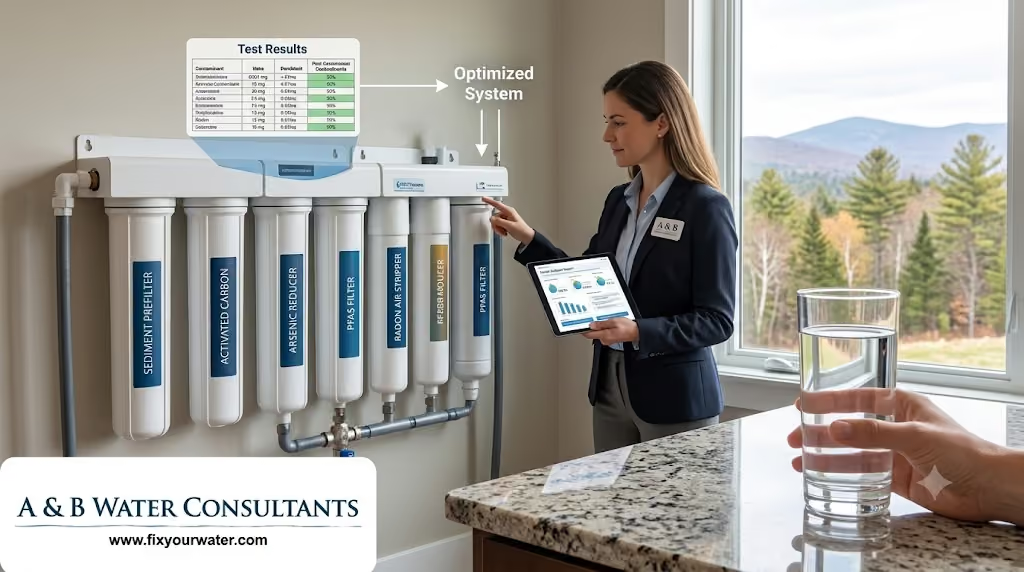
From that foundation, a professional water treatment consultant selects contaminant-specific media. Adsorptive iron-based media is proven for arsenic removal in residential applications. Aeration systems and granular activated carbon (GAC) are the standard approaches for radon in well water. Activated carbon and reverse osmosis are both effective for PFAS removal, with the choice depending on contamination levels and household usage patterns. System sizing accounts for the number of occupants, peak flow demand, and the plumbing configuration of the home.
Contact A&B Water Consultants for a free custom water filtration system quote and get a clear picture of exactly what your home's water requires before committing to any equipment.
Addressing Arsenic, Radon, and PFAS in One Custom Treatment System
One of the most significant gaps in the water treatment industry's public communication is the failure to address overlapping contamination. Many New Hampshire homeowners face not one contaminant but two or three simultaneously. A bedrock well in Merrimack or Londonderry, for example, may carry elevated arsenic, measurable radon, and PFAS compounds from nearby industrial activity all at once.
A professionally engineered multi-stage treatment system can address this reality. A typical treatment train for a complex contamination profile might begin with an aeration system to drive off dissolved radon, followed by adsorptive media for arsenic removal, and conclude with a whole-house activated carbon stage or a point-of-use reverse osmosis unit for PFAS. The order and configuration of these stages matters significantly. Incorrect sequencing can compromise the performance of downstream media or create conditions that allow one contaminant to interfere with another's removal.
This kind of multi-contaminant system design requires genuine engineering expertise. It is not something a retail store can provide, and it is not something a homeowner should attempt to assemble from individual components without professional guidance.
New Hampshire and New England Drinking Water Standards You Should Know
Understanding the regulatory context helps homeowners evaluate their risk and hold their water treatment provider accountable. In New Hampshire, the NHDES enforces a maximum contaminant level for arsenic of 10 micrograms per liter (mcg/L), consistent with the federal EPA standard. However, NHDES also recommends action at lower levels for households with infants or immunocompromised individuals. For radon in drinking water, New Hampshire has historically proposed a state standard of 2,000 picocuries per liter (pCi/L), though private well owners are not currently subject to mandatory testing requirements.
For PFAS, Massachusetts has established some of the most protective standards in the country, with a combined MCL of 20 parts per trillion for six PFAS compounds. New Hampshire has adopted enforceable MCLs for PFAS in public water systems and continues to expand guidance for private well owners. Maine has similarly moved to establish PFAS standards for public supplies and issued guidance for private well testing near known contamination sites.
Knowing these standards allows homeowners to interpret their water test results with context and understand when their water poses a genuine health risk, not just a cosmetic one.
What Happens During Your Free Water Consultation with A&B Water Consultants
Many homeowners hesitate to call a water treatment professional because they are not sure what to expect. The process is straightforward and carries no obligation beyond the conversation itself.
The consultation begins with a discussion of the home's water source, any known concerns, and any symptoms the family has noticed, such as staining, odor, or health-related questions raised by a physician. If a water test has already been performed, those results are reviewed in detail. If not, a certified lab test is arranged as the immediate next step.
Once test results are available, a site visit allows the consultant to assess the plumbing layout, the location of the pressure tank and existing treatment equipment, and the available space for new system components. From this assessment, a custom system design is developed with specific equipment recommendations, sizing calculations, and a clear installation plan. The homeowner receives a written proposal with transparent pricing before any work begins.
Contact A&B Water Consultants for a free custom water filtration system quote and take that first step with complete confidence in what the process involves.
Personalized Filtration Technologies Used in Custom Systems
Whole-House vs. Point-of-Use Configurations
A whole-house (point-of-entry) system treats all water entering the home before it reaches any tap, appliance, or shower. This is the appropriate configuration for radon removal, since radon volatilizes during any water use, not just drinking. It is also preferred when arsenic levels are high enough to pose a risk through skin absorption during bathing, which can occur at elevated concentrations.
Point-of-use systems, such as reverse osmosis units installed under a kitchen sink, are highly effective for PFAS and arsenic removal at the drinking water tap. In many cases, the optimal solution combines both: a whole-house aeration and carbon system for radon, paired with a point-of-use reverse osmosis unit for PFAS and final arsenic polishing.
Treatment Technologies for New England Contaminants
Adsorptive iron-based media, such as granular ferric oxide, is the leading technology for residential arsenic removal from well water. Aeration systems, which introduce air into the water stream to strip dissolved gases, are the most effective approach for radon. Granular activated carbon provides a secondary radon treatment option and is a primary technology for PFAS removal. Reverse osmosis membranes offer broad-spectrum removal across arsenic, PFAS, nitrates, and many other dissolved contaminants, making them a valuable component in multi-contaminant treatment designs.
The True Cost of Generic Filters vs. a Professionally Designed Water Treatment System
The upfront cost of a professionally designed and installed water treatment system is higher than purchasing a pitcher filter or a basic under-sink cartridge. That comparison, however, is misleading when examined over a realistic timeframe.
Retail filter cartridges require frequent replacement, typically every two to six months depending on water quality and usage. For a family dealing with high arsenic levels, a basic filter that is not specifically rated for arsenic removal provides no protection at all, regardless of how often it is changed. The money spent on those cartridges is entirely wasted from a health-protection standpoint.
A professionally installed system, maintained on a proper schedule, is engineered to perform to specification for years. Annual media replacement and periodic water quality verification testing ensure the system continues to meet its design parameters. Over a five to ten year period, the lifecycle cost of a custom system often compares favorably to the cumulative expense of retail filters, and it provides something retail filters cannot: documented, verified removal of the specific contaminants present in that home's water supply.
Contact A&B Water Consultants for a free custom water filtration system quote and get a lifecycle cost comparison based on your actual water test results.
Ongoing Maintenance and Support for Your Filtration System
A water treatment system is not a set-and-forget installation. Media has a finite capacity to adsorb contaminants, and once that capacity is exhausted, the system no longer provides protection. For arsenic adsorption media, replacement schedules are calculated based on the arsenic concentration in the source water and the household's daily water usage. GAC media for radon and PFAS has its own replacement timeline based on similar factors.
Annual water quality verification testing is the only way to confirm that a system is still performing as designed. This is not optional for households dealing with arsenic or PFAS at levels near regulatory limits. A professional service plan ensures that media replacement, system inspections, and annual retesting are handled on schedule, without the homeowner needing to track every component independently.
A&B Water Consultants provides ongoing service support for homeowners throughout New Hampshire, southern Maine, and Massachusetts. Contact A&B Water Consultants for a free custom water filtration system quote and ask about available service plans that keep your system performing year after year.
Frequently Asked Questions About Personalized Water Filtration Systems
What contaminants are most common in New Hampshire well water?
Arsenic, radon, and PFAS are among the most significant contaminants found in New Hampshire private well water. Arsenic originates from the state's granite bedrock geology. Radon is a byproduct of uranium decay in the same rock formations. PFAS contamination is linked to military installations and industrial sites, particularly in the southern part of the state.
How do I know if I need a whole-house water filtration system?
If your water contains radon or if arsenic levels are elevated enough to pose a risk through bathing as well as drinking, a whole-house system is the appropriate solution. A certified water test and professional consultation will identify the right configuration for your specific situation.
Can one water filter remove arsenic, radon, and PFAS at the same time?
A single-cartridge retail filter cannot. However, a professionally engineered multi-stage treatment system can address all three contaminants through a properly sequenced treatment train that combines aeration, adsorptive media, and activated carbon or reverse osmosis components.
How much does a custom water filtration system cost in New Hampshire?
System cost varies based on the contaminants present, the treatment technologies required, and the complexity of the installation. A free consultation and water test provide the information needed to develop an accurate, transparent proposal with no obligation.
What is the difference between a personalized water filter and a store-bought filter?
A personalized water filtration system is engineered specifically for the contaminants identified in a home's water supply, sized for that household's usage, and installed by a certified professional. A store-bought filter uses generic media designed for broad-market appeal, with no assurance that it addresses the specific contaminants present in a given home's water.
How often does a home water filtration system need to be serviced?
Most systems require annual media inspection and replacement on a schedule determined by source water quality and household usage. Annual water quality verification testing is strongly recommended to confirm continued performance. A professional service plan simplifies this process for homeowners.