Water filtration system costs vary more than most homeowners expect, and that variation is rarely random. For families in New Hampshire, southern Maine, and Massachusetts drawing water from private wells, the type of contaminant in the water, the geology of the surrounding bedrock, and the complexity of the treatment solution all drive pricing in ways that generic online estimates simply cannot capture. A one-size-fits-all figure pulled from a national website rarely reflects the reality of treating arsenic-laden granite bedrock water or addressing radon levels that exceed EPA action thresholds.
This guide breaks down the real cost of home water filtration from the perspective of a water treatment professional with over 25 years of experience serving New England families. Whether the concern is arsenic, radon, PFAS, or a combination of contaminants, the goal here is to give homeowners an accurate, transparent picture of what to expect before making one of the most important investments in their home's health and safety.
What Drives Water Filtration System Costs in New England
Several factors determine the cost of home water filtration, and in New England, those factors are more complex than in many other parts of the country. The primary cost drivers include the type and concentration of contaminants present, whether the home uses well water or municipal water, the size of the household, and the specific treatment technology required.
New Hampshire and Maine sit atop some of the oldest granite bedrock formations in North America. That geology is beautiful, but it also creates a well-documented pattern of naturally occurring arsenic and radon in private well water. Arsenic leaches from granite and other mineral-rich rock formations into groundwater over time. Radon, a radioactive gas, dissolves into well water from the same bedrock and can be released into indoor air when water is used for showering, cooking, or laundry. These are not hypothetical risks. The New Hampshire Department of Environmental Services has consistently documented arsenic exceedances in a significant percentage of tested private wells statewide.
PFAS compounds (per- and polyfluoroalkyl substances, sometimes called "forever chemicals") add another layer of complexity. Contamination from military bases, industrial sites, and firefighting foam has affected water supplies across New Hampshire, Massachusetts, and parts of Maine. Treating PFAS requires specific filtration technologies and adds to overall system costs.
The source of water also matters. Well water homes require whole-house, point-of-entry treatment systems because there is no municipal treatment plant handling pre-treatment. That means the homeowner bears the full cost of filtration, which is why understanding the cost of home water filtration upfront is so important.
Water Filtration Cost Comparison: Arsenic, Radon, and PFAS Treatment Systems
The table below provides realistic installed cost ranges for the three primary contaminant types that A&B Water Consultants addresses in New England. These figures reflect professional installation, equipment, media, and initial setup, but not ongoing annual maintenance costs.
These ranges reflect the reality that no two wells are identical. Contaminant concentrations, flow rate requirements, existing plumbing conditions, and site-specific factors all influence final pricing. Contact A&B Water Consultants for a free water filtration system quote tailored to the specific conditions of a home's well water.
Where the Money Actually Goes: Breaking Down Installation Costs
When homeowners see an installed cost figure, it is worth understanding what that number actually covers. Professional water filtration installation in New England is not simply a matter of dropping a tank in a utility room. The cost typically includes the following components:
- Equipment and media: The filtration tank, treatment media (such as adsorptive iron-based media for arsenic or activated carbon for radon and PFAS), control valves, and bypass valves.
- Professional installation labor: Plumbing connections, integration with the existing well system, pressure testing, and system commissioning. Labor rates in New Hampshire and New England generally range from $75 to $150 per hour depending on the scope of work.
- Water testing and site assessment: A professional water quality test is required before any system is specified. Comprehensive testing for arsenic, radon, PFAS, pH, hardness, and other parameters typically costs $150 to $500 depending on the panel selected.
- Permits: Some municipalities and towns in New Hampshire and Maine require permits for water treatment equipment installation. Permit fees vary by jurisdiction but are generally modest.
- System design and engineering: For complex or multi-contaminant scenarios, a professional assessment and custom system design is part of the service and prevents costly errors.
Why New Hampshire and Maine Homeowners Pay More for Water Filtration (And Why It's Worth It)
Homeowners in New Hampshire and Maine often find that water filtration system costs run higher than national averages, and there are legitimate reasons for that. The regional geology creates a baseline level of treatment complexity that does not exist in areas with softer, less mineral-rich groundwater.
Arsenic is not uniformly distributed. Concentrations can vary dramatically between neighboring wells, meaning a system sized for one property may be entirely inappropriate for another just down the road. Radon levels in New Hampshire well water are among the highest documented in the country. The state has some of the most active radon geology in the Northeast, and radon in water is a separate concern from radon in air, requiring its own treatment approach.
Paying more for a professionally designed, properly sized system in this environment is not a premium for premium's sake. It is the difference between a system that reliably reduces contaminants to safe levels and one that underperforms because it was not matched to the actual conditions of the water supply. Affordable water filters purchased off the shelf at a big-box retailer are simply not engineered for the arsenic and radon concentrations commonly found in New Hampshire bedrock wells.
EPA Limits, State Regulations, and What They Mean for Your Filtration Budget
Understanding the regulatory landscape helps homeowners make informed decisions about system selection and budget. The EPA has established maximum contaminant levels (MCLs) for both arsenic and several PFAS compounds. As of 2026, the EPA's enforceable MCL for arsenic in drinking water is 10 parts per billion (ppb). For PFAS, the EPA finalized MCLs in 2024 for PFOA and PFOS at 4 parts per trillion (ppt), among the lowest drinking water standards ever established.
Radon in drinking water is regulated differently. The EPA proposed an MCL of 300 picocuries per liter (pCi/L) for public water systems, but private wells are not subject to federal MCLs. However, New Hampshire and Maine state guidelines provide benchmarks, and many water treatment professionals use the 300 to 4,000 pCi/L range as a practical action threshold depending on indoor air radon levels in the home.
For homeowners selling property in New Hampshire, well water quality disclosures are a real consideration. A well test revealing arsenic or PFAS above EPA limits can complicate a sale, require remediation, or reduce negotiated value. Investing in a properly documented, professionally installed treatment system protects both the family's health and the home's marketability. Contact A&B Water Consultants for a free water filtration system quote and learn what treatment options apply to a specific property's water test results.
Water Testing: The Essential First Step Before Buying Any System
No responsible water treatment professional will recommend a system without first understanding what is actually in the water. Purchasing a filtration system without a comprehensive water test is one of the most common and costly mistakes homeowners make. A system designed for one contaminant may do nothing for another, and in some cases, the wrong system can actually make water quality worse.
A professional water quality assessment for a New Hampshire or Maine well home should include, at minimum, testing for arsenic, radon, pH, hardness, iron, manganese, coliform bacteria, and ideally PFAS if the home is near a known contamination area. The New Hampshire Department of Environmental Services offers a list of certified laboratories, and the state recommends testing private wells at least every five years, or whenever there is a change in water quality, a new well installation, or a nearby land use change.
Professional testing through a certified lab typically costs between $150 and $500 for a comprehensive panel. Some water treatment companies, including A&B Water Consultants, incorporate testing into their assessment process and use the results to design a system that addresses the specific contaminants present at the concentrations found in that specific well.
Long-Term Costs: Maintenance, Media Replacement, and ROI
The upfront installed cost is only part of the total cost of home water filtration. Ongoing maintenance is a necessary and predictable expense that homeowners should factor into their budget from the beginning.
Arsenic adsorption media has a finite capacity and must be replaced periodically, typically every two to five years depending on arsenic concentration and household water usage. GAC media used for radon or PFAS removal also requires scheduled replacement. Aeration systems for radon treatment have fewer consumable media costs but require periodic inspection and maintenance of mechanical components.
Annual maintenance costs for professionally serviced systems in New England generally range from $200 to $1,000 per year depending on system type and contaminant levels. When compared to the cost of bottled water for a family of four, which can easily exceed $1,500 to $2,500 per year, a professionally installed whole-house filtration system often achieves a return on investment within three to five years, while providing far superior and more consistent protection against regulated contaminants.
The Real Cost of Untreated Arsenic and Radon in Your Home's Water Supply
The financial cost of a filtration system becomes easier to justify when weighed against the cost of doing nothing. Chronic exposure to arsenic in drinking water is linked to increased risk of bladder, lung, and skin cancers, as well as cardiovascular disease and developmental effects in children. The EPA classifies arsenic as a known human carcinogen. Long-term exposure at levels even slightly above the 10 ppb MCL carries measurable health risk.
Radon dissolved in water is released into indoor air during showering, dishwashing, and other water use. The EPA estimates that radon in water contributes to thousands of lung cancer deaths annually in the United States. In New Hampshire, where both soil radon and water radon levels tend to be elevated, the combined exposure risk is a genuine public health concern.
Beyond health costs, there are financial and legal implications. Homeowners in New Hampshire and Massachusetts who are aware of contaminant levels above regulatory limits and fail to disclose them during a property sale face potential legal exposure. A documented, professionally installed treatment system with service records is not just a health investment. It is a liability management tool. Contact A&B Water Consultants for a free water filtration system quote and take the first step toward protecting both family health and property value.
How a Custom-Designed Water Treatment System Saves You Money Long-Term
One of the most important distinctions in the water treatment industry is the difference between a custom-designed system and an off-the-shelf solution. Generic filtration systems sold at hardware stores or through online retailers are manufactured to address common, moderate water quality issues. They are not engineered for the arsenic concentrations found in New Hampshire granite bedrock wells, and they are not sized for the flow rates and household demands of a typical New England home.
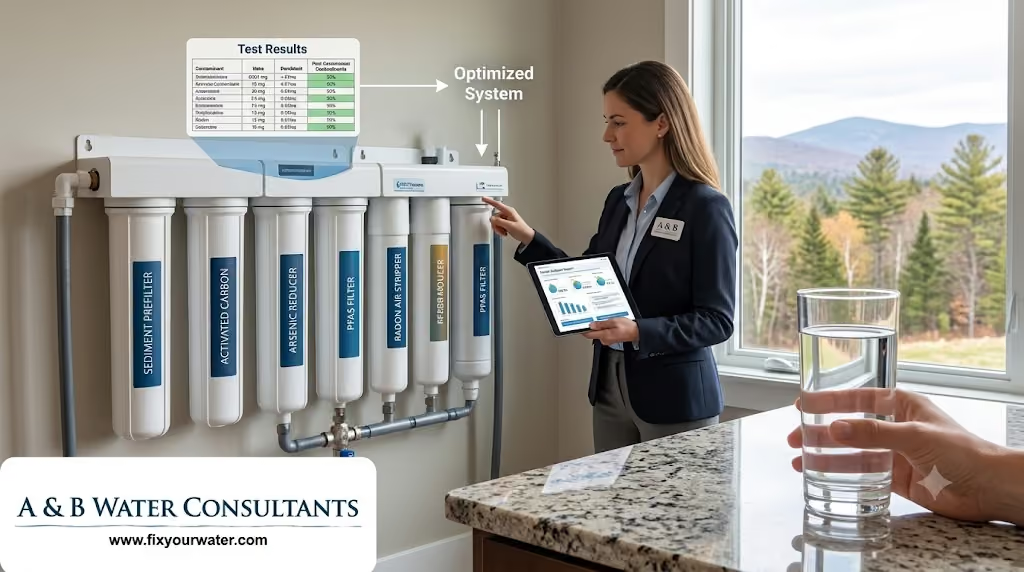
A custom-designed system begins with a thorough site assessment. That process includes reviewing the well log (if available), testing current water quality across a comprehensive panel of contaminants, evaluating the home's plumbing configuration, assessing available space for equipment installation, and calculating the household's peak water demand. From that data, a treatment train is specified that matches the actual problem, not a generic approximation of it.
Over-treating water wastes money on unnecessary media and equipment. Under-treating leaves contaminants at unsafe levels and may require costly retrofits later. A properly designed system, installed correctly the first time by an experienced professional, eliminates both of those failure modes. With over 25 years of experience designing custom solutions for New England well water homes, A&B Water Consultants has the regional expertise to get the system design right from the start, which is where the real long-term savings come from.
Cost vs. Benefit of Whole-House Filtration for New England Homeowners
Whole-house filtration, also called point-of-entry treatment, addresses water quality at the point where the water supply enters the home. Every tap, appliance, and fixture in the house receives treated water. This is the appropriate approach for contaminants like arsenic and radon, which need to be addressed before water is used anywhere in the home.
Point-of-use systems, such as under-sink reverse osmosis units or countertop filters, treat water at a single outlet. For PFAS, an under-sink RO system can be a cost-effective solution for drinking and cooking water specifically, particularly in homes where whole-house PFAS treatment is cost-prohibitive. However, for arsenic and radon, point-of-use systems alone are generally insufficient because exposure occurs through bathing and other non-drinking uses as well.
The disadvantages of whole-house systems include higher upfront costs, space requirements for equipment, and the need for periodic professional maintenance. However, for families in New Hampshire, Maine, and Massachusetts dealing with arsenic or radon in their well water, the comprehensive protection of a whole-house system is not optional. It is the standard of care.
Signs Your Home Needs a Professional Water Filtration Assessment
Some water quality problems announce themselves clearly. Others, like arsenic and radon contamination, are completely invisible without testing. Arsenic has no taste, odor, or color at the concentrations typically found in well water. Radon dissolved in water is similarly undetectable without measurement. This is precisely why professional water testing is the only reliable way to know whether a home's water supply requires treatment.
That said, certain observable signs do warrant immediate attention and professional evaluation:
- Orange, red, or brown staining on fixtures, laundry, or sinks (often indicates iron or manganese)
- Rotten egg or sulfur odor from hot or cold water taps
- Metallic, bitter, or chemical taste in tap water
- Cloudy or discolored water, especially after rain events
- Living in a New Hampshire or Maine community with documented arsenic or radon geology
- Proximity to a military base, industrial site, or area with known PFAS contamination
- A newly drilled well or a recent change in water source
- A neighbor who has tested positive for arsenic or PFAS above EPA limits
Any of these indicators justifies scheduling a professional water quality assessment before investing in any treatment equipment. Contact A&B Water Consultants for a free water filtration system quote and a professional evaluation of the home's water quality needs.
Frequently Asked Questions About Water Filtration System Costs
How much does it cost to install a whole-house water filtration system?
For New England well water homes, professionally installed whole-house systems typically range from $1,500 to $9,000 or more depending on the contaminants present and the treatment technology required. Multi-contaminant systems addressing arsenic, radon, and PFAS simultaneously will fall toward the higher end of that range.
Is a whole-house water filtration system worth it for well water?
For homes with confirmed arsenic, radon, or PFAS contamination above EPA action levels, a whole-house system is not just worth it. It is the appropriate standard of care for protecting family health. The long-term cost is generally lower than bottled water for a family of four, and the health protection is far superior.
What is the most cost-effective water filtration system for arsenic or radon?
For arsenic, Arsenic removal systems (adsorptive media systems using iron-based media or specialty resins) are generally the most cost-effective whole-house solution for moderate arsenic levels. For radon, GAC systems have lower upfront costs, while aeration systems are more effective for very high radon concentrations and have lower ongoing media costs. The most cost-effective solution depends entirely on the specific contaminant levels found in a professional water test.
What are the disadvantages of a whole-house water filter?
Higher upfront installation costs, space requirements for equipment, and the need for scheduled professional maintenance are the primary disadvantages. However, for contaminants like arsenic and radon that require whole-home treatment, these are necessary trade-offs rather than optional considerations.
What is the difference between a whole-house filter and a point-of-use system?
A whole-house (point-of-entry) filter treats all water entering the home before it reaches any fixture. A point-of-use system, such as an under-sink RO unit, treats water only at one specific outlet. For arsenic and radon, whole-house treatment is required. For PFAS, point-of-use RO can be a supplementary or standalone solution for drinking water specifically.
How much does arsenic or radon water treatment cost?
Arsenic removal systems typically cost $1,500 to $3,500 installed for a single-family home. Radon treatment via aeration runs $3,000 to $6,000 installed, while GAC-based radon systems run $1,500 to $3,000. These figures vary based on contaminant concentration, household size, and site-specific installation factors.
Key Takeaways for New England Homeowners
- Water filtration system costs in New Hampshire, Maine, and Massachusetts are driven by contaminant type, concentration, and the complexity of treatment required for regional geology.
- Arsenic, radon, and PFAS each require specific treatment technologies. Generic off-the-shelf filters are not adequate for these contaminants at the levels found in New England bedrock wells.
- Professional water testing is the essential first step before any system purchase. Spending money on the wrong system is the most expensive mistake a homeowner can make.
- Custom-designed systems sized to actual water quality conditions outperform generic systems and prevent costly over- or under-treatment.
- The long-term cost of professionally installed filtration is consistently lower than bottled water and far lower than the health and financial risks of untreated contamination.
- EPA MCLs for arsenic and PFAS create both a health imperative and a disclosure obligation for homeowners in regulated contaminant areas.
Families in New Hampshire, southern Maine, and Massachusetts with private wells deserve water treatment solutions that are matched to their actual water quality conditions, not generic systems designed for a national average that does not reflect New England's unique geology. With over 25 years of regional experience, A&B Water Consultants provides the professional assessment, custom system design, and expert installation that this environment demands. Contact A&B Water Consultants for a free water filtration system quote and take the first step toward safe, reliable water for the entire household.