Most homeowners assume that if their water looks clear and tastes fine, it meets federal safety standards. For those connected to a municipal water system, that assumption has at least some regulatory backing. For the hundreds of thousands of private well owners across New Hampshire, Maine, and Massachusetts, it does not. Water quality standards, as important as they are, contain a significant gap that leaves private well owners entirely responsible for their own water safety. Understanding how these standards work, what they cover, and where they fall short is essential for any New England family drawing water from a private well.
What Are Water Quality Standards?
Water quality standards are legally enforceable benchmarks established by federal and state agencies to define the maximum acceptable levels of contaminants in drinking water and surface water. They serve as the foundation of water safety law in the United States and are designed to protect public health, aquatic ecosystems, and drinking water supplies.
It is important to understand the distinction between two related but different terms: criteria and standards. A water quality criterion is a scientifically derived threshold that identifies the concentration of a contaminant at which health or environmental harm may occur. A water quality standard is the legally enforceable rule that incorporates that criterion and applies it within a specific regulatory context. In other words, criteria inform standards, but standards are what agencies actually enforce.
Standards are typically expressed as Maximum Contaminant Levels (MCLs), which represent the highest concentration of a specific contaminant that is legally permissible in regulated drinking water. These limits are set by the U.S. Environmental Protection Agency (EPA) at the federal level and can be made more stringent by individual states.
Federal Water Quality Standards Under the Clean Water Act and Safe Drinking Water Act
Two primary federal laws govern water quality in the United States. The Clean Water Act (CWA) focuses on protecting surface waters such as rivers, lakes, and streams from pollution. It requires states to establish water quality standards for their surface waters and submit those standards to the EPA for approval. The EPA can reject state standards that fail to meet federal minimums and require revisions.
The Safe Drinking Water Act (SDWA) governs the quality of water delivered through public water systems. Under the SDWA, the EPA sets national primary drinking water regulations, which are enforceable MCLs for contaminants that pose health risks. States can adopt standards that are equal to or stricter than federal limits, and many New England states have done exactly that for contaminants like arsenic and PFAS.
States are also required to review and update their water quality standards every three years under a process known as the triennial review. This cycle allows states to incorporate new scientific findings, respond to emerging contaminants, and align with updated EPA guidance. Recent triennial reviews in New Hampshire and Massachusetts have resulted in significant updates to PFAS-related standards, reflecting growing awareness of these contaminants in regional groundwater.
Why Water Quality Standards Don't Automatically Protect Your Private Well
Here is the critical point that most regulatory guides fail to explain clearly: the Safe Drinking Water Act does not apply to private wells serving fewer than 25 people or 15 service connections. If a household draws its water from a private well, that well is entirely exempt from federal drinking water regulations. No federal agency monitors it. No state agency tests it. No MCL is automatically enforced for the water coming out of the tap.
This exemption places the full burden of testing, interpretation, and treatment on the homeowner. A private well owner in New Hampshire or Maine could be drinking water with arsenic concentrations ten times the federal MCL, and no government agency would be required to notify them or intervene. The water quality standards that protect municipal customers simply do not extend to private well water.
This is not a minor administrative detail. In New England, where private wells are extremely common, particularly in rural and suburban communities across New Hampshire, southern Maine, and central Massachusetts, the private well exemption affects a substantial portion of the population. Contact A&B Water Consultants for a free whole house water filtration quote and find out whether your well water meets current state standards.
New England's Unique Water Quality Challenges: Arsenic, Radon, and PFAS in Private Wells
New England's geology creates a specific and well-documented set of water quality risks that homeowners in other parts of the country may not face to the same degree. Understanding these regional contaminants is essential for anyone relying on a private well in New Hampshire, Maine, or Massachusetts.
Arsenic
The EPA's MCL for arsenic in drinking water is 10 micrograms per liter (10 ppb). New Hampshire has adopted this federal limit, but the state has long recognized that its granite bedrock geology makes arsenic contamination a widespread and serious problem. Arsenic contamination occurs naturally in the rock formations that underlie much of New Hampshire and southern Maine, and it leaches into groundwater over time. Studies have consistently found that a significant percentage of private wells in these states exceed the 10 ppb limit. Long-term arsenic exposure is associated with increased risk of bladder, lung, and skin cancers, as well as cardiovascular and neurological effects.
Radon
Radon is a naturally occurring radioactive gas produced by the decay of uranium in rock and soil. In New England, where granite bedrock is prevalent, radon dissolves into groundwater and can be released into the air when water is used for showering, cooking, or laundry. Unlike arsenic, there is currently no federally enforced MCL for radon in drinking water. The EPA has proposed guidance levels, but federal regulation has not been finalized. New Hampshire and Maine have issued state-level guidance, but enforcement for private wells remains the homeowner's responsibility. Radon in water is a genuine health concern that requires professional testing and, in many cases, aeration treatment to reduce levels to acceptable ranges.
PFAS
Per- and polyfluoroalkyl substances (PFAS) are a group of synthetic chemicals that have been used in industrial and consumer products for decades. They are extremely persistent in the environment and have been detected in groundwater across New England, particularly in areas near military installations, airports, and industrial sites. In 2024, the EPA finalized enforceable MCLs for several PFAS compounds, setting limits as low as 4 parts per trillion for PFOA and PFOS. New Hampshire, Maine, and Massachusetts have all taken active steps to address PFAS in drinking water, with state-level standards that in some cases exceed federal requirements. For private well owners near known contamination sources, PFAS testing is not optional; it is a basic safety measure.
Key Water Quality Parameters Every Homeowner Should Know
Beyond the three contaminants most common in New England wells, there are seven fundamental water quality parameters that define whether water is safe to drink:
- pH: Measures how acidic or alkaline water is. Safe drinking water typically falls between 6.5 and 8.5. Water with a low pH can corrode pipes and leach metals like lead and copper.
- Turbidity: A measure of water clarity. High turbidity can indicate the presence of sediment, bacteria, or other contaminants and is regulated in public systems to protect disinfection effectiveness.
- Hardness: Reflects the concentration of calcium and magnesium. Hard water is not a health risk but can damage plumbing, appliances, and water heaters over time.
- Nitrates: Primarily a concern in agricultural areas, nitrates can reach dangerous levels in private wells near farms or septic systems. The federal MCL is 10 mg/L. High nitrate levels are particularly dangerous for infants.
- Bacteria: Coliform bacteria and E. coli are indicators of fecal contamination. No level of E. coli is acceptable in drinking water.
- Heavy metals: Arsenic, lead, manganese, and iron are among the heavy metals most commonly found in New England well water. Each has specific health implications and regulatory limits.
- Total dissolved solids (TDS): A measure of all dissolved minerals in water. High TDS can affect taste and indicate the presence of other contaminants.
Water Quality Standards in New Hampshire, Maine, and Massachusetts
Each New England state administers its own drinking water program under EPA oversight. New Hampshire's Department of Environmental Services (NH DES), Maine's Department of Environmental Protection (Maine DEP), and the Massachusetts Department of Environmental Protection (MassDEP) each set and enforce state MCLs for regulated public water systems.
New Hampshire has historically been proactive about arsenic regulation, recognizing the state's elevated geological risk. The state has also adopted some of the most aggressive PFAS standards in the country, establishing MCLs for multiple PFAS compounds. Maine and Massachusetts have similarly updated their regulatory frameworks in recent years to address PFAS contamination. For private well owners, these state standards serve as the most relevant benchmarks, even though they are not automatically enforced for private wells.
Groundwater vs. Surface Water Standards: Why Private Well Owners Face Greater Risk
Surface water standards under the Clean Water Act apply to rivers, lakes, and reservoirs. Groundwater standards, which govern aquifers and bedrock wells, operate under a different and often less comprehensive regulatory framework. In New England, most private wells draw from fractured bedrock aquifers, where naturally occurring contaminants like arsenic and radon are concentrated by geological processes rather than human activity.
Because groundwater used by private wells is not subject to the same monitoring requirements as surface water or public water systems, homeowners have no automatic early-warning system when contamination levels rise. Geology shifts slowly, but contamination from nearby PFAS sources, agricultural runoff, or aging septic systems can change water quality more rapidly. This makes periodic professional testing the only reliable way to know what is actually in the water.
How to Read Your Water Test Results Against New Hampshire and New England Standards
Receiving a water test report from a certified laboratory can be confusing without context. Results are typically presented in parts per billion (ppb) or parts per trillion (ppt), and each contaminant is listed alongside a detection level. Here is how to interpret those numbers against current standards:
- If arsenic is detected above 10 ppb, the water exceeds the federal and NH MCL and requires treatment before the water is safe to drink.
- If PFOA or PFOS levels exceed 4 ppt (the current federal MCL), the water fails federal standards. Some New England states have set even lower action levels.
- For radon, the EPA's proposed guidance level is 300 pCi/L (picocuries per liter) for water. NH DES guidance recommends action above this threshold, particularly because radon released from water contributes to indoor air radon levels.
- Nitrates above 10 mg/L require immediate attention, especially in households with infants or pregnant women.
- Any detection of E. coli requires immediate remediation, regardless of concentration.
A professional water quality assessment goes beyond simply running a test. It includes reviewing results in the context of local geology, nearby contamination sources, and the specific characteristics of the home's plumbing and well construction. Contact A&B Water Consultants for a free whole house water filtration quote and get a comprehensive assessment of your well water against current New Hampshire and New England standards.
When Your Water Fails Standards: Treatment Solutions for New England Homeowners
When test results show that water exceeds acceptable contaminant levels, professional treatment is the appropriate response. The right solution depends on the specific contaminants present, their concentrations, and the household's water usage patterns. For New England private well owners, the most common treatment needs involve arsenic, radon, and PFAS.
Arsenic Filtration
Point-of-entry arsenic filtration systems treat all water entering the home, ensuring that every tap delivers water that meets or exceeds the 10 ppb MCL. The most effective technologies for arsenic removal include adsorptive media filters, which bind arsenic to a specialized filtration material, and reverse osmosis systems for point-of-use applications. A custom-designed whole-home system is typically the most practical solution for households with elevated arsenic levels.
Radon Treatment
Aeration is the most effective method for removing radon from well water. Aeration systems expose water to air, allowing the dissolved radon gas to escape before the water reaches household taps. These systems are installed at the point of entry and require professional sizing and installation to achieve adequate radon reduction.
PFAS Removal
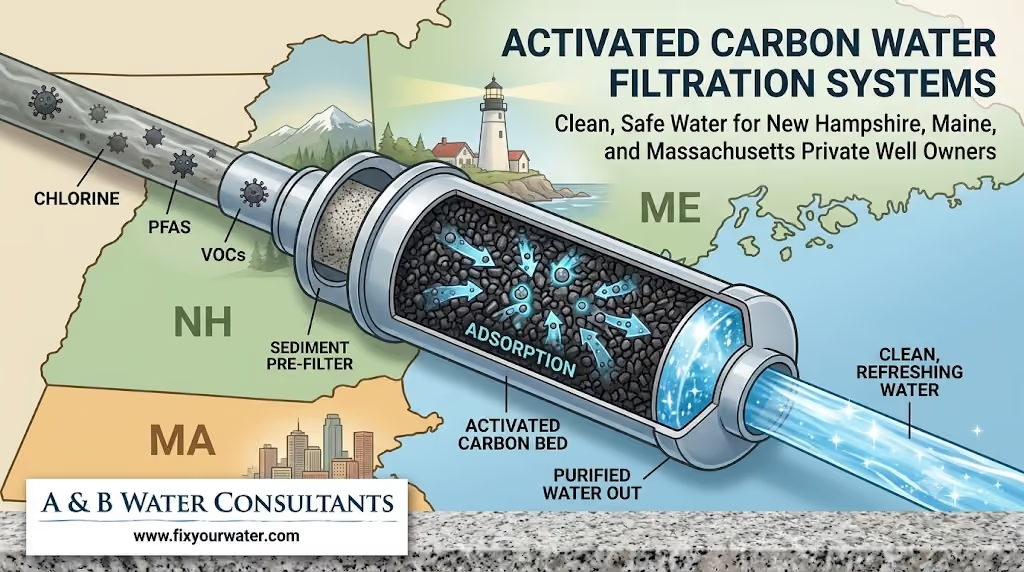
Granular activated carbon (GAC) filtration and reverse osmosis are the two most widely used technologies for PFAS removal. GAC systems are effective for many PFAS compounds and are practical for whole-home treatment. Reverse osmosis provides the highest level of removal and is often used for drinking and cooking water at the point of use. For households with confirmed PFAS contamination, a combination approach may be appropriate depending on the specific compounds detected and their concentrations.
Contact A&B Water Consultants for a free whole house water filtration quote and learn which treatment approach is right for your home's specific water quality profile.
How Often Should You Test Your Well Water Against Current Standards?
There is no universal answer, but there are clear guidelines that apply to most New England private well owners. As a baseline, annual testing for bacteria and nitrates is recommended for all private wells. Testing for arsenic, radon, PFAS, pH, and hardness should be conducted at least every three to five years, or more frequently if local conditions warrant it.
Certain events should trigger immediate retesting regardless of the regular schedule: a change in the water's taste, odor, or appearance; flooding or significant rainfall that could affect the well; nearby construction, land use changes, or known contamination events; a new pregnancy in the household; and any change to the well structure or pump system. If a treatment system is installed, follow-up testing after installation and annually thereafter confirms that the system is performing as expected.
Contact A&B Water Consultants for a free whole house water filtration quote and establish a testing and monitoring schedule appropriate for your well and your region.
Frequently Asked Questions About Water Quality Standards
What are the standards for water quality?
Water quality standards are legally enforceable limits set by the EPA and individual states that define the maximum acceptable concentrations of contaminants in public drinking water and surface water. They are expressed as Maximum Contaminant Levels (MCLs) and are based on health-protective scientific criteria.
What are the 7 water quality parameters?
The seven key water quality parameters for drinking water are pH, turbidity, hardness, nitrates, bacteria (including coliform and E. coli), heavy metals (such as arsenic and lead), and total dissolved solids (TDS). Each parameter has established acceptable ranges or enforceable limits under federal and state regulations.
What are the standards for potable water quality?
Potable water must meet the EPA's National Primary Drinking Water Regulations, which include MCLs for over 90 contaminants. Key limits include 10 ppb for arsenic, 4 ppt for PFOA and PFOS, and zero tolerance for E. coli. States may set stricter limits, and several New England states have done so for arsenic and PFAS.
Which contaminants are most common in New England private wells?
Arsenic, radon, and PFAS are the three contaminants of greatest concern for private well owners in New Hampshire, Maine, and Massachusetts. Naturally occurring arsenic and radon are driven by the region's granite geology, while PFAS contamination is linked to industrial and military sources across the region.
Do water quality standards apply to private wells?
No. The Safe Drinking Water Act exempts private wells serving fewer than 25 people from federal regulation. Private well owners are entirely responsible for their own testing and treatment. State standards serve as useful benchmarks, but they are not automatically enforced for private wells.
What is the safe level of arsenic in drinking water?
The federal MCL for arsenic is 10 micrograms per liter (10 ppb). Some health organizations recommend lower exposure levels, and the EPA recognizes that no level of arsenic in drinking water is entirely without risk. For private well owners in New England, any detection of arsenic above 10 ppb warrants professional treatment.
Working With a Local Expert Makes the Difference
Water quality regulations are complex, and the gap between what federal law requires and what private well owners actually need is significant. For New England homeowners, the combination of regional geology, legacy industrial contamination, and the private well exemption from federal standards creates a situation where professional guidance is not a luxury; it is a practical necessity.
A&B Water Consultants has spent more than 25 years helping families across New Hampshire, southern Maine, and Massachusetts understand their water quality and implement solutions that work. From comprehensive water testing and results interpretation to custom-designed arsenic filtration, radon aeration, and PFAS removal systems, the team brings deep regional expertise to every assessment.
Contact A&B Water Consultants for a free whole house water filtration quote and take the first step toward knowing exactly what is in your water and what it takes to make it safe.