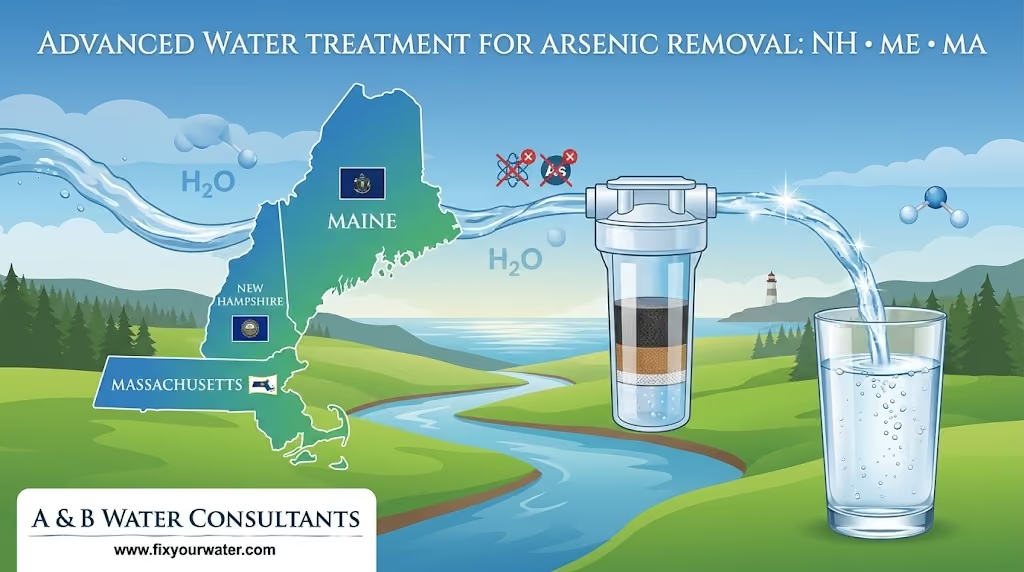
Arsenic in drinking water is not a distant concern reserved for industrial zones or developing nations. For homeowners across New Hampshire, southern Maine, and Massachusetts, it is a very real and measurable risk hiding in private wells every day. Unlike chemical spills or agricultural runoff, the arsenic affecting New England wells is largely geological in origin, meaning it has been present long before the first water line was ever installed. The challenge is not dramatic or visible. Arsenic has no taste, no odor, and no color. The only way to know it is there is to test for arsenic in water, and the only reliable way to protect a household is to install a properly designed treatment system.
This guide is written for homeowners who want to understand the full picture: where arsenic comes from, what it does to the body over time, how professional treatment works, and what it costs to protect a family with a well-sourced water supply. Every section is grounded in the kind of knowledge that comes from more than 25 years of working with New England water chemistry and the families who depend on it.
Why New Hampshire and New England Well Owners Face Higher Arsenic Risk
New England is one of the highest-risk regions in the United States for naturally occurring arsenic in private well water, and the reason comes down to geology. The bedrock beneath New Hampshire, Maine, and Massachusetts is dominated by granite and other igneous and metamorphic formations that were shaped by ancient volcanic activity and glacial movement. These rock formations contain elevated concentrations of naturally occurring arsenic, which slowly dissolves into groundwater as water moves through fractures and pores in the bedrock over time.
Studies conducted by the U.S. Geological Survey and state agencies have consistently found that private wells drawing from granite aquifers in New Hampshire exceed the EPA's maximum contaminant level (MCL) for arsenic at rates significantly higher than the national average. In some southern New Hampshire counties, surveys have found that more than 20 percent of private wells tested above 10 parts per billion (ppb). In parts of Maine and Massachusetts, the picture is similarly concerning, particularly in areas where bedrock wells are the primary water source.
Municipal water systems are regulated and treated, so this risk is concentrated almost entirely among homeowners on private wells. If a home draws water from a drilled bedrock well, the likelihood of arsenic being present at some measurable level is not negligible. It is a regional reality that deserves serious attention and a professional response.
Health Risks of Arsenic Exposure from Drinking Water
Arsenic is classified as a Group 1 human carcinogen by the International Agency for Research on Cancer. Long-term chronic exposure through drinking water is linked to bladder cancer, lung cancer, and skin cancer, as well as cardiovascular disease, peripheral neuropathy, and adverse developmental outcomes in children. These are not theoretical risks. The epidemiological evidence connecting arsenic in drinking water to cancer incidence is robust and has informed regulatory standards globally.
The insidious nature of arsenic exposure is that it accumulates quietly. A family drinking water at 15 or 20 ppb may notice nothing unusual for years while the biological damage compounds. Symptoms of chronic low-level exposure can include fatigue, skin discoloration, and numbness in the extremities, but these are easy to attribute to other causes. By the time a diagnosis connects health problems to water quality, the exposure has often been ongoing for a decade or more.
It is also worth noting that there is no established "safe" level of arsenic in drinking water. The EPA's MCL of 10 ppb represents a regulatory compromise that balances health risk with feasibility of treatment at scale. Some health researchers and organizations advocate for action at levels as low as 5 ppb, particularly for households with young children or pregnant women. For families who want to be genuinely protective of their health, the goal should not be to just barely meet the standard but to reduce exposure as much as practically possible.
How to Tell If Your Water Has Arsenic in It
There is no way to detect arsenic through taste, smell, or sight. The only reliable method is laboratory testing. Homeowners in New Hampshire should work with a lab certified by the NH Department of Environmental Services (NH DES). In Maine and Massachusetts, similar state certification programs exist to ensure accurate, defensible results.
A basic arsenic test will confirm whether arsenic is present and at what concentration, but a basic test alone is rarely sufficient for treatment planning. A comprehensive water quality panel should include arsenic, radon, pH, iron, manganese, hardness, total dissolved solids, and ideally PFAS screening. Each of these parameters affects both the health risk profile of the water and the design of the appropriate treatment system. Iron levels, in particular, are critical to know before selecting an arsenic treatment technology, as high iron can interfere with certain filtration media.
At-home arsenic test kits are available commercially, but they are not appropriate substitutes for certified laboratory analysis. Consumer kits typically have detection limits and accuracy margins that make them unreliable for regulatory or treatment-planning purposes. For a result that can be used to design and verify a treatment system, a certified lab test is the only appropriate choice.
Contact A&B Water Consultants for a free arsenic water treatment quote and to get guidance on which water quality parameters to include in your initial test panel.
Arsenic III vs. Arsenic V: Why Speciation Determines Your Treatment System
One of the most overlooked aspects of arsenic water treatment is speciation: the chemical form in which arsenic exists in a given water source. Arsenic occurs in two primary forms in groundwater. Arsenic V, also called pentavalent arsenic or arsenate, carries a negative charge at normal groundwater pH levels and is relatively straightforward to remove using most adsorption media and reverse osmosis membranes. Arsenic III, also called trivalent arsenic or arsenite, is uncharged at typical groundwater pH, which makes it significantly more difficult to adsorb or filter using standard methods.
This distinction is not academic. A homeowner who installs a granular ferric oxide (GFO) adsorption system without first confirming arsenic speciation may find that the system underperforms if a significant portion of the arsenic in their water is in the trivalent form. In those cases, an oxidation pre-treatment step is necessary to convert As III to As V before the water contacts the adsorption media. This is typically accomplished using an oxidizing filter, chlorine injection, or aeration, depending on the overall water chemistry.
Determining arsenic speciation requires specialized laboratory analysis beyond a standard arsenic total test. A professional water treatment consultant will interpret these results and factor speciation into system design. This is one of the clearest examples of why professional consultation produces better outcomes than purchasing a filter off a shelf based on a single total arsenic result.
Proven Water Treatment Technologies for Arsenic Removal
Adsorption Media Systems
Adsorption-based treatment is the most widely used whole-house approach for arsenic removal in residential settings. The most effective media types include granular ferric oxide (GFO), titanium dioxide-based media, and hybrid iron-impregnated resin. These materials work by attracting and binding arsenic ions as water passes through a media bed, removing them from the water stream before it reaches household fixtures.
GFO media has a strong track record for removing Arsenic V and, with proper pre-treatment, Arsenic III as well. Titanium dioxide media offers high capacity and is effective across a wider pH range, making it well-suited for some New England well water chemistries. Hybrid media products combine multiple adsorptive materials to broaden the treatment window and reduce the sensitivity to water chemistry variations.
All adsorption media has a finite capacity. As the media becomes saturated with arsenic over time, its effectiveness declines. Media replacement is a scheduled maintenance requirement, not an optional service. The frequency depends on the arsenic concentration in the source water, the flow rate, and the media type, but annual inspection and periodic replacement are standard practice.
Reverse Osmosis Point-of-Use Systems
Reverse osmosis (RO) systems use a semi-permeable membrane to reject dissolved contaminants, including arsenic, from the water supply. Under-sink RO units are installed at a single tap, typically in the kitchen, and provide treated water for drinking and cooking. High-quality RO membranes can achieve arsenic rejection rates of 90 to 98 percent, making them highly effective for point-of-use protection.
RO systems have some limitations that are important to understand. They produce a wastewater stream, meaning a portion of the source water is discharged rather than filtered. In homes with high iron content, pre-filtration is necessary to protect the membrane from fouling. RO systems also require periodic membrane replacement and filter cartridge changes to maintain performance. They do not treat water for showering, bathing, or laundry, which is relevant in the context of the broader household arsenic exposure question discussed below.
Whole-House vs. Point-of-Use Arsenic Filtration: Which Is Right for Your Home?
The choice between a whole-house (point-of-entry) system and a point-of-use system is one of the most important decisions in arsenic treatment planning. Neither approach is universally superior. The right choice depends on the arsenic concentration, the household's water use patterns, budget, and whether other contaminants are also present.
A whole-house adsorption system treats all water entering the home, providing protection at every tap, fixture, and appliance. This is the preferred approach for households with arsenic levels significantly above the MCL, for homes with children who may drink water from multiple locations, and for households where the co-contaminant profile warrants comprehensive treatment. Whole-house systems are larger, require professional installation, and carry higher upfront costs, but they provide complete household coverage.
A point-of-use RO system under the kitchen sink is a cost-effective solution for households where arsenic levels are moderately elevated and the primary concern is drinking and cooking water. It is also a practical supplemental measure in homes that already have a whole-house system and want an additional layer of protection at the primary drinking tap.
A professional site assessment is the only reliable way to determine which approach is appropriate. Factors such as water flow rate, pipe configuration, existing treatment equipment, and the full contaminant panel all influence the recommendation.
Can You Shower, Cook, or Bathe with High-Arsenic Well Water?
This is one of the most commonly asked questions by homeowners who have just received a positive arsenic test result, and the answer requires some nuance. Arsenic is primarily a risk through ingestion. Drinking and cooking with high-arsenic water represents the dominant exposure pathway. Skin absorption of inorganic arsenic from bathing or showering is considered minimal by most toxicological assessments, meaning that short-duration skin contact with arsenic-containing water is not the primary health concern.
However, "showering is probably fine" is not a reason to delay treatment. Cooking with arsenic-contaminated water is a significant exposure route. Boiling water does not remove arsenic and actually concentrates it as water evaporates. Ice made from contaminated water carries the same arsenic load as the source. Coffee, tea, soups, and any food cooked in water all represent potential exposure. Young children who may swallow bath water are a population where even bathing exposure deserves consideration.
The practical guidance is this: while showering with elevated arsenic water does not carry the same acute risk as drinking it, the correct response to a confirmed arsenic problem is prompt treatment, not a calculation of which exposures to accept. Contact A&B Water Consultants for a free arsenic water treatment quote and get a professional assessment of the fastest path to safe water throughout your home.
Arsenic Is Rarely Alone: Other Contaminants Commonly Found in New England Well Water
One of the most important realities of New England well water chemistry is that arsenic rarely appears in isolation. The same geological conditions that concentrate arsenic in granite bedrock aquifers also produce elevated levels of other naturally occurring contaminants. Understanding this multi-contaminant landscape is essential for designing a treatment system that actually solves the problem rather than addressing one issue while leaving others untouched.
Radon in water is the most significant co-contaminant concern in New Hampshire and the broader New England region. Dissolved radon in well water can be released into indoor air when water is used for showering or running the tap, contributing to household radon exposure. New Hampshire has some of the highest radon levels in groundwater in the country, and a home that tests positive for arsenic should also be evaluated for radon in both water and air.
PFAS removal solutions have emerged as a growing concern in New Hampshire, Maine, and Massachusetts, particularly in communities near former industrial sites, military installations, and areas where firefighting foam was historically used. PFAS removal solutions require specific treatment approaches, including activated carbon filtration and high-rejection RO membranes, that must be integrated into a comprehensive treatment plan.
Iron and manganese are also commonly elevated in New England bedrock wells. Beyond their effects on taste, staining, and appliance longevity, high iron concentrations directly affect the performance of arsenic adsorption media. Iron can compete with arsenic for binding sites on GFO and titanium dioxide media, reducing effective capacity and shortening media life. In some cases, iron pre-treatment must precede arsenic treatment for the system to function correctly.
A professional water treatment consultation that addresses common water contaminants in New England will evaluate all of these parameters together and design a system that handles the full picture of what is in the water, not just the single contaminant that prompted the call.
How Much Does Professional Arsenic Water Treatment Cost in New Hampshire?
Cost is a practical concern for every homeowner, and providing realistic guidance on what professional arsenic treatment involves financially is important for informed decision-making. The following ranges reflect typical costs for professionally designed and installed systems in New Hampshire and the broader New England region. Actual costs will vary based on water chemistry, system size, existing plumbing, and site conditions.
Whole-House Adsorption Systems
A professionally installed whole-house adsorption system using GFO or titanium dioxide media typically ranges from $2,500 to $5,500 or more for the complete installation, depending on system capacity, media type, and site requirements. Homes with co-contaminants such as iron or radon that require pre-treatment or integrated multi-stage systems will be at the higher end of that range or beyond it. Media replacement, which is required on a schedule determined by water arsenic levels and flow volume, typically costs several hundred dollars per service visit, with annual service contracts available from professional providers.
Under-Sink Reverse Osmosis Systems
A professionally installed under-sink RO system for drinking and cooking water typically ranges from $800 to $2,000 installed, depending on the system specifications and any pre-filtration requirements. Annual filter and membrane maintenance costs generally run between $150 and $400 per year depending on the system and source water quality.
Why Professional Installation Matters
Consumer-grade arsenic filters purchased online or from big-box retailers may appear to offer significant cost savings, but the comparison is not straightforward. A filter sized for the wrong flow rate will underperform. A system installed without accounting for water chemistry, including pH, iron, and arsenic speciation, may fail to achieve adequate arsenic reduction. Post-installation testing to verify performance is a standard component of professional installation and is rarely included with consumer purchases. The cost of a professional system includes engineering, installation, verification, and ongoing support. The cost of a DIY system includes only the hardware.
Contact A&B Water Consultants for a free arsenic water treatment quote and a clear breakdown of what a professionally designed system for your specific home and water chemistry would involve.
What to Expect When You Hire a Professional Arsenic Water Treatment Specialist
One of the reasons homeowners sometimes hesitate to engage a professional water treatment service is uncertainty about what the process involves. Understanding the steps from initial contact to treated water removes that uncertainty and makes it easier to move forward with confidence.
Step 1: Initial Consultation and Water Testing Review
The process begins with a review of existing water test results or, if no test has been conducted, guidance on how to obtain a certified laboratory analysis. A professional consultant will review the full water chemistry panel, not just the arsenic number, to understand the complete treatment challenge. This includes evaluating pH, iron, manganese, hardness, radon, and any PFAS results available.
Step 2: Site Assessment
A site visit allows the treatment specialist to evaluate the physical conditions of the home: where the water enters the house, the available space for equipment installation, the existing plumbing configuration, and the flow rate and pressure of the well system. This information is essential for correctly sizing the treatment system. A system designed for a 10-gallon-per-minute flow rate that is installed on a 5-gallon-per-minute well will underperform. Accurate sizing requires seeing the site.
Step 3: Custom System Design
Based on the water chemistry analysis and site assessment, the specialist designs a system tailored to the home's specific needs. This includes selecting the appropriate media type and vessel size, determining whether pre-treatment for iron or arsenic speciation conversion is necessary, and integrating any additional treatment stages for co-contaminants such as radon or PFAS. The design is not a catalog selection. It is an engineered solution for a specific set of conditions.
Step 4: Professional Installation
Installation is performed by trained technicians who handle all plumbing connections, equipment mounting, system programming, and initial startup. A professional installation ensures that the system is integrated correctly with the existing plumbing, that bypass valves and service connections are properly configured, and that the system is commissioned according to manufacturer and engineering specifications.
Step 5: Post-Installation Verification Testing
After installation, the treated water is tested to confirm that arsenic levels have been reduced to the target concentration. This verification step is a non-negotiable component of professional service. It confirms that the system is performing as designed and provides the homeowner with documented evidence of water quality improvement.
Step 6: Ongoing Maintenance and Annual Retesting
A treatment system is not a one-time installation. Media replacement, filter cartridge changes, and annual water retesting are required to confirm continued performance. A professional service provider will establish a maintenance schedule appropriate to the system and source water, and will conduct periodic retesting to ensure that the arsenic reduction remains effective as the well water chemistry and media capacity evolve over time.
Do Standard Pitcher Filters or Brita Filters Remove Arsenic?
Standard activated carbon pitcher filters, including popular brands like Brita, are not designed or certified to remove inorganic arsenic from drinking water. Activated carbon is effective for chlorine, some volatile organic compounds, and certain taste and odor compounds, but it does not have meaningful adsorptive capacity for the forms of inorganic arsenic found in well water. Using a pitcher filter as an arsenic treatment strategy in a home with confirmed arsenic contamination provides a false sense of security.
Some specialty pitcher filters and countertop units use ion exchange or activated alumina media that can achieve partial arsenic reduction, but these are not substitutes for a properly designed and certified treatment system in a home with elevated arsenic levels. For households with confirmed arsenic contamination, the appropriate response is a professionally designed and installed system that has been verified through post-installation testing.
System Maintenance and Long-Term Performance Monitoring
The longevity and effectiveness of any arsenic treatment system depend entirely on consistent, properly timed maintenance. Adsorption media does not last indefinitely. As it accumulates arsenic over months and years of service, its capacity diminishes. If media is not replaced on schedule, arsenic can begin to break through into the treated water, potentially at elevated concentrations. This is not a theoretical risk. It is a documented failure mode that occurs when maintenance schedules are neglected.
For RO systems, membrane replacement is typically required every two to three years under normal operating conditions, with pre-filter cartridges replaced annually. In homes with high iron or sediment in the source water, pre-filter replacement may be required more frequently to protect the membrane.
Annual water retesting is the only reliable way to confirm that a treatment system continues to meet performance standards. Water chemistry in a bedrock well is not static. Seasonal variations, changes in pumping depth, and shifts in the local groundwater table can all affect arsenic concentrations over time. A system that performed excellently at installation should be verified annually to confirm it continues to do so.
Frequently Asked Questions About Arsenic in Drinking Water
How much does it cost to remove arsenic from water?
Professional arsenic treatment system costs in New Hampshire and New England typically range from approximately $800 to $2,000 for a point-of-use RO system to $2,500 to $5,500 or more for a whole-house adsorption system, depending on water chemistry, system capacity, and site conditions. Ongoing maintenance costs include periodic media replacement and annual retesting. Contact A&B Water Consultants for a free arsenic water treatment quote specific to your home and water conditions.
Can you shower in high-arsenic water?
Skin absorption of inorganic arsenic during showering is considered a low-risk exposure pathway compared to ingestion. However, arsenic-contaminated water should still be treated promptly because cooking, drinking, and incidental ingestion (particularly relevant for young children during bathing) represent meaningful exposure routes. Treating the water supply is the correct response, not selectively managing which exposures to accept.
Can a Brita filter out arsenic?
Standard Brita and similar activated carbon pitcher filters are not effective at removing inorganic arsenic from well water. They are not designed or certified for arsenic removal. Homeowners with confirmed arsenic contamination should not rely on consumer pitcher filters as a treatment solution.
How to tell if your water has arsenic in it?
Arsenic cannot be detected by taste, smell, or appearance. The only way to determine whether arsenic is present in well water is through certified laboratory testing. Homeowners in New Hampshire should use a lab certified by the NH DES. A comprehensive water quality panel that includes arsenic along with other relevant parameters is the appropriate starting point.
Do any water filters remove arsenic?
Yes. Properly designed and certified water treatment systems using granular ferric oxide or titanium dioxide adsorption media, or high-rejection reverse osmosis membranes, are effective at removing arsenic from drinking water. The key is that the system must be correctly sized, designed for the specific water chemistry (including arsenic speciation), professionally installed, and regularly maintained. Not all filters marketed for home use are appropriate or effective for arsenic removal in well water.
How to remove arsenic from water naturally?
There is no practical natural method for removing arsenic from a private well water supply that meets the standards of a properly engineered treatment system. Boiling does not remove arsenic and actually concentrates it. Settling and filtering through natural materials does not achieve reliable or measurable reduction. For household water safety, engineered treatment systems installed by qualified professionals are the appropriate and effective solution.
Taking the Next Step Toward Safe Water for Your Family
For homeowners in New Hampshire, southern Maine, and Massachusetts who rely on private wells, arsenic contamination is not a remote possibility. It is a statistically significant regional risk rooted in the geology beneath their homes. The good news is that effective, professionally designed treatment solutions exist and have been successfully deployed in thousands of New England homes. The path from concern to confidence in water quality is clear: test the water, understand the results, and work with an experienced water treatment professional to design and install the right system for the specific conditions of the home.
A&B Water Consultants has spent more than 25 years working with New England families on exactly this challenge. The combination of regional expertise, knowledge of local geology and water chemistry, and experience with the full range of co-contaminants common in New England wells means that every recommendation is grounded in real-world conditions rather than generic product specifications.
Contact A&B Water Consultants for a free arsenic water treatment quote and take the first step toward water your family can trust.