For homeowners across New Hampshire, southern Maine, and Massachusetts, water quality is not an abstract concern. It is a daily reality that affects every glass of water poured, every meal prepared, and every shower taken. Private well water in New England carries a distinct set of risks rooted in the region's granite bedrock geology and its industrial history. Understanding those risks, and choosing the right water treatment for home use, is one of the most important decisions a family can make for their long-term health.
This guide walks through the contaminants most commonly found in New England well water, explains how professional treatment systems work, and helps homeowners understand why a customized, professionally designed solution consistently outperforms anything available off a store shelf.
Why New England Homeowners Need Home Water Treatment
New England's natural landscape is beautiful, but it presents real challenges for private well owners. The granite and metamorphic bedrock underlying much of New Hampshire, Maine, and Massachusetts naturally contains elevated concentrations of arsenic and uranium. Radon in water, produced by the radioactive decay of radium in bedrock, dissolves readily into groundwater. On top of these geological factors, decades of industrial activity, military operations, and agricultural runoff have introduced synthetic chemical compounds, particularly PFAS (per- and polyfluoroalkyl substances), into groundwater supplies across the region.
Even homeowners connected to municipal water systems are not entirely protected. Treatment plants are designed to meet minimum regulatory standards, and distribution pipes can introduce their own contaminants before water reaches the tap. For private well owners, however, there is no municipal authority monitoring water quality on their behalf. That responsibility falls entirely on the homeowner.
The New Hampshire Department of Environmental Services (NHDES) has long recommended that private well owners test their water regularly, yet surveys consistently show that a significant portion of New England well owners have never had their water professionally tested. That gap between risk and awareness is exactly where families can be unknowingly exposed to harmful contaminants for years.
Common Water Contaminants Found in New Hampshire and Southern Maine Homes
Arsenic in Well Water
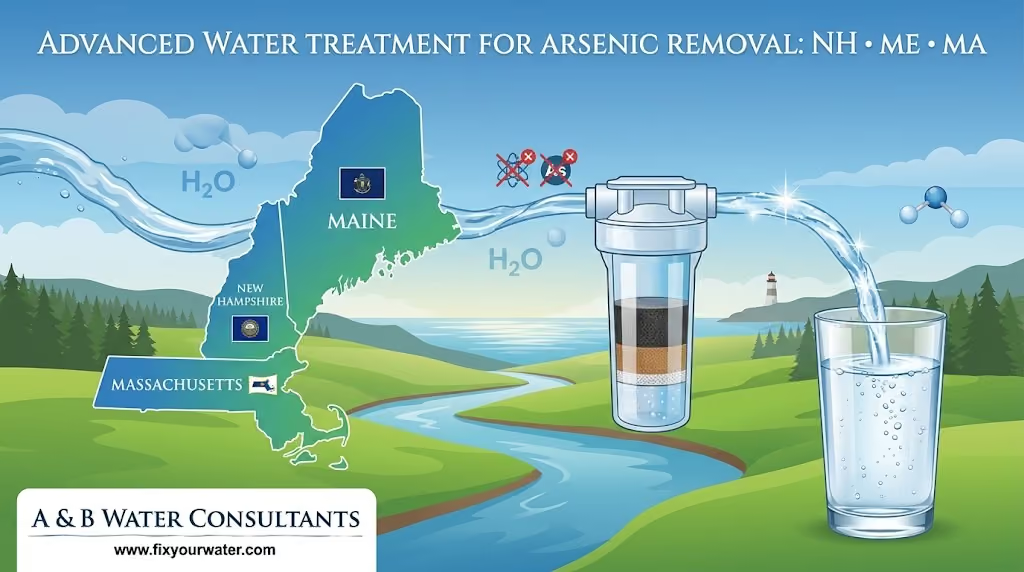
Arsenic is the most frequently detected naturally occurring contaminant in New Hampshire well water. It enters groundwater as bedrock minerals weather over time, releasing inorganic arsenic that dissolves into the water supply. The EPA's maximum contaminant level (MCL) for arsenic is 10 parts per billion (ppb), but the New Hampshire Department of Environmental Services has identified thousands of private wells exceeding that threshold. Long-term exposure to arsenic in drinking water is associated with increased risks of bladder, lung, and skin cancers, as well as cardiovascular disease and developmental effects in children. Learn more about arsenic water treatment options for New England homeowners.
Arsenic is colorless, odorless, and tasteless. A homeowner has no way of knowing it is present without laboratory testing.
Radon in Water
Radon is well known as a soil gas that enters homes through foundation cracks, but dissolved radon in well water is a separate and often overlooked problem. When groundwater containing radon is used indoors, the gas is released into the air during showering, dishwashing, and other water use. This creates an inhalation exposure risk inside the home. New Hampshire consistently ranks among the top states in the country for radon in groundwater, and the risk extends into southern Maine and parts of Massachusetts as well.
PFAS Contamination
PFAS, sometimes called "forever chemicals," are a group of synthetic compounds that do not break down in the environment or in the human body. They have been linked to thyroid disease, immune system suppression, certain cancers, and reproductive health issues. In New England, PFAS contamination is concentrated near military installations, airports, and industrial sites where aqueous film-forming foam (AFFF) was used, but the contamination plumes have spread into private well water in communities well beyond those original sources.
Radon in Your Home's Water: A Hidden New England Health Risk
Most national water treatment companies and product retailers do not address radon in water at all. For New England homeowners, this is a significant oversight. Radon dissolved in groundwater is a distinct treatment challenge that requires specific equipment and expertise.
When radon-laden water is used in a kitchen or bathroom, agitation releases the gas into the indoor air. Studies from the EPA and the University of Maine have estimated that radon in water contributes meaningfully to indoor radon air levels, particularly in tightly constructed, energy-efficient homes where ventilation is limited. New Hampshire has some of the highest radon-in-water concentrations in the country, and the problem is prevalent in granite-rich areas of southern Maine and the Merrimack Valley in Massachusetts as well.
Two primary treatment methods are used by professionals to address radon in water. Aeration systems, also called radon aeration units, pass water through a chamber where air is introduced to strip dissolved radon gas out of the water before it enters the household plumbing. Granular activated carbon (GAC) systems can also capture radon, though they require more careful management because the captured radon accumulates in the media over time. For most New Hampshire and Maine homeowners with elevated radon in water, aeration is the preferred point-of-entry solution. Contact A&B Water Consultants for a free water treatment quote and find out whether radon in your well water is a concern for your household.
PFAS Contamination in New England: What Homeowners Need to Know
PFAS contamination has become one of the most pressing water quality issues in New Hampshire and Massachusetts. The NH PFAS Investigation has identified dozens of communities where private wells have tested above the state's maximum contaminant levels for PFAS compounds. In Massachusetts, the Department of Environmental Protection has similarly flagged communities near former industrial sites and military bases where PFAS has migrated into groundwater.
The EPA finalized enforceable MCLs for six PFAS compounds in 2024, setting limits as low as 4 parts per trillion (ppt) for PFOA and PFOS. These are extraordinarily low concentrations, and they reflect the growing scientific consensus that even trace PFAS exposure carries meaningful health risks over time.
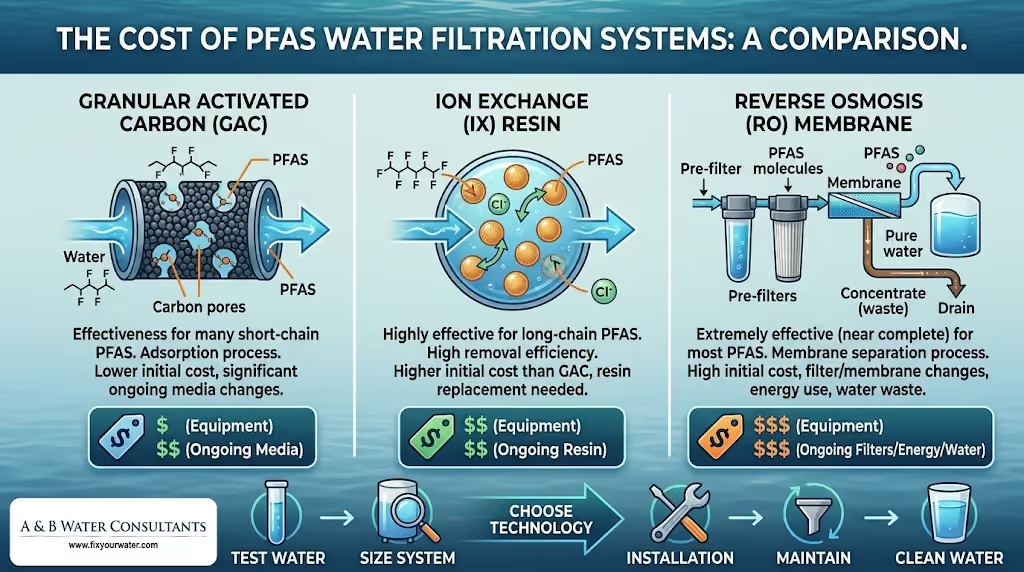
Effective PFAS removal requires specific treatment technologies. Activated carbon filtration, particularly with high-quality granular activated carbon or carbon block media, can reduce PFAS levels significantly. Reverse osmosis (RO) systems are highly effective at removing PFAS at the point of use; consider our guide on reverse osmosis (RO) systems and other point-of-use options. For whole-house PFAS treatment, a point-of-entry activated carbon system designed and sized by a professional is the most practical solution for most New England homes. When evaluating carbon solutions, homeowners should review resources on PFAS filtration systems to understand the differences in media and contact time.
It is important to note that not all carbon filters perform equally. The type of carbon, the contact time with water, and the flow rate through the system all affect PFAS removal efficiency. This is precisely why professional system design matters so much, and why off-the-shelf carbon filters sold at hardware stores may not achieve the removal rates homeowners assume they are getting.
Water Quality Concerns Specific to New Hampshire, Maine, and Massachusetts
New Hampshire has the highest rate of arsenic exceedances in private wells of any state in the northeastern United States. According to NHDES data, roughly one in five private wells tested in the state has shown arsenic levels above the EPA limit of 10 ppb. Certain regions, including the Lakes Region, the seacoast area, and communities along the Merrimack River corridor, show particularly elevated rates.
In southern Maine, the geology transitions from the White Mountains southward into the same granite-dominated formations that drive arsenic and radon risk in New Hampshire. Communities in York County and Cumberland County have documented arsenic problems in private wells, and radon in water is a widespread concern throughout the state.
Massachusetts presents a dual challenge. The western and central parts of the state share the granite bedrock geology that elevates arsenic and radon risk. Meanwhile, eastern Massachusetts communities near former military installations, including areas around Joint Base Cape Cod, have faced significant PFAS contamination in both public and private water supplies. The Massachusetts Department of Environmental Protection has been actively investigating PFAS impacts across the state, and homeowners in affected communities need targeted treatment solutions rather than generic filtration products.
Why Generic Water Filters Often Fall Short for New England Well Water
Walk into any home improvement store and there is no shortage of water filtration products claiming to improve water quality. Pitcher filters, under-sink units, and whole-house systems are marketed broadly, but they are rarely engineered for the specific contaminant profile found in New England well water.
Standard carbon block filters are effective for chlorine, taste, and odor. They are not designed to remove arsenic. Many pitcher-style filters do not address heavy metals at all. A homeowner who purchases a whole-house water filter believing it will protect their family from arsenic or PFAS is not getting the protection they think they are.
Arsenic removal requires adsorptive media specifically formulated to bind arsenate and arsenite ions, or a properly designed reverse osmosis system. Radon removal requires aeration equipment or high-capacity GAC systems with appropriate sizing for the home's water demand. PFAS removal requires high-contact-time activated carbon or RO membranes. None of these needs are met by generic products designed for municipal water supplies with chlorine as the primary concern.
Buying the wrong system does not just waste money. It creates a false sense of security while the actual contaminant continues to enter the home's water supply. Professional testing followed by a custom-designed system is the only reliable approach for New England well owners.
Types of Home Water Treatment Systems
Point-of-Entry (Whole-House) Systems
A point-of-entry (POE) system is installed on the main water line where it enters the home, treating all water before it reaches any tap, fixture, or appliance. For contaminants like radon and arsenic that affect all water uses, including bathing and laundry, a whole-house water filter is the appropriate solution. POE systems are also the standard approach for homes with PFAS contamination that affects the entire water supply.
Point-of-Use (POU) Systems
Point-of-use systems, including under-sink reverse osmosis units, treat water at a single tap. They are effective for reducing arsenic and PFAS in drinking and cooking water, and they are sometimes used as a supplemental layer of protection alongside a whole-house system. However, they do not address radon or other contaminants that pose risks through inhalation or skin contact during bathing.
Specialty Systems for New England Contaminants
Arsenic-specific systems use adsorptive media (such as iron-based or titanium-based media) or reverse osmosis to achieve reliable arsenic removal. Radon aeration systems are designed specifically for dissolved radon in groundwater. PFAS carbon filtration systems use high-capacity activated carbon engineered for per- and polyfluoroalkyl substance removal. These are not interchangeable with standard household filters.
How to Choose the Right Water Treatment System for Your Home
Choosing water treatment systems without professional guidance is a common and costly mistake. The best water treatment options for any home depend entirely on what is actually in that home's water, not on what a product label claims or what a neighbor installed.
The process of choosing a water treatment system should always begin with certified laboratory testing. A comprehensive well water test from a state-certified laboratory identifies which contaminants are present and at what concentrations. That data drives every subsequent decision: which treatment technology to use, how large the system needs to be, and where it should be installed in the home.
After testing, a professional water treatment consultant matches the system type to the specific contaminants identified. System sizing is equally important. A system designed for a two-person household may be inadequate for a family of five with higher water demand, resulting in reduced contact time with treatment media and lower removal efficiency.
Contact A&B Water Consultants for a free water treatment quote and get expert guidance on the best water treatment options for your specific well water conditions.
What Happens During a Professional Home Water Treatment Consultation
Many homeowners are unsure what to expect when they reach out to a professional water treatment company. The process with A&B Water Consultants is straightforward and designed to give families clear, actionable information.
The consultation begins with an on-site water quality assessment. A certified consultant visits the home, reviews any existing water test results, and collects water samples for laboratory analysis if testing has not been completed recently. The consultant also evaluates the home's plumbing configuration, water pressure, and flow rate, all of which affect system selection and placement.
Once laboratory results are available, the consultant designs a custom treatment system matched to the home's specific contaminant profile and water demand. This includes selecting the appropriate treatment media, sizing the system correctly, and identifying the optimal installation point. The homeowner receives a detailed proposal explaining what the system will treat, how it works, and what maintenance it will require.
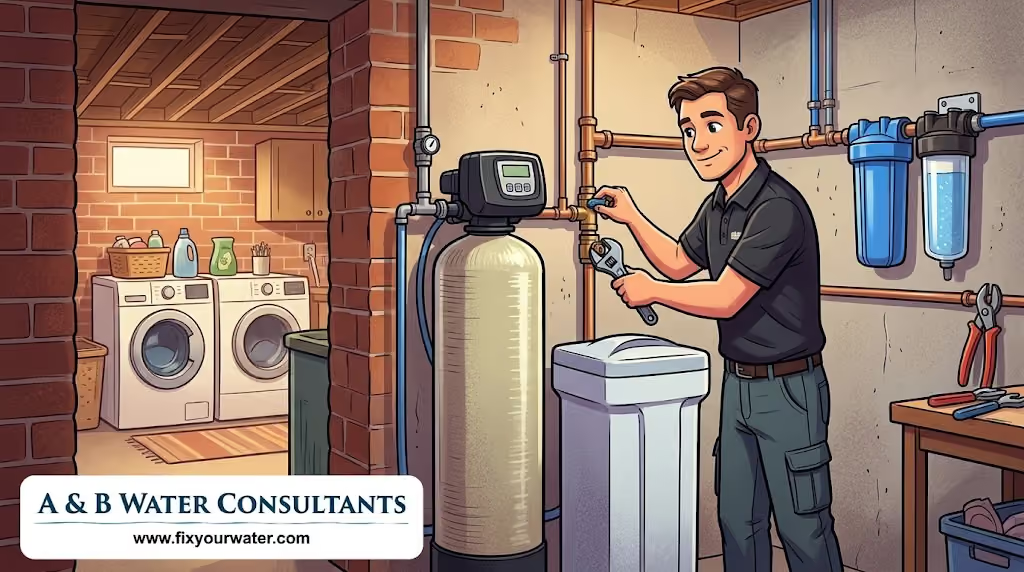
Installation is performed by experienced technicians who ensure the system is correctly integrated with the home's plumbing. After installation, the consultant reviews the maintenance schedule with the homeowner, covering filter and media replacement intervals and what signs to watch for that might indicate a system needs servicing. Ongoing support and scheduled maintenance are part of the professional service relationship, not an afterthought.
Benefits of Professional Home Water Treatment
The advantages of working with a professional water treatment company over purchasing off-the-shelf products extend well beyond the quality of the equipment itself. Professional systems are verified through pre- and post-installation water testing, confirming that contaminant levels have been reduced to safe concentrations. That verification is something no retail product can provide.
Custom-designed systems are engineered for the home's actual water chemistry, flow rate, and household demand. They are sized correctly, installed properly, and supported by a maintenance program that keeps them performing as designed over the long term. For families in New Hampshire and southern Maine dealing with arsenic, radon, or PFAS, a professionally installed whole-house water treatment system is not a luxury. It is a health investment with measurable returns.
From a financial perspective, professional systems also offer long-term cost advantages. A correctly sized and maintained system avoids the premature media exhaustion and reduced performance that comes from undersized or improperly installed equipment. It also eliminates the ongoing expense of bottled water, which many families resort to when they distrust their tap water but have not yet addressed the underlying problem.
Contact A&B Water Consultants for a free water treatment quote and learn how a professionally designed system compares in cost to the alternatives your family may currently be using.
System Costs and What to Expect as an Investment
Water treatment system costs vary considerably based on the contaminants being addressed, the size of the home, and the complexity of the installation. As a general reference for New England homeowners:
- A point-of-use reverse osmosis system for arsenic or PFAS removal typically ranges from $500 to $1,500 installed, depending on system capacity and configuration.
- A whole-house arsenic adsorption system for a typical single-family home generally falls in the range of $1,500 to $4,000 installed, depending on arsenic levels and water demand.
- Radon aeration systems for whole-house radon-in-water treatment typically range from $2,000 to $5,000 installed, reflecting the more complex equipment and installation requirements.
- Whole-house PFAS activated carbon systems range broadly based on system size and carbon type, generally from $2,000 to $6,000 or more for high-capacity configurations.
These ranges reflect professional installation with properly engineered systems. They should be understood as investments in long-term health protection rather than simple appliance purchases. Annual maintenance costs, including media and filter replacement, typically run from $150 to $500 per year depending on the system type and local water conditions.
Frequently Asked Questions About Home Water Treatment in New England
What is the best water treatment system for a home?
There is no single best system for every home. The right system depends entirely on what contaminants are present in the water. For New Hampshire and Maine well owners, arsenic filtration, radon aeration, and PFAS carbon treatment are the most commonly needed solutions, often in combination. A professional water test is the essential first step.
How much should a whole-house water treatment system cost?
Whole-house systems for New England contaminants typically range from $1,500 to $6,000 or more installed, depending on the contaminants addressed, system size, and installation complexity. Professional installation ensures the system is correctly sized and performs as designed.
What is the best method of water purification at home?
The best method depends on the specific contaminant. Reverse osmosis is highly effective for arsenic and PFAS at the point of use. Adsorptive media filtration handles arsenic in whole-house applications. Aeration is the preferred method for radon in water. Activated carbon addresses PFAS. No single method handles all contaminants equally well.
What contaminants are common in New Hampshire well water?
Arsenic, radon, uranium, manganese, and PFAS are among the most commonly detected contaminants in New Hampshire private wells. Arsenic and radon are driven by the state's granite bedrock geology. PFAS contamination is associated with industrial and military activity in specific communities.
Does a whole-house water filter remove radon?
Standard whole-house carbon filters provide some radon reduction, but they are not designed or sized for reliable radon removal. A dedicated radon aeration system or a high-capacity GAC system specifically designed for radon treatment is required for effective radon-in-water removal.
How do I know if my home water needs treatment?
The only reliable way to know is through certified laboratory testing. Arsenic, radon, and PFAS are all undetectable by taste, smell, or appearance. Any private well owner in New Hampshire, southern Maine, or Massachusetts should have their water professionally tested, particularly if the well has never been tested or if testing has not been done within the past few years.
Take the Next Step Toward Safer Water for Your Family
New England homeowners face a set of water quality challenges that most national brands and generic product retailers are simply not equipped to address. The combination of naturally occurring arsenic and radon from granite bedrock geology, compounded by PFAS contamination from industrial and military sources, demands a locally informed, professionally designed approach to water treatment for home use.
With over 25 years of experience serving families in New Hampshire, southern Maine, and Massachusetts, A&B Water Consultants brings the regional expertise and custom system design capability that this environment requires. From certified water testing to professionally installed arsenic filtration, radon aeration, and PFAS removal systems, every solution is tailored to the specific conditions of the home it serves.
Contact A&B Water Consultants for a free water treatment quote and take the first step toward knowing exactly what is in your water and what it will take to protect your family from it.