For homeowners in New Hampshire, southern Maine, and Massachusetts, water quality is not a minor inconvenience. It is a genuine public health concern. The region's granite bedrock geology naturally elevates arsenic and radon levels in private wells, and PFAS contamination from industrial and agricultural sources has compounded the problem significantly. When families start researching solutions, one of the first questions they ask is straightforward: what does a water filtration system actually cost?
The honest answer is that the cost of water filtration systems varies considerably depending on what contaminants are present, how concentrated they are, and what kind of system is required to treat them effectively. This guide breaks down real cost expectations for New England homeowners, explains what drives those costs, and helps families make informed decisions about protecting their drinking water.
Why Water Filtration Costs More in New Hampshire and New England
National cost estimates found on generic home improvement websites rarely reflect what New England homeowners actually pay. The reason comes down to geology and contaminant complexity.
New Hampshire, Maine, and Massachusetts sit atop some of the oldest granite bedrock formations in North America. As groundwater moves through fractured granite, it picks up naturally occurring arsenic and radon at levels that frequently exceed EPA maximum contaminant levels. According to the New Hampshire Department of Environmental Services, arsenic is detected in a significant percentage of private wells across the state, particularly in the Merrimack Valley and Lakes Region.
Layered on top of naturally occurring contaminants, PFAS compounds from military installations, industrial sites, and firefighting foam have contaminated both surface water and private wells in communities throughout the region. Treating a combination of arsenic, radon, and PFAS simultaneously requires engineered, multi-stage systems. That complexity is reflected in cost, and it is why a simple off-the-shelf pitcher filter or basic carbon block unit is simply not adequate for most New England well owners.
Cost of Treating Arsenic, Radon, and PFAS in Your Well Water
Rather than listing costs by generic system type, the more useful framework for New England homeowners is to understand what treatment for each specific contaminant actually costs.
Arsenic Removal Systems
Arsenic removal typically requires a point-of-entry (whole-house) adsorptive media system or a combination of oxidation and filtration. Professionally installed arsenic filtration systems for a typical New Hampshire home generally range from $1,500 to $4,500, depending on arsenic concentration, flow rate requirements, and whether pre-treatment is needed. Higher arsenic levels require more robust media and larger tanks, which increases cost.
Radon in Water Treatment
Radon dissolved in well water requires either aeration (air stripping) or granular activated carbon (GAC) treatment. Aeration systems are more effective for high radon concentrations and typically cost between $3,000 and $6,000 installed. GAC systems are less expensive upfront (roughly $1,500 to $3,000) but carry ongoing disposal costs for the spent carbon media, which becomes radioactive over time and requires licensed disposal.
PFAS Removal Systems
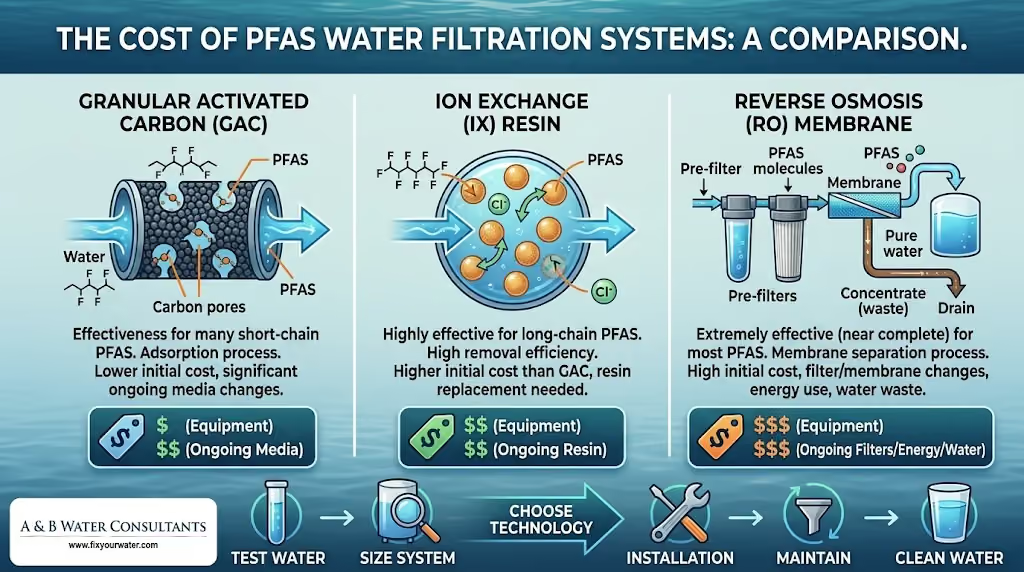
PFAS removal is among the more technically demanding and costly treatment challenges. Effective PFAS removal requires either high-capacity granular activated carbon (GAC), reverse osmosis (RO), or ion exchange resin systems. For whole-house PFAS treatment, professionally installed systems typically range from $3,000 to $8,000 or more, depending on the specific PFAS compounds present, their concentration, and household water demand. Point-of-use reverse osmosis systems that address PFAS at the kitchen tap are available at lower price points (roughly $800 to $2,500 installed), but they do not protect the entire home.
Contact A&B Water Consultants for a free PFAS water filtration system quote tailored to your specific contaminant results and household needs.
How Your Water Test Results Determine Your Filtration System Cost
One of the most important and frequently overlooked factors in the cost of water filtration systems is the actual concentration of contaminants found in a professional water test. This is not simply about whether a contaminant is present. It is about how much is present.
A homeowner with arsenic at 5 parts per billion (ppb) may need a straightforward adsorptive media system. A homeowner with arsenic at 50 ppb requires a more robust system with larger media volume, potentially pre-oxidation, and more frequent media replacement. The same principle applies to PFAS: a home with trace levels of one or two PFAS compounds is a very different treatment challenge than a home with multiple compounds at elevated concentrations.
This is why no reputable water treatment professional will quote a system price without first reviewing water test results. Any company that offers a firm price without knowing what is in the water is not providing a meaningful estimate. A professional water analysis, which typically costs between $100 and $400 depending on the panel selected, is the essential first step before any system investment. In many cases, A&B Water Consultants can advise on which testing panel is appropriate based on a home's location and known regional contaminants.
Custom-Designed Systems vs. Off-the-Shelf Filters: What You Actually Get for the Price
Big-box home improvement stores sell water filtration products that range from $30 pitcher filters to $500 under-sink units. These products are not designed for the contaminant profiles found in New England well water, and that distinction matters enormously.
A retail carbon filter may reduce chlorine taste and some sediment. It will not meaningfully address arsenic, radon, or PFAS at the concentrations commonly found in New Hampshire and Maine wells. Purchasing one of these products and assuming the water is safe is a false economy that carries real health consequences.
A custom-designed system, engineered by a qualified water treatment professional, begins with a site assessment and a review of laboratory water test results. The system is then sized and configured specifically for that home's water chemistry, flow rate, and contaminant profile. Media selection, tank sizing, pre-treatment requirements, and bypass configurations are all determined by the specific conditions at that address. The result is a system that actually works for that water, not a generic product designed for average conditions that may not resemble anything in New England.
The upfront cost is higher. The effectiveness and long-term reliability are also substantially higher.
Calculating the True 5-Year Cost of Your Water Filtration System
Upfront equipment and installation costs are only part of the financial picture. A realistic 5-year cost framework helps homeowners compare options accurately.
Sample 5-Year Cost Framework for a Whole-House PFAS and Arsenic System
- Year 1: Equipment and professional installation ($4,000 to $8,000) plus water testing ($150 to $400) plus initial site assessment (often included in the quote)
- Years 2 to 5: Annual filter media replacement or regeneration ($200 to $800 per year depending on system type), annual water quality verification test ($100 to $250), and periodic service visits ($150 to $300 per visit)
- 5-Year Total (estimated range): $5,500 to $12,000 for a professionally installed, maintained whole-house system
Compare this to the alternative: a family of four purchasing bottled water for drinking and cooking spends roughly $1,200 to $2,400 per year, totaling $6,000 to $12,000 over five years, without treating bathing water, laundry water, or any other point of use. And bottled water does not protect against radon absorbed through showering, which is a real exposure pathway that whole-house treatment addresses directly.
Contact A&B Water Consultants for a free PFAS water filtration system quote and a realistic cost breakdown for your specific situation.
Installation Costs: What to Expect When Hiring a Professional
Labor costs for water filtration system installation in New Hampshire, Maine, and Massachusetts reflect regional contractor rates. Homeowners should expect professional installation labor to add $500 to $2,000 to the equipment cost, depending on the complexity of the installation, the condition of existing plumbing, and whether any modifications to the pressure tank or plumbing configuration are required.
For systems that require electrical connections (such as aeration systems for radon), electrical contractor involvement may add additional cost. Some municipalities and towns in Massachusetts require permits for whole-house water treatment installations, which adds a modest but real cost and timeline consideration.
Professional installation is not optional for contaminant-specific systems. Improper installation of an arsenic or PFAS system can result in channeling through the media bed, bypass leakage, or incorrect flow rates, all of which compromise treatment effectiveness. A system that is not installed correctly may show acceptable water test results immediately after installation and then fail over time as media becomes exhausted unevenly.
Ongoing Maintenance and Filter Replacement Costs
Every filtration system requires ongoing maintenance. The costs and schedules vary by system type:
- Adsorptive media (arsenic): Media replacement every 3 to 5 years typically, costing $300 to $700 for media plus service labor
- GAC systems (PFAS or radon): Carbon media replacement every 1 to 3 years, costing $400 to $1,200 depending on tank size; radon GAC media requires licensed disposal
- Reverse osmosis (PFAS point-of-use): Membrane replacement every 2 to 3 years ($100 to $300), pre-filter cartridges every 6 to 12 months ($30 to $80)
- Aeration systems (radon): Lower ongoing media costs but require periodic inspection of the air pump and controls; annual service typically $150 to $300
Annual water quality testing is also a necessary ongoing cost. Verifying that the system continues to perform as designed is the only way to confirm that treated water remains safe. Many homeowners in New Hampshire and Maine test annually as a standard practice.
Signs Your New England Home Needs a Water Filtration System
Some contaminants, including arsenic, radon, and PFAS, are colorless, odorless, and tasteless. Homeowners cannot detect them without testing. However, other warning signs that indicate water quality problems include:
- Orange, brown, or reddish staining on fixtures, laundry, or sinks (iron or manganese)
- Sulfur or "rotten egg" odor (hydrogen sulfide)
- Cloudy or turbid water (sediment or bacterial issues)
- Hard water scaling on appliances and fixtures
- A failed or borderline water test result from a state-certified laboratory
- A nearby property with confirmed PFAS or arsenic contamination
- A home located in a known high-arsenic geology area of New Hampshire or Maine
Any of these signs warrants a professional water quality assessment before investing in a filtration system. The assessment determines what is actually present, which dictates what treatment is appropriate and what the cost will be.
Is a Whole-House Water Filtration System Worth the Investment?
For New England homeowners on private wells with confirmed arsenic, radon, or PFAS contamination, the answer is almost always yes. The health risks associated with long-term exposure to these contaminants are well-documented. Arsenic is a known human carcinogen. PFAS compounds have been linked to immune system disruption, thyroid disease, and certain cancers. Radon in water contributes to both waterborne ingestion risk and airborne radon exposure during showering.
Beyond health considerations, a professionally installed water treatment system adds demonstrable value to a property in New England real estate markets. Buyers in New Hampshire and Massachusetts increasingly request water quality documentation as part of the purchase process. A home with a functioning, documented treatment system for known contaminants is a more attractive and more easily financed property than one with an unresolved water quality issue.
Contact A&B Water Consultants for a free PFAS water filtration system quote and learn what a professionally designed system would cost for your home.
How to Budget for a Water Filtration System
Realistic budgeting requires moving past the generic national cost ranges found on home improvement websites. A homeowner in Concord, New Hampshire with elevated arsenic and PFAS in a high-flow well has very different needs and costs than a homeowner in a Massachusetts suburb on municipal water with a simple chlorine taste issue.
Hidden costs that generic estimates frequently omit include:
- Pre-treatment requirements (sediment filtration, pH adjustment) that must be installed before the primary treatment system
- Plumbing modifications required by the installation location
- Electrical work for powered treatment systems
- Annual testing required to verify system performance
- Licensed media disposal fees for spent GAC from radon systems
- Permitting fees in municipalities that require them
The most reliable way to get an accurate budget figure is to request a professional quote based on actual water test results and a site assessment. Online calculators and national averages are useful for initial planning but should not be used as the basis for a purchasing decision.
Frequently Asked Questions About Water Filtration System Costs
How much should a whole-house water filtration system cost?
For New England homeowners treating arsenic, radon, or PFAS, whole-house systems typically range from $3,000 to $10,000 or more installed, depending on the contaminants present and system complexity. Simple sediment or iron filtration systems can cost less.
How much does a plumber charge to install a water filtration system?
Labor costs in New Hampshire, Maine, and Massachusetts typically range from $500 to $2,000 for water filtration installation, depending on system complexity and existing plumbing conditions. Specialized water treatment contractors may bundle labor into an all-inclusive system price.
Is it worth getting a whole-house water filtration system?
For homes with confirmed arsenic, radon, or PFAS contamination, yes. Whole-house systems protect every point of use, including bathing and laundry, and provide documented water quality that supports home resale value.
What is the most cost-effective water filtration system?
The most cost-effective system is the one correctly matched to the specific contaminants in a home's water. A system that does not address the actual contaminants present is not cost-effective at any price.
What are the disadvantages of a whole-house water filter?
Higher upfront cost, ongoing maintenance requirements, and the need for professional installation and periodic testing are the primary considerations. For homes with serious contaminant issues, these are manageable costs relative to the health and property value benefits.
Getting an Accurate Quote for Your Home
Before requesting a quote, homeowners should have a recent professional water test from a state-certified laboratory, know the age and general condition of their plumbing system, and have a sense of their household's daily water usage. This information allows a water treatment professional to recommend the appropriate system size and configuration without guesswork.
With over 25 years of experience designing custom water treatment solutions for families across New Hampshire, southern Maine, and Massachusetts, A&B Water Consultants brings contaminant-specific expertise that generic national providers simply cannot match. Contact A&B Water Consultants for a free PFAS water filtration system quote and take the first step toward water your family can trust.