Arsenic in drinking water is not a distant environmental concern for New England homeowners. It is a present, measurable threat sitting quietly in private wells across New Hampshire, Maine, and Massachusetts. Unlike many contaminants, arsenic has no taste, no odor, and no color. A family can drink arsenic-laden water for years without any immediate warning signs, all while chronic exposure quietly increases health risks. Understanding how to remove arsenic from water, and doing so with a properly designed professional system, is one of the most important investments a well-water household can make.
Why Arsenic in Well Water Is a Serious Concern in New England
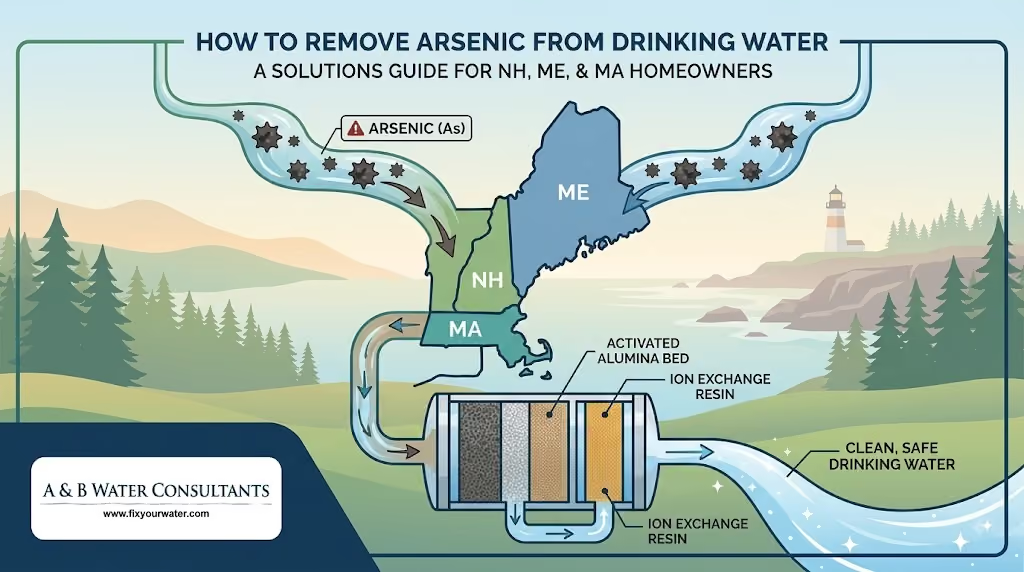
Arsenic contamination in New England is not the result of industrial spills or agricultural runoff in most cases. It is geogenic, meaning it originates naturally from the granite and bedrock formations that define the geology of New Hampshire, Maine, and Massachusetts. As groundwater moves through fractured bedrock, it dissolves arsenic from mineral deposits and carries it into private wells.
This is a critical distinction for homeowners: no amount of surface-level caution prevents geogenic arsenic from entering a well. The contamination comes from the earth itself, and the only solution is proper treatment at the point where water enters the home or is consumed.
New Hampshire consistently ranks among the states with the highest rates of arsenic in private well water. Studies from the U.S. Geological Survey and the NH Department of Environmental Services have found that a significant percentage of private wells in the state exceed the EPA's maximum contaminant level (MCL) of 10 micrograms per liter, commonly expressed as 10 parts per billion (ppb). Private well owners are not subject to the same mandatory monitoring requirements as public water systems, which means the responsibility for testing and treatment falls entirely on the homeowner.
Which Areas of New Hampshire and New England Have the Highest Arsenic Risk?
Not all regions carry equal risk, and understanding local geology helps homeowners assess their urgency. In New Hampshire, towns situated on or near granite-rich bedrock formations, particularly in Rockingham, Hillsborough, Merrimack, and Strafford counties, have documented elevated arsenic levels in private wells. Communities such as Bedford, Goffstown, Londonderry, Derry, and Raymond have seen notable rates of arsenic exceedances in well testing data.
In southern Maine, the same granite-dominated geology extends northward, putting well owners in York and Cumberland counties at meaningful risk. Massachusetts communities in the Merrimack Valley and areas underlain by similar bedrock formations also face elevated exposure potential.
These are not isolated cases. The bedrock geology of New England is fundamentally arsenic-bearing, and any private well drawing from that geology should be considered a candidate for testing regardless of how long a family has used the water without apparent issue.
What Are the Health Risks of Arsenic in Drinking Water?
The health effects of arsenic exposure are well-documented and sobering. Chronic low-level exposure, the kind that occurs when a household unknowingly drinks water slightly above the EPA limit for months or years, is the primary concern for private well users. Long-term arsenic ingestion has been linked to cancers of the bladder, lung, and skin, as well as cardiovascular disease, peripheral neuropathy, and developmental effects in children.
Children and pregnant women face elevated risk. Developing nervous systems are particularly vulnerable to arsenic's neurotoxic properties, and prenatal exposure has been associated with cognitive impairment and low birth weight. For families with young children or those planning pregnancies, addressing arsenic contamination is not optional.
The EPA's MCL of 10 ppb was set as a regulatory compromise between public health ideals and treatment feasibility. Some researchers argue the threshold should be lower. This means that even water testing at or near the limit warrants serious consideration of arsenic filtration systems.
How to Test Your Well Water for Arsenic
The only way to know whether a private well contains arsenic is to test it. The NH Department of Health and Human Services recommends that all private well owners test their water for arsenic at least once, and more frequently if previous results were elevated or if the well has been altered. Annual or biennial testing is a reasonable standard for households in high-risk geological areas.
Testing should be conducted through a state-certified laboratory rather than relying on at-home kits. Certified labs follow strict chain-of-custody protocols and provide results that meet legal and regulatory standards. Sample collection instructions must be followed precisely, typically requiring a first-draw sample collected before water has run through the tap. The NH DES maintains a list of certified laboratories, and many water treatment professionals, including A&B Water Consultants, can assist with proper sample collection and submission.
When results arrive, understanding them is straightforward: any result above 10 ppb requires action. Results between 5 and 10 ppb should prompt serious consideration of treatment, particularly for households with children or vulnerable individuals. Contact A&B Water Consultants for a free arsenic water removal quote and guidance on interpreting your test results.
Why the Type of Arsenic in Your Well Determines the Right Treatment System
This is one of the most overlooked details in arsenic treatment, and it is one that separates professional system design from off-the-shelf guesswork. Arsenic exists in two primary oxidation states in groundwater: arsenic III (arsenite) and arsenic V (arsenate).
Arsenic V is the form that most filtration media and reverse osmosis membranes remove effectively. Arsenic III, however, is not readily captured by most standard filtration methods. It must first be converted to arsenic V through an oxidation step before filtration can work as intended.
New Hampshire groundwater, which is typically low in dissolved oxygen and has a reducing chemistry, often contains a significant proportion of arsenic III. A system designed without accounting for arsenic speciation may appear to be functioning while actually failing to remove a substantial portion of the arsenic present. This is precisely why professional water chemistry analysis is essential before any system is selected or installed. A qualified specialist will test not just arsenic levels but also pH, iron content, competing ions, and dissolved oxygen, all of which influence which arsenic removal methods will perform correctly in a given well.
Proven Methods to Remove Arsenic from Well Water
Adsorptive Media Filtration
Adsorptive media filtration is widely considered the gold standard for whole-house arsenic removal in residential settings. Iron-based media (such as iron oxide or greensand) and titanium dioxide media attract and bind arsenic molecules as water passes through the filter bed. These systems are highly effective at removing arsenic V and, when paired with proper oxidation pretreatment, can address arsenic III as well.
These systems require periodic backwashing to maintain effectiveness and eventual media replacement, typically every several years depending on water chemistry and usage. Professional sizing is critical: an undersized media tank will exhaust prematurely, while an oversized system may not backwash effectively.
Reverse Osmosis Systems
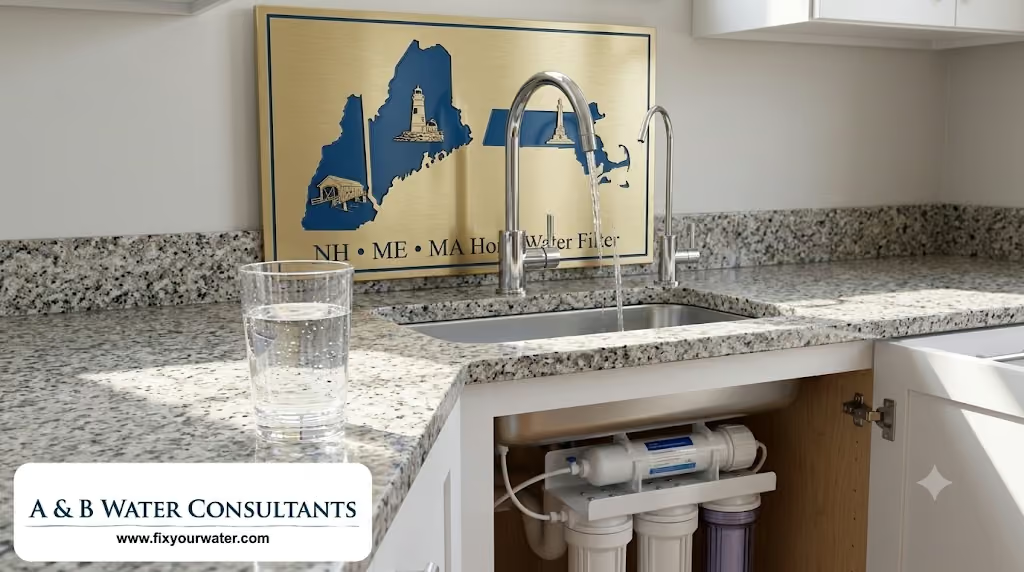
Reverse osmosis (RO) forces water through a semi-permeable membrane that blocks arsenic molecules, removing up to 95% of arsenic at the point of use. RO systems are most commonly installed under the kitchen sink to treat drinking and cooking water. They are an excellent option for households seeking high-confidence removal at the tap, particularly when whole-house treatment is not yet in place.
The limitation of point-of-use RO is that it only treats water at one location. Bathing, brushing teeth, and cooking with water from other taps remains untreated. For comprehensive household protection, RO is often paired with a whole-house adsorptive media system. Homeowners evaluating whole-house vs. point-of-use options should review local filtration systems guidance to determine which configuration best suits their needs.
Oxidation and Filtration
When arsenic III is present, an oxidation step must precede filtration. This can be accomplished through chemical oxidation (such as chlorination), aeration, or oxidizing filter media. The choice of oxidation method depends on the well's overall water chemistry and whether other contaminants like iron or manganese are also present.
Point-of-Entry vs. Point-of-Use Arsenic Treatment Systems
Homeowners evaluating arsenic removal methods will encounter two primary system categories. Point-of-entry (POE) systems treat all water entering the home, providing protection at every tap, shower, and appliance. Point-of-use (POU) systems treat water at a single location, most commonly the kitchen sink.
For households with arsenic levels significantly above the EPA limit, or for families with children, a whole-house POE system is generally the more comprehensive and appropriate solution. It eliminates exposure from all water sources, including inhalation of steam during showering, which can be a secondary exposure pathway at very high arsenic concentrations.
POU systems, particularly RO units, are an excellent complement to POE treatment or a practical first step for households prioritizing drinking water protection while planning a whole-house solution. A professional assessment helps determine which approach is most appropriate given arsenic levels, household size, and budget. Contact A&B Water Consultants for a free arsenic water removal quote to explore which system configuration fits your home.
What Happens If You Ignore Elevated Arsenic in Your Well Water?
Private well owners operate outside the regulatory net that governs public water systems. There is no government agency that will automatically notify a well owner of elevated arsenic or mandate remediation. This creates a silent liability that many homeowners underestimate.
From a health standpoint, ignoring elevated arsenic means accepting a compounding risk. Arsenic accumulates in the body over time, and the damage to internal organs, particularly the bladder and lungs, is largely irreversible once it progresses. The cancers associated with chronic arsenic exposure have long latency periods, meaning the consequences of inaction today may not become clinically apparent for a decade or more.
From a property standpoint, a home with a documented arsenic problem and no treatment system in place carries real liability in real estate transactions. New Hampshire sellers are required to disclose known water quality issues, and a failed arsenic test without a remediation system can complicate or derail a home sale. Installing a properly designed arsenic filtration system protects both the family's health and the property's value.
Treating Arsenic Alongside Radon and PFAS: A Smarter Approach for New England Well Owners
New Hampshire and Maine well water rarely presents a single-contaminant problem. The same bedrock geology that releases arsenic into groundwater also releases radon, uranium, and manganese. Additionally, PFAS (per- and polyfluoroalkyl substances) contamination has been identified in private wells across New England, particularly in communities near military installations, airports, and industrial sites.
Addressing these contaminants individually, with separate systems designed and installed at different times, is both more expensive and less efficient than a comprehensive, bundled treatment approach. A professional water quality assessment that tests for arsenic, radon, PFAS, uranium, manganese, and other relevant parameters provides a complete picture of what is in the water and enables a single, coordinated treatment plan.
A&B Water Consultants specializes in exactly this kind of multi-contaminant assessment and system design. With over 25 years of experience serving New England families, the team understands how these contaminants interact with each other and with treatment media, allowing for systems that address multiple issues efficiently and cost-effectively. Contact A&B Water Consultants for a free arsenic water removal quote that includes a full water quality consultation.
How to Choose a Qualified Arsenic Water Treatment Specialist in New Hampshire
The internet makes it easy to purchase an arsenic filter and attempt self-installation. It is equally easy to buy the wrong system, install it incorrectly, or fail to account for the water chemistry factors that determine whether a system will actually work. For a contaminant as consequential as arsenic, the stakes of getting it wrong are significant.
When evaluating a water treatment professional, homeowners should look for several key qualifications. The specialist should conduct a comprehensive water test, not just an arsenic test, before recommending any system. They should be able to explain arsenic speciation and how their recommended system addresses the specific form of arsenic present in the well. They should provide documentation of system performance, including expected arsenic reduction percentages, and offer a clear maintenance plan.
Licensing and certification matter as well. In New Hampshire, water treatment professionals should be familiar with NH DES guidelines and state-certified testing requirements. Ask for references from local homeowners who have had arsenic systems installed, and verify that the company has experience with New England well water chemistry specifically.
A&B Water Consultants has been serving New Hampshire, southern Maine, and Massachusetts homeowners for more than 25 years. Every system is custom-designed based on individual water chemistry analysis, household water usage, and the specific contaminants present. Contact A&B Water Consultants for a free arsenic water removal quote and take the first step toward confident, clean water.
Frequently Asked Questions About Arsenic Removal
Can boiling remove arsenic from well water?
No. Boiling water does not remove arsenic and can actually make the problem worse. As water evaporates during boiling, the arsenic becomes more concentrated in the remaining water. Boiling is effective against biological contaminants like bacteria but has no effect on dissolved heavy metals or metalloids like arsenic.
Can a Brita filter remove arsenic?
Standard pitcher filters, including Brita, use activated carbon and are not designed to remove arsenic. They are effective for improving taste and reducing chlorine but should not be relied upon for arsenic removal. Specialized arsenic-rated filters exist, but even these require professional guidance to ensure they are appropriate for the specific form of arsenic present in a given well.
Is it safe to shower in water with elevated arsenic?
Skin absorption of arsenic during showering or bathing is generally considered minimal at typical well water concentrations. The primary exposure pathway is ingestion. However, at very high arsenic levels, inhalation of steam during hot showers may present a secondary concern. A whole-house treatment system eliminates this question entirely.
How long does an arsenic filtration system last?
The lifespan of an arsenic filtration system depends on the technology used. Adsorptive media systems typically require media replacement every three to seven years, depending on arsenic levels and water usage. RO membranes generally need replacement every two to three years. Regular professional servicing ensures the system continues to perform at rated efficiency.
How do I know if my well water has arsenic in it?
The only reliable way to know is laboratory testing. Arsenic is completely undetectable by taste, smell, or appearance. A certified laboratory test provides accurate results and is the essential first step for any private well owner in New England.
What states and regions have the most arsenic in their water?
New England, particularly New Hampshire, Maine, and parts of Massachusetts, ranks among the highest-risk regions in the country for naturally occurring arsenic in private well water. The granite-rich bedrock geology of the region is the primary driver. New Hampshire has some of the highest documented rates of private well arsenic exceedances in the northeastern United States.