Per- and polyfluoroalkyl substances, better known as PFAS, have become one of the most pressing drinking water concerns facing homeowners across New England. In New Hampshire, Maine, and Massachusetts, families drawing water from private wells or aging municipal systems face an invisible threat that standard home filters simply cannot address. Understanding how to remove PFAS from water, and doing it correctly, requires more than a pitcher filter from the hardware store. It requires professional assessment, certified technology, and a treatment system designed around the specific chemistry of the water coming into the home.
This guide walks through everything homeowners need to know: what PFAS are, where contamination has been documented in the region, which removal technologies actually work, and why professional PFAS removal consistently outperforms consumer-grade alternatives when the stakes involve long-term family health.
What Are PFAS and Why Are They a Concern in New England Drinking Water?
PFAS are a large family of synthetic chemicals that have been used since the 1940s in products ranging from non-stick cookware and food packaging to firefighting foam and industrial coatings. The term "forever chemicals" reflects their defining characteristic: the carbon-fluorine bond at their core is one of the strongest in chemistry, meaning these compounds do not break down naturally in the environment or in the human body.
Documented health effects of PFAS exposure include increased risk of certain cancers (particularly kidney and testicular cancer), thyroid disease, elevated cholesterol, immune system disruption, and developmental problems in fetuses and young children. Families with pregnant women, infants, or young children face heightened concern because PFAS can cross the placental barrier and accumulate in breast milk.
New England's industrial history, combined with its high rate of private well use, makes the region particularly vulnerable. Military installations, manufacturing facilities, and landfills have all contributed to PFAS loading in local groundwater. In New Hampshire, Pease Air Force Base in Portsmouth is one of the most well-documented PFAS contamination sites in the country, where PFOA and PFOS from firefighting foam contaminated the Haven well field serving thousands of residents. Contamination has also been detected in communities near Merrimack, where a manufacturing facility released PFAS compounds into the Merrimack River watershed for decades. In Maine, communities near Brunswick Naval Air Station and Loring Air Force Base have faced significant PFAS contamination. In Massachusetts, sites in Ayer, Devens, and communities near Otis Air National Guard Base have recorded elevated PFAS levels in both groundwater and public supplies.
How to Find Out If PFAS Is in Your Water
Before any treatment decision can be made, homeowners need reliable data about what is actually in their water. PFAS contamination is colorless, odorless, and tasteless, meaning there is no sensory indication of its presence.
Step 1: Identify Nearby Contamination Sources
Proximity to military bases, airports, industrial facilities, landfills, or wastewater treatment plants increases the likelihood of PFAS exposure. The Environmental Working Group maintains a publicly accessible PFAS contamination map, and state environmental agencies in New Hampshire, Maine, and Massachusetts publish updated lists of known contamination sites.
Step 2: Order Certified Laboratory Water Testing
Private well owners should have their water tested by a state-certified laboratory capable of analyzing for the full suite of PFAS compounds, not just PFOA and PFOS. New Hampshire's Department of Environmental Services maintains a list of certified labs, as do Maine's DEP and Massachusetts's MassDEP. A comprehensive PFAS panel typically tests for 18 to 40 compounds and provides quantitative results in parts per trillion (ppt).
Step 3: Compare Results Against Regulatory Standards
The EPA finalized enforceable Maximum Contaminant Levels (MCLs) for six PFAS compounds in 2024, setting limits of 4 ppt for PFOA and PFOS individually. New Hampshire has established some of the strictest state-level standards in the country, with MCLs of 12 ppt for PFOA, 15 ppt for PFOS, 18 ppt for PFNA, and 11 ppt for PFHxS. Massachusetts has adopted MCLs of 20 ppt for a combined sum of six PFAS compounds. These regulatory benchmarks help homeowners understand whether their results require immediate action.
The Three Proven Technologies for Removing PFAS from Drinking Water
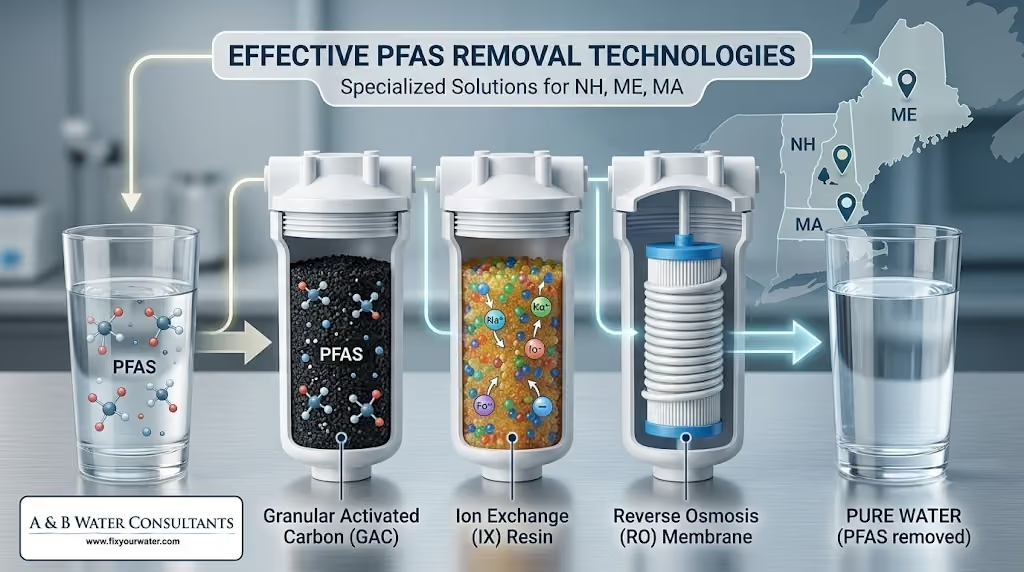
When evaluating the best PFAS filtration methods, three technologies have demonstrated consistent, verified effectiveness in independent testing and regulatory review. Each has distinct strengths and appropriate applications.
Activated Carbon Filtration
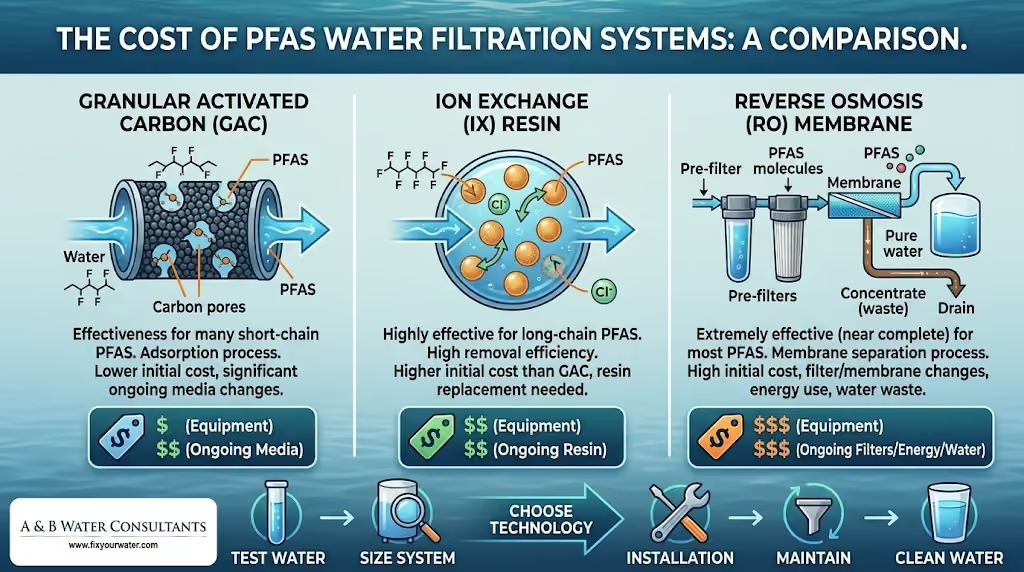
Granular activated carbon (GAC) and carbon block filters work by adsorbing PFAS molecules onto the porous surface of the carbon media as water passes through. GAC is widely used in both municipal treatment and whole-home residential systems. It performs well against long-chain PFAS compounds like PFOA and PFOS but shows reduced effectiveness against shorter-chain PFAS variants. Carbon media must be replaced on a regular schedule because once the adsorption capacity is exhausted, PFAS can break through into treated water. The effectiveness of activated carbon PFAS removal depends heavily on contact time, flow rate, and the specific PFAS compounds present.
Reverse Osmosis Systems
Reverse osmosis (RO) uses high-pressure membranes to physically block PFAS molecules from passing through to the treated water stream. Because PFAS molecules are relatively large compared to water molecules, well-maintained RO membranes achieve removal rates consistently above 90 percent, and often above 95 percent, for a broad range of PFAS compounds. Professional sizing and installation are critical because an undersized membrane, inadequate pre-filtration, or improper pressure settings will compromise performance. RO systems also produce a concentrate stream (reject water) that must be properly managed.
Ion Exchange Resin Systems
Ion exchange using anion exchange resins represents one of the most targeted PFAS removal technologies available. These resins are specifically engineered to attract and bind PFAS molecules, including shorter-chain compounds that carbon filters handle less effectively. Ion exchange PFAS removal is increasingly favored in professional treatment designs where the PFAS profile includes a broad range of compound types. Single-use anion exchange resins are particularly effective but require periodic replacement and proper disposal as a regulated waste.
Whole-Home vs. Point-of-Use PFAS Treatment: Which Is Right for Your Household?
One of the most consequential decisions in PFAS treatment design is whether to install a whole-home point-of-entry (POE) system or a point-of-use (POU) device at a single tap.
Whole-home PFAS filter systems treat all water entering the home before it reaches any fixture. This matters because PFAS exposure is not limited to drinking water alone. Bathing, cooking, washing produce, and even running the dishwasher can contribute to exposure when water is contaminated. For households with confirmed PFAS contamination above regulatory limits, a whole-home system provides comprehensive protection that no single under-sink or countertop unit can replicate.
Point-of-use devices, including under-sink RO units and countertop filters, address drinking and cooking water at a single location. They are appropriate as a supplemental layer or in situations where contamination is very low-level and exposure risk is limited to ingestion. However, for private well owners in New Hampshire or Maine with meaningful PFAS detections, relying on a POU device alone leaves significant exposure pathways unaddressed.
Professional system design is necessary when PFAS levels are elevated, when multiple contaminants are present, or when the home's plumbing configuration requires customized installation. Contact A&B Water Consultants for a free PFAS water treatment quote and a professional assessment of which system configuration is appropriate for the home's specific water chemistry and usage profile.
NSF Certification and What It Means When Choosing a PFAS Treatment System
Not all filters marketed as PFAS-reducing systems deliver verified performance. NSF International and the Water Quality Association (WQA) provide independent certification programs that test treatment products against standardized challenge water conditions.
NSF/ANSI Standard 58 applies to reverse osmosis systems and certifies performance for specific contaminant reduction, including PFAS. NSF/ANSI Standard 53 applies to activated carbon and other point-of-use filters certified for health-effects contaminant reduction. Homeowners should look specifically for systems certified under these standards for PFAS reduction, not just for general contaminant reduction.
A professional water treatment consultant will specify only NSF-certified or WQA-certified components, ensuring that the treatment system's performance claims are backed by independent verification rather than manufacturer marketing. This distinction matters enormously when the goal is protecting a family from a confirmed health threat.
Why Private Well Owners in New Hampshire and Maine Face Greater PFAS Risk
New Hampshire and Maine have among the highest rates of private well use in the United States. Approximately 40 percent of New Hampshire residents and nearly 30 percent of Maine residents rely on private wells as their primary drinking water source. This creates a critical regulatory gap that many homeowners do not fully appreciate.
Public water systems are subject to EPA and state MCLs, routine monitoring requirements, and mandatory public notification when contaminants exceed limits. Private well owners receive none of these protections. There is no government agency monitoring the water coming from a private well, no automatic testing requirement, and no notification system if a nearby contamination source affects groundwater. The responsibility for testing, interpreting results, and implementing treatment falls entirely on the homeowner.
In communities near former military bases, industrial sites, or areas where PFAS-containing firefighting foam was historically applied to agricultural fields, this regulatory gap means that families may have been drinking contaminated water for years without any indication of a problem. Private well PFAS testing is not just advisable in these areas; it is essential. Contact A&B Water Consultants for a free PFAS water treatment quote and learn how professional testing and treatment can close the regulatory gap that leaves private well owners unprotected.
Where PFAS Contamination Has Been Found in New Hampshire, Maine, and Massachusetts
Understanding the geographic distribution of PFAS contamination in New England helps homeowners assess their own risk level. The following represents a summary of documented contamination areas, though the full picture continues to evolve as testing expands.
New Hampshire
Pease Air Force Base in Portsmouth is the state's most prominent contamination site, where PFAS from aqueous film-forming foam (AFFF) contaminated municipal wells supplying the Pease Development Authority. Merrimack has been significantly affected by PFAS releases from a manufacturing facility, with contamination detected in private wells and the Merrimack River. Additional detections have been documented in Litchfield, Bedford, and communities along the Merrimack River corridor. The NH Department of Environmental Services has conducted extensive private well testing in affected communities and continues to expand its monitoring programs.
Maine
Brunswick Naval Air Station and Loring Air Force Base are the primary military-related contamination sources in Maine. The state has also documented PFAS contamination from the application of PFAS-containing biosolids (sewage sludge used as agricultural fertilizer) on farmland, affecting private wells in rural communities including Fairfield, Canaan, and Arundel. Maine has taken a proactive regulatory stance and offers state-funded testing for certain affected communities.
Massachusetts
Contamination near Otis Air National Guard Base on Cape Cod has affected both groundwater and public water supplies in Barnstable County. Communities in the Ayer and Devens area have documented PFAS in municipal supplies. The MassDEP has conducted statewide monitoring of public water systems and continues to identify new detections, particularly in communities with historical industrial activity.
PFAS, Arsenic, and Radon: Addressing Multiple Contaminants in New England Well Water
One aspect of water treatment that rarely receives adequate attention is the reality that PFAS contamination rarely occurs in isolation in New England well water. The region's geology naturally produces elevated arsenic levels in groundwater, particularly in the granite-rich bedrock of New Hampshire and Maine. Radon, a radioactive gas that dissolves into groundwater from uranium-bearing rock, is another endemic concern throughout the region.
Homeowners dealing with PFAS often discover, upon comprehensive testing, that their water also contains arsenic above the EPA's MCL of 10 parts per billion, or radon at levels that require treatment. This co-contamination reality has important implications for treatment system design. A system optimized solely for PFAS removal may not address arsenic or radon, and vice versa. Conversely, a well-designed whole-home treatment system can be engineered to address all three contaminants simultaneously, using a sequential treatment train that applies the right technology to each specific threat.
This integrated approach is precisely where professional expertise adds value that no off-the-shelf product can replicate. A&B Water Consultants has over 25 years of experience designing custom treatment systems for New England well water, including combined PFAS, arsenic, and radon treatment configurations. Contact A&B Water Consultants for a free PFAS water treatment quote and discuss how a comprehensive treatment system can address all of the water quality concerns present in the home.
The Real Cost of PFAS Removal: Professional Systems vs. Consumer Filters Over Time
Many homeowners initially gravitate toward pitcher filters or countertop units because the upfront cost is low. A PFAS-rated pitcher filter might cost $50 to $100, with replacement filters running $30 to $60 every one to three months. On the surface, this seems economical. The total cost of ownership calculation tells a different story.
Over five years, a family relying on a pitcher filter for PFAS reduction might spend $300 to $600 on replacement filters alone, not counting the original unit. More importantly, pitcher filters address only drinking water at a single point, leaving all other exposure pathways unprotected. There is also no professional monitoring to confirm that the filter is actually performing, and no follow-up testing to verify contaminant reduction.
A professionally installed whole-home GAC or RO system typically requires an upfront investment ranging from $2,000 to $8,000 or more depending on system complexity, water chemistry, and the specific PFAS compounds present. Annual maintenance costs for filter media replacement and professional service inspections add $300 to $800 per year. However, this investment protects all water uses throughout the home, is designed and sized for the specific contamination profile, and includes performance verification through follow-up testing. When evaluated over a 10-year horizon, the cost difference between professional whole-home treatment and consumer filter replacement narrows considerably, while the protection gap remains enormous.
Professional Installation vs. Off-the-Shelf Filters: Why It Matters for PFAS
The limitations of DIY filter products for PFAS removal go beyond cost. An undersized carbon filter installed without knowledge of the home's flow rate, PFAS concentration, or water chemistry may provide a false sense of security while allowing significant PFAS breakthrough. Consumer-grade RO units are rarely sized for whole-home use and may not maintain adequate pressure for consistent membrane performance.
Professional water treatment begins with baseline testing that identifies not just PFAS levels but also the specific compounds present, pH, hardness, iron content, and other parameters that affect treatment system performance. This data drives system selection and sizing. A professional installer also ensures that the system is integrated correctly with the home's plumbing, that pre-filtration is adequate to protect the primary treatment media, and that the system is commissioned with performance verification testing.
Long-term performance monitoring is another critical differentiator. A professional water treatment consultant schedules follow-up testing to confirm that the system continues to reduce PFAS to target levels as the media ages, providing accountability that no retail filter product can offer.
Maintaining Your PFAS Treatment System for Long-Term Effectiveness
Even the best-designed PFAS treatment system will fail if maintenance is neglected. Each technology type has specific service requirements that must be followed to maintain performance.
Activated carbon media in whole-home GAC systems typically requires replacement every one to three years, depending on flow volume and PFAS concentration in the source water. Carbon block filters in POU systems may need replacement every six to twelve months. RO membranes generally last two to five years under normal conditions but should be tested annually to confirm rejection rates. Ion exchange resins have variable lifespans depending on whether they are regenerable or single-use; single-use anion exchange resins used for PFAS removal are typically replaced based on volume throughput calculations established at system commissioning.
Signs that a PFAS treatment system may be underperforming include increased water hardness, taste changes, or reduced flow rate. However, because PFAS has no taste or odor, the only reliable way to confirm continued effectiveness is periodic water testing from a certified laboratory. Annual professional service visits that include media inspection, pressure testing, and water quality verification are the standard of care for households with confirmed PFAS contamination.
What to Expect When You Work With a Professional PFAS Water Treatment Specialist
Many homeowners hesitate to engage a professional water treatment consultant because they are uncertain what the process involves. Understanding the typical engagement sequence removes that uncertainty.
The process begins with an initial consultation, during which the consultant reviews available water test data, discusses the home's water usage patterns, and identifies any existing treatment equipment. If comprehensive PFAS testing has not been completed, the consultant arranges certified laboratory analysis of the water supply.
Once test results are available, the consultant develops a treatment recommendation that specifies the appropriate technology, system configuration, and sizing for the home's specific conditions. This proposal includes a detailed cost breakdown, expected performance outcomes, and a maintenance schedule. The homeowner reviews and approves the design before any equipment is ordered.
Installation is performed by licensed technicians who integrate the system with the home's plumbing and conduct initial commissioning tests. Post-installation water testing confirms that the system is achieving target PFAS reduction levels before the project is considered complete. Ongoing service agreements provide scheduled maintenance visits and periodic water quality verification to ensure continued performance.
Contact A&B Water Consultants for a free PFAS water treatment quote and take the first step toward a professionally designed treatment solution that protects the entire household.
Frequently Asked Questions About PFAS Removal
Can PFAS be completely filtered out of water?
High-performance reverse osmosis systems and properly maintained ion exchange systems can reduce PFAS concentrations by more than 95 percent, bringing levels well below EPA and state MCLs. Complete elimination to zero is technically difficult to verify given the detection limits of laboratory equipment, but certified treatment systems can achieve reductions that eliminate meaningful health risk when properly installed and maintained.
What is the cheapest way to remove PFAS from water?
The lowest upfront cost option is a certified pitcher or countertop filter rated for PFAS reduction. However, this approach addresses only a fraction of total household PFAS exposure and provides no protection for bathing, cooking, or other water uses. For households with confirmed contamination, the cheapest approach in the short term is often the most expensive in terms of ongoing health risk and long-term filter replacement costs. A professional consultation can identify the most cost-effective whole-home solution for the specific contamination level present.
Will a Brita water filter remove PFAS?
Standard Brita pitcher filters are not certified for PFAS reduction and should not be relied upon for this purpose. Some Brita products with enhanced filtration media have been certified for limited PFAS reduction, but these are point-of-use devices that address drinking water only and do not provide comprehensive household protection.
What is the biggest source of PFAS exposure?
Drinking water is one of the most significant exposure routes, particularly in communities near contamination sources. Other sources include food packaged in PFAS-containing materials, non-stick cookware, and certain consumer products. For households with contaminated well water, drinking water often represents the dominant exposure pathway and the one most directly addressable through treatment.
What state has the most PFAS in water?
PFAS contamination is a national issue, but states with high concentrations of military bases, industrial activity, and aging infrastructure tend to show higher contamination rates. Michigan, Pennsylvania, and California have documented extensive contamination, but New England states including New Hampshire and Massachusetts have some of the most stringent testing requirements, which means more contamination is being detected and reported than in states with less comprehensive monitoring programs.
Is PFAS in toilet paper?
Research has identified PFAS compounds in some toilet paper products, likely from PFAS-containing materials used in paper manufacturing or from recycled paper content. However, the primary exposure route from toilet paper is indirect (through wastewater and biosolids) rather than direct ingestion, making drinking water treatment the more impactful intervention for household PFAS exposure reduction.
Protecting Your Family Starts With the Right Professional Partner
PFAS contamination in New England's drinking water is a documented, serious public health concern that demands a response proportionate to the risk. For homeowners in New Hampshire, southern Maine, and Massachusetts, particularly those relying on private wells, the absence of regulatory oversight means that protecting the family's water supply is a personal responsibility that cannot be delegated to a government agency or addressed with a retail filter product.
The most effective path forward combines certified laboratory testing, professional system design using proven PFAS removal technologies, proper installation by licensed technicians, and ongoing maintenance with performance verification. This is exactly the approach that A&B Water Consultants has delivered to New England families for over 25 years, combining deep regional knowledge with custom-engineered treatment solutions that address PFAS alongside the arsenic and radon concerns that are endemic to the region's geology.
Contact A&B Water Consultants for a free PFAS water treatment quote and take the first step toward water that the whole family can trust.